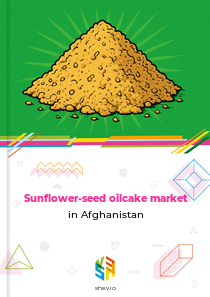







Earlier Report Observations
The sunflower-seed oilcake market in Afghanistan saw domestic production decline from 5 027 т in 2018 to 4 012 т in 2020. This drop was driven by severe drought affecting agricultural output in 2018 and global trade restrictions disrupting supply chains in 2020, which constrained oilseed processing. Production recovered to 4 655 т in 2021 as increased use of industrial and semi-industrial oil extraction machines expanded processing capacity.
Output fell again in 2022 and 2023, reaching 2 951 т in 2023. This was due to persistent shortages of standard storage facilities leading to crop losses and a sharp rise in edible oil prices following the removal of preferential currency exchange rates, which hampered domestic processing. The overall market volume was supported by rising imports, which reached 1 861 т in 2023, keeping total supply at 4 811 т.
In 2024, imports remained significant at 1 155 т, while limited investments in oilseed processing infrastructure and ongoing efforts by international organizations to build storage warehouses continued to influence the market landscape.
Table of content
- 1. Disclaimer
- 2. Terms of use of the report
- 3. Product codes in the statistical classifications used in the report
-
4. Key Market Indicators and Trends
-
4.1. Key Market Indicators
-
4.1.1. In kind
- 4.1.1.1. Production, 2018-2023
- 4.1.1.2. Imports, 2018-2024
- 4.1.1.3. Exports, 2018-2024
- 4.1.1.4. Market size, 2018-2023
-
4.1.1. In kind
- 4.2. Market Trends and Factors
-
4.1. Key Market Indicators
-
5. Production
-
5.1. Production in Afghanistan
- 5.1.1. Annual dynamics of production in Afghanistan in kind, 2018-2023, t
- 5.1.2. Annual dynamics of production in Afghanistan in value, 2018-2023, $ US
-
5.2. Global production by Country, 2018-2023
- 5.2.1. Annual dynamics of production by macroregions in kind, 2018-2023, t
- 5.2.2. Dynamics of production structure by macroregions in kind, 2018-2023
- 5.2.3. Annual dynamics of production by country in kind, 2018-2023, t
- 5.2.4. Structure of production by countries in kind, 2018-2023
- 5.2.5. Dynamics of peoduction structure by countries in kind, 2018-2023
-
5.1. Production in Afghanistan
-
6. Imports
-
6.1. Imports (Direct Data*)
- 6.1.1. Imports - Total information
-
6.1.2. Imports in kind, t
- 6.1.2.1. Annual dynamics of product's imports to Afghanistan in kind, 2018-2024, t
- 6.1.2.2. Dynamics of product's imports in kind to Afghanistan by countries, 2018-2024, t
- 6.1.2.3. Structure of product's imports in kind by countries, 2018-2024
-
6.1.3. Imports in value, K $ US
- 6.1.3.1. Annual dynamics of product's imports to Afghanistan in value, 2018-2024, K $ US
- 6.1.3.2. Dynamics of product's imports in value to Afghanistan by countries, 2018-2024, K $ US
- 6.1.3.3. Structure of product's imports in value by countries, 2018-2024
-
6.1.4. Average price of product's imports, $ US/t
- 6.1.4.1. Annual dynamics of average price of product's imports to Afghanistan, 2018-2024, $ US/t
- 6.1.4.2. Dynamics of average price of product's imports to Afghanistan by countries, 2018-2024, $ US/t
-
6.2. Imports (Mirror Data)
- 6.2.1. Imports - Total information
-
6.2.2. Imports in kind, t
- 6.2.2.1. Annual dynamics of product's imports to Afghanistan in kind, 2018-2024, t
- 6.2.2.2. Dynamics of product's imports in kind to Afghanistan by countries, 2018-2024, t
- 6.2.2.3. Structure of product's imports in kind by countries, 2018-2024
-
6.2.3. Imports in value, K $ US
- 6.2.3.1. Annual dynamics of product's imports to Afghanistan in value, 2018-2024, K $ US
- 6.2.3.2. Dynamics of product's imports in value to Afghanistan by countries, 2018-2024, K $ US
- 6.2.3.3. Structure of product's imports in value by countries, 2018-2024
-
6.2.4. Average price of product's imports, $ US/t
- 6.2.4.1. Annual dynamics of average price of product's imports to Afghanistan, 2018-2024, $ US/t
- 6.2.4.2. Dynamics of average price of product's imports to Afghanistan by countries, 2018-2024, $ US/t
-
6.1. Imports (Direct Data*)
-
7. Trade balance
-
7.1. Trade balance (Direct Data)
- 7.1.1. In kind, t
- 7.1.2. In value, K $ US
-
7.2. Trade balance (Mirror Data)
- 7.2.1. In kind, t
- 7.2.2. In value, K $ US
-
7.1. Trade balance (Direct Data)
-
8. Top buying and selling countries, 2018-2024
-
8.1. Direct Data
- 8.1.1. Import in Value by Countries-buyers
- 8.1.2. Export in Value by Countries-suppliers
-
8.2. Mirror Data
- 8.2.1. Import in Value by Countries-buyers
- 8.2.2. Export in Value by Countries-suppliers
-
8.1. Direct Data
Production sunflower-seed oilcake in Afghanistan
In kind, 2017-2020, t
Top producers of sunflower-seed oilcake, 2017-2020
World map of production of sunflower-seed oilcake, 2017-2020
Afghanistan's sunflower-seed oilcake production has declined for the second year in a row. In 2020, the country produced 3 947 tonnes, marking a significant drop of 19.8% compared to the previous year. Looking at the period from 2017 to 2020, overall production fell by 20.7%, which translates to an average annual decrease of 7.4%. The highest production level was recorded in 2018 at 5 027 tonnes, with that year also seeing the largest increase of 1.0%.
Annual dynamics of production in Afghanistan in kind, 2017-2020, t
| Parameter | 2018 | 2019 | 2020 | CAGR | |
|---|---|---|---|---|---|
| 1 | Change from last year | 1.0% | (2.1%) | (19.8%) | (7.4%) |
Exports sunflower-seed oilcake from Afghanistan
According to marketing analysis, Afghanistan did not export any sunflower-seed oilcake between 2017 and 2020.
Imports sunflower-seed oilcake to Afghanistan
Imports in kind, kg
Annual dynamics of product's imports to Afghanistan in kind, 2017-2020, kg
| Parameter | 2018 | 2019 | 2020 | CAGR | |
|---|---|---|---|---|---|
| 1 | Change from last year | n/a | n/a | n/a | - |
From 2017 to 2020, Afghanistan's imports of sunflower-seed oilcake were dominated by two countries: Uzbekistan, which accounted for 64.6% of total imports, and Pakistan, with 35.4%. Together, these two nations made up 100.0% of all import flows during this period.
Structure of product's imports in kind by countries, 2017-2020
World map of product's imports to Afghanistan in kind, 2017-2020
Imports in value, $ US
Annual dynamics of product's imports to Afghanistan in value, 2017-2020, $ US
| Parameter | 2018 | 2019 | 2020 | CAGR | |
|---|---|---|---|---|---|
| 1 | Change from last year | n/a | n/a | n/a | - |
In value terms, Afghanistan's imports of sunflower-seed oilcake from 2017 to 2020 were concentrated in two key markets: Uzbekistan and Pakistan. Combined, they represented 100.0% of the total import value over these years.
Structure of product's imports in value by countries, 2017-2020
World map of product's imports to Afghanistan in value, 2017-2020
Related Reports
Sunflower-seed oilcake market in Switzerland
2026-03-29
Sunflower-seed oilcake market in Tunisia
2026-03-29
Sunflower-seed oilcake market in India
2026-03-29

Cottonseed oil-cake market in Afghanistan
2026-03-29

In-depth market research on this product
Global Sunflower Seeds Market 2021–2031: Size, Share, Trends and Forecast
Global market report: size, trends and forecast to 2031 · 184 pages
Why Choose Us?
Only Verified Data
No Hidden Costs or Separate Fees
Smarter Subscription Pricing
Contact Our Team
Submit your inquiry using the form below — our team will get back to you within 24 hours.