






"Western Africa" region includes following countries:
 Cabo Verde
 Benin
Benin Gambia
 Ghana
Ghana Guinea
 Côte d'Ivoire
 Liberia
 Mali
Mali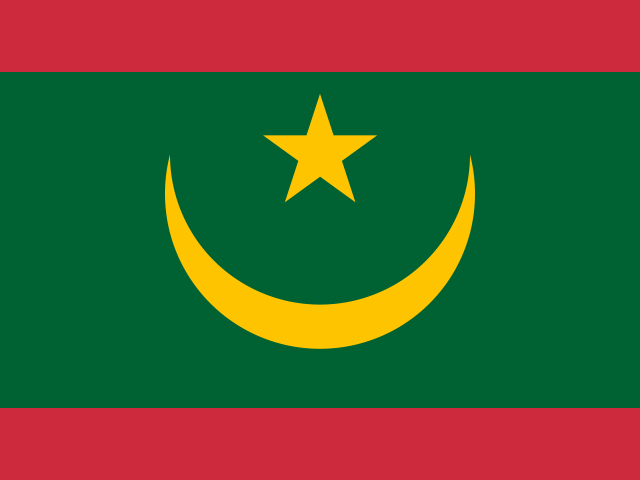 Mauritania
 Niger
Niger Nigeria
 Guinea-Bissau
 Saint Helena, Ascension and Tristan da Cunha
 Senegal
 Sierra Leone
 Togo
Togo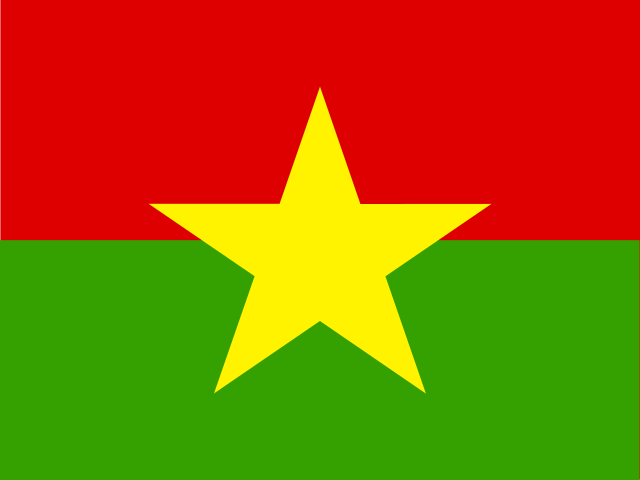 Burkina Faso
Earlier Report Observations
Sesame seed production in West Africa showed significant volatility but overall growth from 949 thousand tons in 2018 to 953 thousand tons in 2023. The initial increase to 1 087 thousand tons in 2019 was driven by the West Africa Agricultural Productivity Program (PPAAO) in Mali, which introduced high-yield sesame varieties and provided input subsidies, boosting yields. However, production fell sharply to 764 thousand tons in 2020 as the COVID-19 pandemic disrupted supply chains and farming activities. Recovery began in 2021, reaching 815 thousand tons, supported by the Pafao program that promoted market access and formal partnerships for sesame cooperatives. Further growth to 844 thousand tons in 2022 and 953 thousand tons in 2023 was bolstered by continued regional initiatives improving farm financing and the expansion of companies like Mitsumi Distribution, which enhanced technology distribution for agricultural modernization.
The market volume for sesame seeds in West Africa experienced pronounced swings, largely dictated by export fluctuations. Starting at 609 thousand tons in 2018, it dropped to 477 thousand tons in 2019 as exports to China intensified, redirecting a larger share of production abroad. The decline continued to 426 thousand tons in 2020 due to pandemic-related supply chain disruptions, and further to 284 thousand tons in 2021 when exports surged to 532 thousand tons. However, the market rebounded to 446 thousand tons in 2022 and 606 thousand tons in 2023 as export volumes decreased to 400 thousand tons and 348 thousand tons respectively, allowing more production to remain within the region. This shift coincided with regional programs like Pafao that encouraged local consumption of family-farmed products.
Longer-term trends have included a growing focus on sustainable and climate-resilient agriculture, supported by projects like the 'Innovations for Climate-Smart Family Agriculture' call, which promoted adaptive practices for crops including sesame. Technological advancements in natural seed processing, such as chemical-free pasteurization, were adopted to meet international quality and safety standards. Furthermore, strengthened Sino-African cooperation with facilitated customs and logistics has influenced export strategies, although annual export volumes show sensitivity to global demand patterns. Infrastructure developments, like Guinea's planned second undersea fiber-optic cable, aim to digitalize market access for agricultural producers, including those in the sesame sector.
Table of content
- 1. Disclaimer
- 2. Terms of use of the report
- 3. Product codes in the statistical classifications used in the report
-
4. Key Market Indicators and Trends
-
4.1. Key Market Indicators
-
4.1.1. In kind
- 4.1.1.1. Production, 2018-2023
- 4.1.1.2. Imports, 2018-2024
- 4.1.1.3. Exports, 2018-2024
- 4.1.1.4. Market size, 2018-2023
-
4.1.1. In kind
- 4.2. Market Trends and Factors
-
4.1. Key Market Indicators
-
5. Production
-
5.1. Production in Western Africa
- 5.1.1. Annual dynamics of production in Western Africa in kind, 2018-2023, K t
-
5.2. Global production by Country, 2018-2023
- 5.2.1. Annual dynamics of production by macroregions in kind, 2018-2023, K t
- 5.2.2. Dynamics of production structure by macroregions in kind, 2018-2023
- 5.2.3. Annual dynamics of production by country in kind, 2018-2023, K t
- 5.2.4. Structure of production by countries in kind, 2018-2023
- 5.2.5. Dynamics of peoduction structure by countries in kind, 2018-2023
-
5.1. Production in Western Africa
-
6. Imports
-
6.1. Imports (Direct Data*)
- 6.1.1. Imports - Total information
-
6.1.2. Imports in kind, K t
- 6.1.2.1. Annual dynamics of product's imports to Cabo Verde in kind, 2018-2024, K t
- 6.1.2.2. Dynamics of product's imports in kind to Cabo Verde by countries, 2018-2024, K t
- 6.1.2.3. Structure of product's imports in kind by countries, 2018-2024
-
6.1.3. Imports in value, M $ US
- 6.1.3.1. Annual dynamics of product's imports to Cabo Verde in value, 2018-2024, M $ US
- 6.1.3.2. Dynamics of product's imports in value to Cabo Verde by countries, 2018-2024, M $ US
- 6.1.3.3. Structure of product's imports in value by countries, 2018-2024
-
6.1.4. Average price of product's imports, $ US/t
- 6.1.4.1. Annual dynamics of average price of product's imports to Cabo Verde, 2018-2024, $ US/t
- 6.1.4.2. Dynamics of average price of product's imports to Cabo Verde by countries, 2018-2024, $ US/t
-
6.2. Imports (Mirror Data)
- 6.2.1. Imports - Total information
-
6.2.2. Imports in kind, K t
- 6.2.2.1. Annual dynamics of product's imports to Cabo Verde in kind, 2018-2024, K t
- 6.2.2.2. Dynamics of product's imports in kind to Cabo Verde by countries, 2018-2024, K t
- 6.2.2.3. Structure of product's imports in kind by countries, 2018-2024
-
6.2.3. Imports in value, M $ US
- 6.2.3.1. Annual dynamics of product's imports to Cabo Verde in value, 2018-2024, M $ US
- 6.2.3.2. Dynamics of product's imports in value to Cabo Verde by countries, 2018-2024, M $ US
- 6.2.3.3. Structure of product's imports in value by countries, 2018-2024
-
6.2.4. Average price of product's imports, $ US/t
- 6.2.4.1. Annual dynamics of average price of product's imports to Cabo Verde, 2018-2024, $ US/t
- 6.2.4.2. Dynamics of average price of product's imports to Cabo Verde by countries, 2018-2024, $ US/t
-
6.1. Imports (Direct Data*)
-
7. Exports
-
7.1. Exports (Direct Data*)
- 7.1.1. Exports - Total information
-
7.1.2. Exports in kind, K t
- 7.1.2.1. Annual dynamics of product's exports from Cabo Verde in kind, 2018-2024, K t
- 7.1.2.2. Dynamics of product's exports in kind from Cabo Verde by countries, 2018-2024, K t
- 7.1.2.3. Structure of product's exports in kind by countries, 2018-2024
-
7.1.3. Exports in value, M $ US
- 7.1.3.1. Annual dynamics of product's exports from Cabo Verde in value, 2018-2024, M $ US
- 7.1.3.2. Dynamics of product's exports in value from Cabo Verde by countries, 2018-2024, M $ US
- 7.1.3.3. Structure of product's exports in value by countries, 2018-2024
-
7.1.4. Average price of product's exports, $ US/t
- 7.1.4.1. Annual dynamics of average price of product's exports from Cabo Verde, 2018-2024, $ US/t
- 7.1.4.2. Dynamics of average price of product's exports from Cabo Verde by countries, 2018-2024, $ US/t
-
7.2. Exports (Mirror Data)
- 7.2.1. Exports - Total information
-
7.2.2. Exports in kind, K t
- 7.2.2.1. Annual dynamics of product's exports from Cabo Verde in kind, 2018-2024, K t
- 7.2.2.2. Dynamics of product's exports in kind from Cabo Verde by countries, 2018-2024, K t
- 7.2.2.3. Structure of product's exports in kind by countries, 2018-2024
-
7.2.3. Exports in value, M $ US
- 7.2.3.1. Annual dynamics of product's exports from Cabo Verde in value, 2018-2024, M $ US
- 7.2.3.2. Dynamics of product's exports in value from Cabo Verde by countries, 2018-2024, M $ US
- 7.2.3.3. Structure of product's exports in value by countries, 2018-2024
-
7.2.4. Average price of product's exports, $ US/t
- 7.2.4.1. Annual dynamics of average price of product's exports from Cabo Verde, 2018-2024, $ US/t
- 7.2.4.2. Dynamics of average price of product's exports from Cabo Verde by countries, 2018-2024, $ US/t
-
7.1. Exports (Direct Data*)
-
8. Trade balance
-
8.1. Trade balance (Direct Data)
- 8.1.1. In kind, K t
- 8.1.2. In value, M $ US
-
8.2. Trade balance (Mirror Data)
- 8.2.1. In kind, K t
- 8.2.2. In value, M $ US
-
8.1. Trade balance (Direct Data)
-
9. Top buying and selling countries, 2018-2024
-
9.1. Direct Data
- 9.1.1. Import in Value by Countries-buyers
- 9.1.2. Export in Value by Countries-suppliers
-
9.2. Mirror Data
- 9.2.1. Import in Value by Countries-buyers
- 9.2.2. Export in Value by Countries-suppliers
-
9.1. Direct Data
Production sesame seeds in Western Africa
In kind, 2017-2020, K t
Top producers of sesame seeds, 2017-2020
World map of production of sesame seeds, 2017-2020
After two consecutive years of growth, sesame seed production in Western Africa declined. In 2019, production reached its peak at 1,087 thousand tons, but then fell sharply by 29.8% to 764 thousand tons in 2020. Over the 2017-2020 period, overall production decreased by 15.7%, which translates to an average annual decline of 5.5%. The most significant year-on-year increase occurred in 2019, when production rose by 14.6%.
Annual dynamics of production in Western Africa in kind, 2017-2020, K t
| Parameter | 2018 | 2019 | 2020 | CAGR | |
|---|---|---|---|---|---|
| 1 | Change from last year | 4.7% | 14.6% | (29.8%) | (5.5%) |
Exports sesame seeds from Western Africa
Exports in kind, K t
The export market for sesame seeds from Western Africa showed considerable volatility during this period. Exports hit their lowest point in 2017 and peaked in 2019, with a 2.8-fold difference between these years. In 2020, exports totaled 342.4 thousand tons, marking a substantial decline of 44.3% compared to 2019. The highest export volume was recorded in 2019 at 615.2 thousand tons, which also saw the largest annual increase of 75.6%.
Annual dynamics of product's exports from Western Africa in kind, 2017-2020, K t
| Parameter | 2018 | 2019 | 2020 | CAGR | |
|---|---|---|---|---|---|
| 1 | Change from last year | 62.1% | 75.6% | (44.3%) | 16.6% |
From 2017 to 2020, Japan, China, and Turkey were the largest buyers of sesame seeds from Western Africa in volume terms. Japan accounted for 29.8% of exports, China for 20.1%, and Turkey for 9.4%. Together, these three countries represented 59.3% of total sesame seed exports from the region.
Structure of product's exports in kind by countries, 2017-2020
World map of product's exports from Western Africa in kind, 2017-2020
Exports in value, M $ US
In value terms, sesame seed exports from Western Africa showed a different trend. In 2020, export value reached 386.9 million US dollars, a modest increase of 2.2% compared to 2019. Over the 2017-2020 period, export value grew by 48.9%, equivalent to an average annual growth rate of 14.2%. The highest value was recorded in 2018 at 437.9 million US dollars, which also saw the largest annual increase of 68.5%. The most significant decline occurred in 2019, when export value fell by 13.5%.
Annual dynamics of product's exports from Western Africa in value, 2017-2020, M $ US
| Parameter | 2018 | 2019 | 2020 | CAGR | |
|---|---|---|---|---|---|
| 1 | Change from last year | 68.5% | (13.5%) | 2.2% | 14.2% |
In value terms, China, Japan, and Turkey remained the key export destinations for Western African sesame seeds from 2017 to 2020. China accounted for 21.7% of export value, Japan for 18.5%, and Turkey for 13.6%. Collectively, these three markets represented 53.8% of total export value.
Structure of product's exports in value by countries, 2017-2020
World map of product's exports from Western Africa in value, 2017-2020
Imports sesame seeds to Western Africa
Imports in kind, K t
Import volumes of sesame seeds into Western Africa were highly volatile during these years. Imports reached their lowest point in 2017 and peaked in 2018, with a 7.5-fold difference between these years. In 2020, imports totaled 10.4 thousand tons, showing a slight decrease of 2.2% compared to 2019. The largest annual decline occurred in 2019, when imports fell by 53.2%, while the most significant increase was in 2018, with a remarkable 650.0% growth.
Annual dynamics of product's imports to Western Africa in kind, 2017-2020, K t
| Parameter | 2018 | 2019 | 2020 | CAGR | |
|---|---|---|---|---|---|
| 1 | Change from last year | 650.0% | (53.2%) | (2.2%) | 50.8% |
From 2017 to 2020, Cameroon and Chad were the main sources of sesame seed imports into Western Africa in volume terms. Together, these two countries accounted for 19.8% of total imports.
Structure of product's imports in kind by countries, 2017-2020
World map of product's imports to Western Africa in kind, 2017-2020
Imports in value, M $ US
Import values of sesame seeds into Western Africa also exhibited volatility during this period. Imports reached their minimum in 2017 and peaked in 2020, with a 4.2-fold difference between these years. In 2020, import value amounted to 9.4 million US dollars, reflecting a sharp increase of 150.7% compared to 2019. The largest annual decline was recorded in 2019, when import value fell by 28.8%.
Annual dynamics of product's imports to Western Africa in value, 2017-2020, M $ US
| Parameter | 2018 | 2019 | 2020 | CAGR | |
|---|---|---|---|---|---|
| 1 | Change from last year | 135.9% | (28.8%) | 150.7% | 61.5% |
From 2017 to 2020, three main markets—Cameroon, Chad, and Poland—together accounted for 23.2% of total sesame seed import value into Western Africa.
Structure of product's imports in value by countries, 2017-2020
World map of product's imports to Western Africa in value, 2017-2020
Related Reports

2026-03-28
Sesame seeds market in Cameroon
2026-03-28
2026-03-28
2026-03-28

Primary sugar crops market in Western Africa
2026-03-30


Cotton seeds market in Western Africa
2026-03-28

Melon seeds market in Western Africa
2026-03-28
In-depth market research on this product
Global Sesame Seeds Market 2021–2031: Size, Share, Trends and Forecast
Global market report: size, trends and forecast to 2031 · 215 pages
Why Choose Us?
Only Verified Data
No Hidden Costs or Separate Fees
Smarter Subscription Pricing
Contact Our Team
Submit your inquiry using the form below — our team will get back to you within 24 hours.