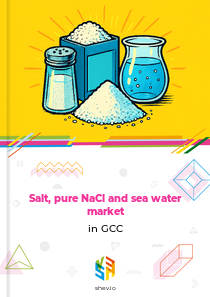







"GCC" region includes following countries:
 Bahrain
 Qatar
Qatar Kuwait
 the United Arab Emirates
 Oman
Oman Saudi Arabia
Earlier Report Observations
Between 2018 and 2020, the GCC salt market volume contracted sharply from 6.4 million t to 3.3 million t. This decline was primarily driven by a steep fall in imports, coinciding with global supply chain disruptions that affected salt availability and pricing across the region.
Market recovery began in 2021, with volume reaching 4.3 million t in 2022. This growth was underpinned by rising demand from the food and beverage and chemical industries, coupled with population growth in GCC countries, which expanded overall consumption.
Imports surged to 7.4 million t in 2023, highlighting renewed reliance on foreign supply. In 2024, a strategic partnership between Tata Chemicals and SABIC to jointly develop chlor-alkali and derivatives signaled moves toward greater regional industrial integration, potentially influencing future market structure.
Table of content
- 1. Disclaimer
- 2. Terms of use of the report
- 3. Product codes in the statistical classifications used in the report
-
4. Key Market Indicators and Trends
-
4.1. Key Market Indicators
-
4.1.1. In kind
- 4.1.1.1. Production, 2018-2022
- 4.1.1.2. Imports, 2018-2024
- 4.1.1.3. Exports, 2018-2024
- 4.1.1.4. Market size, 2018-2022
-
4.1.1. In kind
- 4.2. Market Trends and Factors
-
4.1. Key Market Indicators
-
5. Production
-
5.1. Production in GCC
- 5.1.1. Annual dynamics of production in GCC in kind, 2018-2022, K t
-
5.2. Global production by Country, 2018-2022
- 5.2.1. Annual dynamics of production by country in kind, 2018-2022, K t
- 5.2.2. Structure of production by countries in kind, 2018-2022
- 5.2.3. Dynamics of peoduction structure by countries in kind, 2018-2022
-
5.1. Production in GCC
-
6. Imports
-
6.1. Imports (Direct Data*)
- 6.1.1. Imports - Total information
-
6.1.2. Imports in kind, K t
- 6.1.2.1. Annual dynamics of product's imports to Bahrain in kind, 2018-2024, K t
- 6.1.2.2. Dynamics of product's imports in kind to Bahrain by countries, 2018-2024, K t
- 6.1.2.3. Structure of product's imports in kind by countries, 2018-2024
-
6.1.3. Imports in value, M $ US
- 6.1.3.1. Annual dynamics of product's imports to Bahrain in value, 2018-2024, M $ US
- 6.1.3.2. Dynamics of product's imports in value to Bahrain by countries, 2018-2024, M $ US
- 6.1.3.3. Structure of product's imports in value by countries, 2018-2024
-
6.1.4. Average price of product's imports, $ US/t
- 6.1.4.1. Annual dynamics of average price of product's imports to Bahrain, 2018-2024, $ US/t
- 6.1.4.2. Dynamics of average price of product's imports to Bahrain by countries, 2018-2024, $ US/t
-
6.2. Imports (Mirror Data)
- 6.2.1. Imports - Total information
-
6.2.2. Imports in kind, K t
- 6.2.2.1. Annual dynamics of product's imports to Bahrain in kind, 2018-2024, K t
- 6.2.2.2. Dynamics of product's imports in kind to Bahrain by countries, 2018-2024, K t
- 6.2.2.3. Structure of product's imports in kind by countries, 2018-2024
-
6.2.3. Imports in value, M $ US
- 6.2.3.1. Annual dynamics of product's imports to Bahrain in value, 2018-2024, M $ US
- 6.2.3.2. Dynamics of product's imports in value to Bahrain by countries, 2018-2024, M $ US
- 6.2.3.3. Structure of product's imports in value by countries, 2018-2024
-
6.2.4. Average price of product's imports, $ US/t
- 6.2.4.1. Annual dynamics of average price of product's imports to Bahrain, 2018-2024, $ US/t
- 6.2.4.2. Dynamics of average price of product's imports to Bahrain by countries, 2018-2024, $ US/t
-
6.1. Imports (Direct Data*)
-
7. Exports
-
7.1. Exports (Direct Data*)
- 7.1.1. Exports - Total information
-
7.1.2. Exports in kind, K t
- 7.1.2.1. Annual dynamics of product's exports from Bahrain in kind, 2018-2024, K t
- 7.1.2.2. Dynamics of product's exports in kind from Bahrain by countries, 2018-2024, K t
- 7.1.2.3. Structure of product's exports in kind by countries, 2018-2024
-
7.1.3. Exports in value, M $ US
- 7.1.3.1. Annual dynamics of product's exports from Bahrain in value, 2018-2024, M $ US
- 7.1.3.2. Dynamics of product's exports in value from Bahrain by countries, 2018-2024, M $ US
- 7.1.3.3. Structure of product's exports in value by countries, 2018-2024
-
7.1.4. Average price of product's exports, $ US/t
- 7.1.4.1. Annual dynamics of average price of product's exports from Bahrain, 2018-2024, $ US/t
- 7.1.4.2. Dynamics of average price of product's exports from Bahrain by countries, 2018-2024, $ US/t
-
7.2. Exports (Mirror Data)
- 7.2.1. Exports - Total information
-
7.2.2. Exports in kind, K t
- 7.2.2.1. Annual dynamics of product's exports from Bahrain in kind, 2018-2024, K t
- 7.2.2.2. Dynamics of product's exports in kind from Bahrain by countries, 2018-2024, K t
- 7.2.2.3. Structure of product's exports in kind by countries, 2018-2024
-
7.2.3. Exports in value, M $ US
- 7.2.3.1. Annual dynamics of product's exports from Bahrain in value, 2018-2024, M $ US
- 7.2.3.2. Dynamics of product's exports in value from Bahrain by countries, 2018-2024, M $ US
- 7.2.3.3. Structure of product's exports in value by countries, 2018-2024
-
7.2.4. Average price of product's exports, $ US/t
- 7.2.4.1. Annual dynamics of average price of product's exports from Bahrain, 2018-2024, $ US/t
- 7.2.4.2. Dynamics of average price of product's exports from Bahrain by countries, 2018-2024, $ US/t
-
7.1. Exports (Direct Data*)
-
8. Trade balance
-
8.1. Trade balance (Direct Data)
- 8.1.1. In kind, K t
- 8.1.2. In value, M $ US
-
8.2. Trade balance (Mirror Data)
- 8.2.1. In kind, K t
- 8.2.2. In value, M $ US
-
8.1. Trade balance (Direct Data)
-
9. Top buying and selling countries, 2018-2024
-
9.1. Direct Data
- 9.1.1. Import in Value by Countries-buyers
- 9.1.2. Export in Value by Countries-suppliers
-
9.2. Mirror Data
- 9.2.1. Import in Value by Countries-buyers
- 9.2.2. Export in Value by Countries-suppliers
-
9.1. Direct Data
Production salt, pure NaCl and sea water in GCC
In kind, 2017-2020, K t
Top producers of salt, pure NaCl and sea water, 2017-2020
World map of production of salt, pure NaCl and sea water, 2017-2020
Following two years of growth, salt, pure NaCl, and seawater production in the GCC region declined. In 2020, production reached 2 290 K t, marking a significant 19.7% decrease compared to 2019. Over the 2017-2020 period, production fell by 11.8%, with a compound annual growth rate of 4.1%. The highest production level was recorded in 2019 at 2 851 K t, which also saw the largest annual increase of 5.0%.
Annual dynamics of production in GCC in kind, 2017-2020, K t
| Parameter | 2018 | 2019 | 2020 | CAGR | |
|---|---|---|---|---|---|
| 1 | Change from last year | 4.6% | 5.0% | (19.7%) | (4.1%) |
Exports salt, pure NaCl and sea water from GCC
Exports in kind, K t
The market displayed volatility throughout the observed period. The lowest export volume occurred in 2020, while the highest was recorded in 2018, with a peak-to-trough ratio of 18 times. In 2020, salt, pure NaCl, and seawater exports from the GCC amounted to 84 K t, representing a substantial 12.6% year-over-year decline. The maximum export volume was 1 488 K t in 2018, which also experienced the largest annual increase of 1 494.6%. The most significant decline happened in 2019 with a 93.5% drop.
Annual dynamics of product's exports from GCC in kind, 2017-2020, K t
| Parameter | 2018 | 2019 | 2020 | CAGR | |
|---|---|---|---|---|---|
| 1 | Change from last year | 1 494.6% | (93.5%) | (12.6%) | (3.3%) |
From 2017 to 2020, India remained the primary buyer of salt, pure NaCl, and seawater from the GCC, accounting for 2.6% of total exports in kind.
Structure of product's exports in kind by countries, 2017-2020
World map of product's exports from GCC in kind, 2017-2020
Exports in value, M $ US
Salt, pure NaCl, and seawater exports from the GCC declined for the second consecutive year. In 2020, exports stood at 15.3 M $ US, showing a moderate 8.3% decrease compared to the previous year. Over the 2017-2020 period, exports increased by 6.3%, with a compound annual growth rate of 2.1%. The highest value was recorded in 2018 at 17.1 M $ US, which also saw the largest annual increase of 18.6%.
Annual dynamics of product's exports from GCC in value, 2017-2020, M $ US
| Parameter | 2018 | 2019 | 2020 | CAGR | |
|---|---|---|---|---|---|
| 1 | Change from last year | 18.6% | (2.3%) | (8.3%) | 2.1% |
Between 2017 and 2020, exports in value terms of salt, pure NaCl, and seawater from the GCC were not heavily concentrated. Iraq accounted for 2.1% of exports, India for 1.6%, and Yemen for 1.2%, together representing only 4.9% of total flows.
Structure of product's exports in value by countries, 2017-2020
World map of product's exports from GCC in value, 2017-2020
Imports salt, pure NaCl and sea water to GCC
Imports in kind, K t
Market behavior during these years was characterized by volatility. The period from 2018 to 2020 showed a peak-to-trough amplitude of 4.7 times. In 2020, GCC imports of salt, pure NaCl, and seawater were recorded at 1 097 K t, reflecting a robust 11.1% reduction compared to 2019. The maximum import volume was 5 168 K t in 2018, which also experienced the largest annual increase of 370.6%. The most significant decline occurred in 2019 with a 76.1% drop.
Annual dynamics of product's imports to GCC in kind, 2017-2020, K t
| Parameter | 2018 | 2019 | 2020 | CAGR | |
|---|---|---|---|---|---|
| 1 | Change from last year | 370.6% | (76.1%) | (11.1%) | (0.0%) |
During 2017-2020, India concentrated 73.1% of total imports in kind of salt, pure NaCl, and seawater to the GCC, with the remaining flows distributed among multiple smaller partners.
Structure of product's imports in kind by countries, 2017-2020
World map of product's imports to GCC in kind, 2017-2020
Imports in value, M $ US
Salt, pure NaCl, and seawater imports into the GCC increased for the third consecutive year. In 2020, GCC imports totaled 15.3 M $ US, representing a 4.5% year-over-year growth. Over the 2017-2020 period, imports rose by 19.6%, with a compound annual growth rate of 6.2%.
Annual dynamics of product's imports to GCC in value, 2017-2020, M $ US
| Parameter | 2018 | 2019 | 2020 | CAGR | |
|---|---|---|---|---|---|
| 1 | Change from last year | 9.5% | 4.5% | 4.5% | 6.2% |
From 2017 to 2020, India contributed 32.9% of imports in value terms, the Netherlands 12.7%, and the United States 8.4%, together accounting for 54.1% of total flows.
Structure of product's imports in value by countries, 2017-2020
World map of product's imports to GCC in value, 2017-2020
Related Reports

Salt, pure NaCl and sea water market Ukraine
2026-03-29
Kaolin and kaolinic clays market in GCC
2026-03-29

2026-03-29

2026-03-29

Poultry meat and offal market in GCC
2026-03-27
In-depth market research on this product
Global Sea Salt Market 2021–2031: Size, Share, Trends and Forecast
Global market report: size, trends and forecast to 2031 · 184 pages
Why Choose Us?
Only Verified Data
No Hidden Costs or Separate Fees
Smarter Subscription Pricing
Contact Our Team
Submit your inquiry using the form below — our team will get back to you within 24 hours.