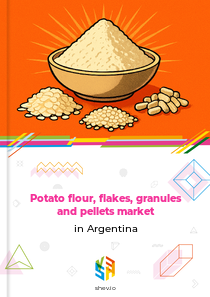







Earlier Report Observations
The market volume for potato flour, flakes, granules and pellets in Argentina fluctuated considerably between 2018 and 2023. After reaching 12,170 t in 2018, it fell sharply to 7,737 t in 2019, influenced by economic instability and peso devaluation that raised prices for basic food items. The entry of transnational capital into the potato production chain around 2018 introduced new market dynamics, while regulatory measures such as Resolución 50/2018 established effective quality management and identification systems for processed potato products.
The COVID-19 pandemic in 2020 reversed the decline, boosting home consumption of flours and driving demand for gluten-free alternatives like potato flour, which lifted market volume to 8,527 t. This growth continued into 2021, supported by growing consumer preference for healthy and gluten-free products, pushing volume to 9,024 t. However, in 2022 adverse weather conditions and potato shortages in key producing regions led to substantial raw material price increases, curbing production and reducing market size to 8,543 t. Regulatory updates, including new snack standards in the Argentine Food Code with sodium reduction targets and specific packaging requirements for potato-based products, also shaped industry practices during this period.
By 2023, the market contracted further to 7,775 t, as high input costs likely persisted. Throughout the period, innovation in potato-derived convenience foods and the strengthening of seed potato production through bioplants and technological support provided a foundation for product diversification, even as overall market volume exhibited volatility.
Table of content
- 1. Disclaimer
- 2. Terms of use of the report
- 3. Product codes in the statistical classifications used in the report
-
4. Key Market Indicators and Trends
-
4.1. Key Market Indicators
-
4.1.1. In kind
- 4.1.1.1. Production, 2018-2023
- 4.1.1.2. Imports, 2018-2024
- 4.1.1.3. Exports, 2018-2024
- 4.1.1.4. Market size, 2018-2023
-
4.1.1. In kind
- 4.2. Market Trends and Factors
-
4.1. Key Market Indicators
-
5. Production
-
5.1. Production in Argentina
- 5.1.1. Annual dynamics of production in Argentina in kind, 2018-2023, t
- 5.1.2. Annual dynamics of production in Argentina in value, 2018-2023, $ US
-
5.2. Global production by Country, 2018-2023
- 5.2.1. Annual dynamics of production by macroregions in kind, 2018-2023, t
- 5.2.2. Dynamics of production structure by macroregions in kind, 2018-2023
- 5.2.3. Annual dynamics of production by country in kind, 2018-2023, t
- 5.2.4. Structure of production by countries in kind, 2018-2023
- 5.2.5. Dynamics of peoduction structure by countries in kind, 2018-2023
-
5.1. Production in Argentina
-
6. Imports
-
6.1. Imports (Direct Data)
- 6.1.1. Imports - Total information
-
6.1.2. Imports in kind, t
- 6.1.2.1. Annual dynamics of product's imports to Argentina in kind, 2018-2024, t
- 6.1.2.2. Dynamics of product's imports in kind to Argentina by countries, 2018-2024, t
- 6.1.2.3. Structure of product's imports in kind by countries, 2018-2024
-
6.1.3. Imports in value, K $ US
- 6.1.3.1. Annual dynamics of product's imports to Argentina in value, 2018-2024, K $ US
- 6.1.3.2. Dynamics of product's imports in value to Argentina by countries, 2018-2024, K $ US
- 6.1.3.3. Structure of product's imports in value by countries, 2018-2024
-
6.1.4. Average price of product's imports, $ US/t
- 6.1.4.1. Annual dynamics of average price of product's imports to Argentina, 2018-2024, $ US/t
- 6.1.4.2. Dynamics of average price of product's imports to Argentina by countries, 2018-2024, $ US/t
-
6.2. Imports (Mirror Data)
- 6.2.1. Imports - Total information
-
6.2.2. Imports in kind, t
- 6.2.2.1. Annual dynamics of product's imports to Argentina in kind, 2018-2024, t
- 6.2.2.2. Dynamics of product's imports in kind to Argentina by countries, 2018-2024, t
- 6.2.2.3. Structure of product's imports in kind by countries, 2018-2024
-
6.2.3. Imports in value, K $ US
- 6.2.3.1. Annual dynamics of product's imports to Argentina in value, 2018-2024, K $ US
- 6.2.3.2. Dynamics of product's imports in value to Argentina by countries, 2018-2024, K $ US
- 6.2.3.3. Structure of product's imports in value by countries, 2018-2024
-
6.2.4. Average price of product's imports, $ US/t
- 6.2.4.1. Annual dynamics of average price of product's imports to Argentina, 2018-2024, $ US/t
- 6.2.4.2. Dynamics of average price of product's imports to Argentina by countries, 2018-2024, $ US/t
-
6.1. Imports (Direct Data)
-
7. Trade balance
-
7.1. Trade balance (Direct Data)
- 7.1.1. In kind, t
- 7.1.2. In value, K $ US
-
7.2. Trade balance (Mirror Data)
- 7.2.1. In kind, t
- 7.2.2. In value, K $ US
-
7.1. Trade balance (Direct Data)
-
8. Top buying and selling countries, 2018-2024
-
8.1. Direct Data
- 8.1.1. Import in Value by Countries-buyers
- 8.1.2. Export in Value by Countries-suppliers
-
8.2. Mirror Data
- 8.2.1. Import in Value by Countries-buyers
- 8.2.2. Export in Value by Countries-suppliers
-
8.1. Direct Data
Production potato flour, flakes, granules and pellets in Argentina
In kind, 2017-2020, t
Globally, Argentina ranked as the 16th largest producer of potato flour, flakes, granules, and pellets from 2017 to 2020.
Top producers of potato flour, flakes, granules and pellets, 2017-2020
World map of production of potato flour, flakes, granules and pellets, 2017-2020
Following a two-year decline, Argentina's production of potato flour, flakes, granules, and pellets rebounded in 2020. That year, output reached 7 965 tonnes, marking an 11.4% increase compared to 2019. However, over the entire 2017-2020 period, production fell by 31.5%, with a compound annual growth rate of -11.8%. The lowest production level was recorded in 2019 at 7 151 tonnes, which also saw the steepest annual decline of 34.2%.
Annual dynamics of production in Argentina in kind, 2017-2020, t
| Parameter | 2018 | 2019 | 2020 | CAGR | |
|---|---|---|---|---|---|
| 1 | Change from last year | (6.5%) | (34.2%) | 11.4% | (11.8%) |
Exports potato flour, flakes, granules and pellets from Argentina
Exports in kind, t
Annual dynamics of product's exports from Argentina in kind, 2017-2020, t
| Parameter | 2018 | 2019 | 2020 | CAGR | |
|---|---|---|---|---|---|
| 1 | Change from last year | n/a | n/a | n/a | - |
From 2017 to 2020, nearly all of Argentina's exports of potato flour, flakes, granules, and pellets in volume terms went to Brazil, which accounted for 97.2% of total shipments.
Structure of product's exports in kind by countries, 2017-2020
World map of product's exports from Argentina in kind, 2017-2020
Exports in value, K $ US
Annual dynamics of product's exports from Argentina in value, 2017-2020, K $ US
| Parameter | 2018 | 2019 | 2020 | CAGR | |
|---|---|---|---|---|---|
| 1 | Change from last year | n/a | n/a | n/a | - |
During 2017-2020, Argentina's export structure in value terms was highly concentrated, with Brazil alone making up 94.3% of total export flows.
Structure of product's exports in value by countries, 2017-2020
World map of product's exports from Argentina in value, 2017-2020
Imports potato flour, flakes, granules and pellets to Argentina
Imports in kind, t
Argentina's imports of potato flour, flakes, granules, and pellets declined for the third year in a row in 2020. Imports totaled 562 tonnes, down 4.1% from the previous year. Over the 2017-2020 period, imports dropped by 72.4%, with a compound annual decline rate of 34.9%.
Annual dynamics of product's imports to Argentina in kind, 2017-2020, t
| Parameter | 2018 | 2019 | 2020 | CAGR | |
|---|---|---|---|---|---|
| 1 | Change from last year | (36.2%) | (54.9%) | (4.1%) | (34.9%) |
From 2017 to 2020, the Netherlands (37.9% of import volume), Germany (19.3%), and Russia (11.9%) were the leading sources for Argentina's imports of potato flour, flakes, granules, and pellets in volume terms, together representing 69.0% of total imports.
Structure of product's imports in kind by countries, 2017-2020
World map of product's imports to Argentina in kind, 2017-2020
Imports in value, K $ US
Argentina's imports of potato flour, flakes, granules, and pellets in value terms fell for the third consecutive year in 2020. Imports amounted to 748 thousand US dollars, a 24.7% decrease compared to 2019. Between 2017 and 2020, imports declined by 72.5%, equivalent to an annualized rate of -35.0%.
Annual dynamics of product's imports to Argentina in value, 2017-2020, K $ US
| Parameter | 2018 | 2019 | 2020 | CAGR | |
|---|---|---|---|---|---|
| 1 | Change from last year | (28.4%) | (49.1%) | (24.7%) | (35.0%) |
Throughout 2017-2020, the Netherlands (33.0% of import value), Germany (18.4%), and France (13.2%) formed the core of Argentina's imports of potato flour, flakes, granules, and pellets in value terms, collectively accounting for 64.7% of total import flows.
Structure of product's imports in value by countries, 2017-2020
World map of product's imports to Argentina in value, 2017-2020
Related Reports

Maize starch market in Argentina
2026-03-28

2026-03-28

Why Choose Us?
Only Verified Data
No Hidden Costs or Separate Fees
Smarter Subscription Pricing
Contact Our Team
Submit your inquiry using the form below — our team will get back to you within 24 hours.