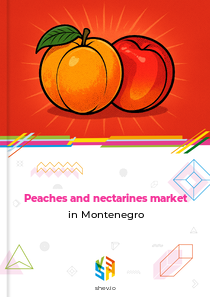







Earlier Report Observations
The market for fresh peaches and nectarines in Montenegro reached its peak at 4 283 tons in 2019, followed by a steep decline to 2 539 tons in 2020. A recovery phase then lifted the market volume to 3 587 tons by 2022.
In 2023, the market experienced a slight contraction to 3 384 tons. Throughout the period, imports remained the dominant source of supply, while domestic production fluctuated between 900 and 1 300 tons.
Table of content
- 1. Disclaimer
- 2. Terms of use of the report
- 3. Product codes in the statistical classifications used in the report
-
4. Key Market Indicators and Trends
-
4.1. Key Market Indicators
-
4.1.1. In kind
- 4.1.1.1. Production, 2018-2023
- 4.1.1.2. Imports, 2018-2024
- 4.1.1.3. Exports, 2018-2024
- 4.1.1.4. Market size, 2018-2023
-
4.1.1. In kind
- 4.2. Market Trends and Factors
-
4.1. Key Market Indicators
-
5. Production
-
5.1. Production in Montenegro
- 5.1.1. Annual dynamics of production in Montenegro in kind, 2018-2023, t
- 5.1.2. Annual dynamics of production in Montenegro in value, 2018-2023, $ US
-
5.2. Global production by Country, 2018-2023
- 5.2.1. Annual dynamics of production by macroregions in kind, 2018-2023, t
- 5.2.2. Dynamics of production structure by macroregions in kind, 2018-2023
- 5.2.3. Annual dynamics of production by country in kind, 2018-2023, t
- 5.2.4. Structure of production by countries in kind, 2018-2023
- 5.2.5. Dynamics of peoduction structure by countries in kind, 2018-2023
-
5.1. Production in Montenegro
-
6. Imports
-
6.1. Imports (Direct Data)
- 6.1.1. Imports - Total information
-
6.1.2. Imports in kind, t
- 6.1.2.1. Annual dynamics of product's imports to Montenegro in kind, 2018-2024, t
- 6.1.2.2. Dynamics of product's imports in kind to Montenegro by countries, 2018-2024, t
- 6.1.2.3. Structure of product's imports in kind by countries, 2018-2024
-
6.1.3. Imports in value, K $ US
- 6.1.3.1. Annual dynamics of product's imports to Montenegro in value, 2018-2024, K $ US
- 6.1.3.2. Dynamics of product's imports in value to Montenegro by countries, 2018-2024, K $ US
- 6.1.3.3. Structure of product's imports in value by countries, 2018-2024
-
6.1.4. Average price of product's imports, $ US/t
- 6.1.4.1. Annual dynamics of average price of product's imports to Montenegro, 2018-2024, $ US/t
- 6.1.4.2. Dynamics of average price of product's imports to Montenegro by countries, 2018-2024, $ US/t
-
6.2. Imports (Mirror Data)
- 6.2.1. Imports - Total information
-
6.2.2. Imports in kind, t
- 6.2.2.1. Annual dynamics of product's imports to Montenegro in kind, 2018-2024, t
- 6.2.2.2. Dynamics of product's imports in kind to Montenegro by countries, 2018-2024, t
- 6.2.2.3. Structure of product's imports in kind by countries, 2018-2024
-
6.2.3. Imports in value, K $ US
- 6.2.3.1. Annual dynamics of product's imports to Montenegro in value, 2018-2024, K $ US
- 6.2.3.2. Dynamics of product's imports in value to Montenegro by countries, 2018-2024, K $ US
- 6.2.3.3. Structure of product's imports in value by countries, 2018-2024
-
6.2.4. Average price of product's imports, $ US/t
- 6.2.4.1. Annual dynamics of average price of product's imports to Montenegro, 2018-2024, $ US/t
- 6.2.4.2. Dynamics of average price of product's imports to Montenegro by countries, 2018-2024, $ US/t
-
6.1. Imports (Direct Data)
-
7. Exports
-
7.1. Exports (Direct Data)
- 7.1.1. Exports - Total information
-
7.1.2. Exports in kind, t
- 7.1.2.1. Annual dynamics of product's exports from Montenegro in kind, 2018-2024, t
- 7.1.2.2. Dynamics of product's exports in kind from Montenegro by countries, 2018-2024, t
- 7.1.2.3. Structure of product's exports in kind by countries, 2018-2024
-
7.1.3. Exports in value, K $ US
- 7.1.3.1. Annual dynamics of product's exports from Montenegro in value, 2018-2024, K $ US
- 7.1.3.2. Dynamics of product's exports in value from Montenegro by countries, 2018-2024, K $ US
- 7.1.3.3. Structure of product's exports in value by countries, 2018-2024
-
7.1.4. Average price of product's exports, $ US/t
- 7.1.4.1. Annual dynamics of average price of product's exports from Montenegro, 2018-2024, $ US/t
- 7.1.4.2. Dynamics of average price of product's exports from Montenegro by countries, 2018-2024, $ US/t
-
7.2. Exports (Mirror Data)
- 7.2.1. Exports - Total information
-
7.2.2. Exports in kind, t
- 7.2.2.1. Annual dynamics of product's exports from Montenegro in kind, 2018-2024, t
- 7.2.2.2. Dynamics of product's exports in kind from Montenegro by countries, 2018-2024, t
- 7.2.2.3. Structure of product's exports in kind by countries, 2018-2024
-
7.2.3. Exports in value, K $ US
- 7.2.3.1. Annual dynamics of product's exports from Montenegro in value, 2018-2024, K $ US
- 7.2.3.2. Dynamics of product's exports in value from Montenegro by countries, 2018-2024, K $ US
- 7.2.3.3. Structure of product's exports in value by countries, 2018-2024
-
7.2.4. Average price of product's exports, $ US/t
- 7.2.4.1. Annual dynamics of average price of product's exports from Montenegro, 2018-2024, $ US/t
- 7.2.4.2. Dynamics of average price of product's exports from Montenegro by countries, 2018-2024, $ US/t
-
7.1. Exports (Direct Data)
-
8. Trade balance
-
8.1. Trade balance (Direct Data)
- 8.1.1. In kind, t
- 8.1.2. In value, K $ US
-
8.2. Trade balance (Mirror Data)
- 8.2.1. In kind, t
- 8.2.2. In value, K $ US
-
8.1. Trade balance (Direct Data)
-
9. Top buying and selling countries, 2018-2024
-
9.1. Direct Data
- 9.1.1. Import in Value by Countries-buyers
- 9.1.2. Export in Value by Countries-suppliers
-
9.2. Mirror Data
- 9.2.1. Import in Value by Countries-buyers
- 9.2.2. Export in Value by Countries-suppliers
-
9.1. Direct Data
Production peaches and nectarines in Montenegro
In kind, 2017-2020, t
Top producers of peaches and nectarines, 2017-2020
World map of production of peaches and nectarines, 2017-2020
In 2019, Montenegro's production of peaches and nectarines reached its lowest point at 1 036 tonnes. However, production rebounded in 2020, increasing by 21.0% year-on-year to reach 1 254 tonnes. The highest production level was recorded earlier, in 2018, at 1 292 tonnes. The most significant production decline occurred in 2019, when output fell by 19.8%.
Annual dynamics of production in Montenegro in kind, 2017-2020, t
| Parameter | 2018 | 2019 | 2020 | CAGR | |
|---|---|---|---|---|---|
| 1 | Change from last year | 0.9% | (19.8%) | 21.0% | (0.7%) |
Exports peaches and nectarines from Montenegro
Exports in kind, t
The export market for peaches and nectarines from Montenegro showed considerable volatility during the observed period. Exports hit their lowest point in 2019 at just 38 tonnes, but then surged dramatically in 2020 to 182 tonnes, representing a remarkable 375.3% increase compared to the previous year. The peak export volume was recorded earlier, in 2017. The difference between the 2017 peak and the 2019 low was substantial, with exports in 2017 being 7.2 times higher. The most significant decline occurred in 2019, when exports dropped by 66.1%.
Annual dynamics of product's exports from Montenegro in kind, 2017-2020, t
| Parameter | 2018 | 2019 | 2020 | CAGR | |
|---|---|---|---|---|---|
| 1 | Change from last year | (58.8%) | (66.1%) | 375.3% | (12.8%) |
From 2017 to 2020, Serbia was the dominant buyer of Montenegrin peaches and nectarines, accounting for 93.3% of total exports in volume terms.
Structure of product's exports in kind by countries, 2017-2020
World map of product's exports from Montenegro in kind, 2017-2020
Exports in value, K $ US
The export market in value terms displayed an unstable trend throughout the period. Exports reached their lowest point in 2019 at 19 thousand US dollars, but then experienced a sharp recovery in 2020, jumping to 155 thousand US dollars—a dramatic 731.4% increase year-on-year. The peak export value was recorded earlier, in 2017. The difference between the 2017 high and the 2019 low was significant, with 2017 exports being 9.9 times higher. The most substantial decline occurred in 2019, when export value fell by 73.6%.
Annual dynamics of product's exports from Montenegro in value, 2017-2020, K $ US
| Parameter | 2018 | 2019 | 2020 | CAGR | |
|---|---|---|---|---|---|
| 1 | Change from last year | (61.7%) | (73.6%) | 731.4% | (5.6%) |
Throughout the 2017–2020 period, Serbia overwhelmingly dominated the geographic structure of Montenegrin peach and nectarine exports in value terms, capturing 94.2% of total export flows.
Structure of product's exports in value by countries, 2017-2020
World map of product's exports from Montenegro in value, 2017-2020
Imports peaches and nectarines to Montenegro
Imports in kind, t
In 2020, Montenegro's imports of peaches and nectarines totaled 1 467 tonnes, representing a 55.3% decrease compared to the previous year. Looking at the broader 2017–2020 period, imports declined by 47.1%, which translates to an average annual decrease of 19.1%. The highest import volume was recorded in 2019 at 3 285 tonnes, which also saw the largest annual increase of 23.8%.
Annual dynamics of product's imports to Montenegro in kind, 2017-2020, t
| Parameter | 2018 | 2019 | 2020 | CAGR | |
|---|---|---|---|---|---|
| 1 | Change from last year | (4.3%) | 23.8% | (55.3%) | (19.1%) |
Between 2017 and 2020, Serbia and Greece together accounted for the majority of Montenegro's peach and nectarine imports in volume terms, while other markets played a much smaller role.
Structure of product's imports in kind by countries, 2017-2020
World map of product's imports to Montenegro in kind, 2017-2020
Imports in value, K $ US
After two consecutive years of growth, Montenegro's imports of peaches and nectarines in value terms declined in 2020. Import value fell to 1 135 thousand US dollars, marking a sharp 47.6% reduction compared to the previous year. Over the entire 2017–2020 period, imports decreased by 39.4%, equivalent to an average annual decline of 15.4%. The peak import value was recorded in 2019 at 2 165 thousand US dollars, which also saw the largest annual increase of 9.3%.
Annual dynamics of product's imports to Montenegro in value, 2017-2020, K $ US
| Parameter | 2018 | 2019 | 2020 | CAGR | |
|---|---|---|---|---|---|
| 1 | Change from last year | 5.8% | 9.3% | (47.6%) | (15.4%) |
From 2017 to 2020, Serbia and Greece together accounted for 80.3% of Montenegro's total peach and nectarine imports in value terms, with the remaining imports spread thinly across other markets.
Structure of product's imports in value by countries, 2017-2020
World map of product's imports to Montenegro in value, 2017-2020
Related Reports

Peaches and nectarines market in Tajikistan
2026-03-28
Peaches and nectarines market in Yemen
2026-03-28
Peaches and nectarines market in Cameroon
2026-03-28

Citrus fruit market in Montenegro
2026-03-28

2026-03-28
In-shell walnuts market in Montenegro
2026-03-28

2026-03-28
Why Choose Us?
Only Verified Data
No Hidden Costs or Separate Fees
Smarter Subscription Pricing
Contact Our Team
Submit your inquiry using the form below — our team will get back to you within 24 hours.