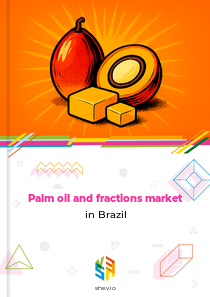







Earlier Report Observations
The Brazilian palm oil market volume demonstrated significant growth over the 2018-2023 period, rising from 545.8 thousand tons to 884.2 thousand tons. This overall expansion was underpinned by a substantial increase in domestic production, which grew by over 75% from 362.7 thousand tons to 637.4 thousand tons, while export volumes consistently declined.
Market dynamics showed notable volatility, with a temporary contraction in 2019 to 527.0 thousand tons coinciding with a sharp drop in imports. A subsequent surge, peaking at 931.0 thousand tons in 2021, was driven by a combination of rising production and a record inflow of imports reaching 365.0 thousand tons. After a modest correction in 2022, the market volume climbed again in 2023 to 884.2 thousand tons.
The steady decline in exports, which fell from 30.7 thousand tons to 13.7 thousand tons, consistently redirected a larger share of domestic output to the local market, further supporting the growth in total market size throughout the period.
Table of content
- 1. Disclaimer
- 2. Terms of use of the report
- 3. Product codes in the statistical classifications used in the report
-
4. Key Market Indicators and Trends
-
4.1. Key Market Indicators
-
4.1.1. In kind
- 4.1.1.1. Production, 2018-2023
- 4.1.1.2. Imports, 2018-2025
- 4.1.1.3. Exports, 2018-2025
- 4.1.1.4. Market size, 2018-2023
-
4.1.1. In kind
- 4.2. Market Trends and Factors
-
4.1. Key Market Indicators
-
5. Production
-
5.1. Production in Brazil
- 5.1.1. Annual dynamics of production in Brazil in kind, 2018-2023, K t
- 5.1.2. Annual dynamics of production in Brazil in value, 2018-2023, $ US
-
5.2. Global production by Country, 2018-2023
- 5.2.1. Annual dynamics of production by macroregions in kind, 2018-2023, K t
- 5.2.2. Dynamics of production structure by macroregions in kind, 2018-2023
- 5.2.3. Annual dynamics of production by country in kind, 2018-2023, K t
- 5.2.4. Structure of production by countries in kind, 2018-2023
- 5.2.5. Dynamics of peoduction structure by countries in kind, 2018-2023
-
5.1. Production in Brazil
-
6. Exports
-
6.1. Exports (Direct Data)
- 6.1.1. Exports - Total information
-
6.1.2. Exports in kind, K t
- 6.1.2.1. Annual dynamics of product's exports from Brazil in kind, 2018-2025, K t
- 6.1.2.2. Dynamics of product's exports in kind from Brazil by countries, 2018-2025, K t
- 6.1.2.3. Structure of product's exports in kind by countries, 2018-2025
-
6.1.3. Exports in value, M $ US
- 6.1.3.1. Annual dynamics of product's exports from Brazil in value, 2018-2025, M $ US
- 6.1.3.2. Dynamics of product's exports in value from Brazil by countries, 2018-2025, M $ US
- 6.1.3.3. Structure of product's exports in value by countries, 2018-2025
-
6.1.4. Average price of product's exports, $ US/t
- 6.1.4.1. Annual dynamics of average price of product's exports from Brazil, 2018-2025, $ US/t
- 6.1.4.2. Dynamics of average price of product's exports from Brazil by countries, 2018-2025, $ US/t
-
6.2. Exports (Mirror Data)
- 6.2.1. Exports - Total information
-
6.2.2. Exports in kind, K t
- 6.2.2.1. Annual dynamics of product's exports from Brazil in kind, 2018-2025, K t
- 6.2.2.2. Dynamics of product's exports in kind from Brazil by countries, 2018-2025, K t
- 6.2.2.3. Structure of product's exports in kind by countries, 2018-2025
-
6.2.3. Exports in value, M $ US
- 6.2.3.1. Annual dynamics of product's exports from Brazil in value, 2018-2025, M $ US
- 6.2.3.2. Dynamics of product's exports in value from Brazil by countries, 2018-2025, M $ US
- 6.2.3.3. Structure of product's exports in value by countries, 2018-2025
-
6.2.4. Average price of product's exports, $ US/t
- 6.2.4.1. Annual dynamics of average price of product's exports from Brazil, 2018-2025, $ US/t
- 6.2.4.2. Dynamics of average price of product's exports from Brazil by countries, 2018-2025, $ US/t
-
6.1. Exports (Direct Data)
-
7. Imports
-
7.1. Imports (Direct Data)
- 7.1.1. Imports - Total information
-
7.1.2. Imports in kind, K t
- 7.1.2.1. Annual dynamics of product's imports to Brazil in kind, 2018-2025, K t
- 7.1.2.2. Dynamics of product's imports in kind to Brazil by countries, 2018-2025, K t
- 7.1.2.3. Structure of product's imports in kind by countries, 2018-2025
-
7.1.3. Imports in value, M $ US
- 7.1.3.1. Annual dynamics of product's imports to Brazil in value, 2018-2025, M $ US
- 7.1.3.2. Dynamics of product's imports in value to Brazil by countries, 2018-2025, M $ US
- 7.1.3.3. Structure of product's imports in value by countries, 2018-2025
-
7.1.4. Average price of product's imports, $ US/t
- 7.1.4.1. Annual dynamics of average price of product's imports to Brazil, 2018-2025, $ US/t
- 7.1.4.2. Dynamics of average price of product's imports to Brazil by countries, 2018-2025, $ US/t
-
7.2. Imports (Mirror Data)
- 7.2.1. Imports - Total information
-
7.2.2. Imports in kind, K t
- 7.2.2.1. Annual dynamics of product's imports to Brazil in kind, 2018-2025, K t
- 7.2.2.2. Dynamics of product's imports in kind to Brazil by countries, 2018-2025, K t
- 7.2.2.3. Structure of product's imports in kind by countries, 2018-2025
-
7.2.3. Imports in value, M $ US
- 7.2.3.1. Annual dynamics of product's imports to Brazil in value, 2018-2025, M $ US
- 7.2.3.2. Dynamics of product's imports in value to Brazil by countries, 2018-2025, M $ US
- 7.2.3.3. Structure of product's imports in value by countries, 2018-2025
-
7.2.4. Average price of product's imports, $ US/t
- 7.2.4.1. Annual dynamics of average price of product's imports to Brazil, 2018-2025, $ US/t
- 7.2.4.2. Dynamics of average price of product's imports to Brazil by countries, 2018-2025, $ US/t
-
7.1. Imports (Direct Data)
-
8. Trade balance
-
8.1. Trade balance (Direct Data)
- 8.1.1. In kind, K t
- 8.1.2. In value, M $ US
-
8.2. Trade balance (Mirror Data)
- 8.2.1. In kind, K t
- 8.2.2. In value, M $ US
-
8.1. Trade balance (Direct Data)
-
9. Top buying and selling countries, 2018-2025
-
9.1. Direct Data
- 9.1.1. Import in Value by Countries-buyers
- 9.1.2. Export in Value by Countries-suppliers
-
9.2. Mirror Data
- 9.2.1. Import in Value by Countries-buyers
- 9.2.2. Export in Value by Countries-suppliers
-
9.1. Direct Data
Production palm oil and fractions in Brazil
In kind, 2018-2021, K t
From 2018 to 2021, Brazil ranked 12th globally in the production of palm oil and fractions.
Top producers of palm oil and fractions, 2018-2021
World map of production of palm oil and fractions, 2018-2021
Brazil's production of palm oil and fractions grew for the third year in a row. In 2021, output reached 579.2 thousand tonnes, showing little change from the previous year. Over the 2018-2021 period, production rose by 59.7%, with an average annual growth rate of 16.9%.
Annual dynamics of production in Brazil in kind, 2018-2021, K t
| Parameter | 2019 | 2020 | 2021 | CAGR | |
|---|---|---|---|---|---|
| 1 | Change from last year | 10.4% | 44.0% | 0.4% | 16.9% |
Exports palm oil and fractions from Brazil
Exports in kind, K t
In 2021, Brazil exported 13.1 thousand tonnes of palm oil and fractions, a 24.0% decrease compared to 2020. Between 2018 and 2021, exports fell by 57.3%, equivalent to an annualized decline of 24.7%. The sharpest drop occurred in 2019, at 44.5%, while the largest increase was in 2020, at 1.1%.
Annual dynamics of product's exports from Brazil in kind, 2018-2021, K t
| Parameter | 2019 | 2020 | 2021 | CAGR | |
|---|---|---|---|---|---|
| 1 | Change from last year | (44.5%) | 1.1% | (24.0%) | (24.7%) |
From 2018 to 2021, Switzerland, Colombia, and Germany were the key export partners for palm oil and fractions in volume terms. Switzerland accounted for 44.2% of exports, Colombia for 21.6%, and Germany for 15.9%, together making up 81.8% of total flows.
Structure of product's exports in kind by countries, 2018-2021
World map of product's exports from Brazil in kind, 2018-2021
Exports in value, M $ US
The market showed an unstable trend over this period. Exports peaked in 2018 and hit their lowest point in 2019, with a 1.8-fold difference between these years. In 2021, Brazil exported 18.3 million US dollars worth of palm oil and fractions, a 71.1% increase from the previous year. The lowest value was recorded in 2019 at 10.6 million US dollars, with the largest decline that year at 45.3%.
Annual dynamics of product's exports from Brazil in value, 2018-2021, M $ US
| Parameter | 2019 | 2020 | 2021 | CAGR | |
|---|---|---|---|---|---|
| 1 | Change from last year | (45.3%) | 1.2% | 71.1% | (1.8%) |
Throughout 2018-2021, Switzerland, Germany, and Colombia were the main partners for exports in value terms. Switzerland represented 35.9% of exports, Germany 17.7%, and Colombia 15.2%, collectively accounting for 68.8% of total flows.
Structure of product's exports in value by countries, 2018-2021
World map of product's exports from Brazil in value, 2018-2021
Imports palm oil and fractions to Brazil
Imports in kind, K t
Brazil's imports of palm oil and fractions increased for the second consecutive year. In 2021, imports totaled 365.0 thousand tonnes, surging by 49.8% year-over-year. Over the 2018-2021 period, imports grew by 70.7%, with an average annual growth rate of 19.5%. The lowest volume was in 2019 at 143.4 thousand tonnes, with the largest decline that year at 32.9%, while the biggest increase was in 2020 at 69.9%.
Annual dynamics of product's imports to Brazil in kind, 2018-2021, K t
| Parameter | 2019 | 2020 | 2021 | CAGR | |
|---|---|---|---|---|---|
| 1 | Change from last year | (32.9%) | 69.9% | 49.8% | 19.5% |
From 2018 to 2021, Indonesia and Colombia were the primary sources for imports in volume terms, together accounting for 92.8% of total flows, with other partners playing a much smaller role individually.
Structure of product's imports in kind by countries, 2018-2021
World map of product's imports to Brazil in kind, 2018-2021
Imports in value, M $ US
The market exhibited an unstable trend throughout the timeframe. Imports reached their lowest volume in 2019 and peaked in 2021, with a 4.3-fold difference between these years. In 2021, Brazil's imports of palm oil and fractions amounted to 393.6 million US dollars, up by 118.4% from the previous year. The minimum value was in 2019 at 90.7 million US dollars, with the largest decline that year at 40.7%.
Annual dynamics of product's imports to Brazil in value, 2018-2021, M $ US
| Parameter | 2019 | 2020 | 2021 | CAGR | |
|---|---|---|---|---|---|
| 1 | Change from last year | (40.7%) | 98.6% | 118.4% | 37.0% |
In 2018-2021, Indonesia and Colombia remained the main markets for imports in value terms, jointly representing 91.0% of total flows, while other partners made up the remainder.
Structure of product's imports in value by countries, 2018-2021
World map of product's imports to Brazil in value, 2018-2021
Related Reports

Palm oil and fractions market in Mexico
2026-03-28

Non-vegetable waxes market in Brazil
2026-03-28
Soybean oil and fractions market in Brazil
2026-03-28

Corn oil and fractions market in Brazil
2026-03-28
Castor oil and fractions market in Brazil
2026-03-28
Why Choose Us?
Only Verified Data
No Hidden Costs or Separate Fees
Smarter Subscription Pricing
Contact Our Team
Submit your inquiry using the form below — our team will get back to you within 24 hours.