






"South America" region includes following countries:
 Argentina
 Bolivia
 Brazil
 Chile
Chile Colombia
 Ecuador
 Falkland Islands (Malvinas)
 French Guiana
 Guyana
 Paraguay
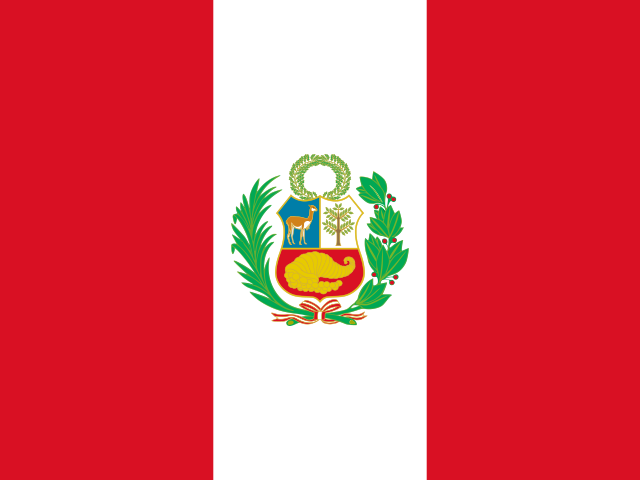 Peru
Peru Suriname
 Uruguay
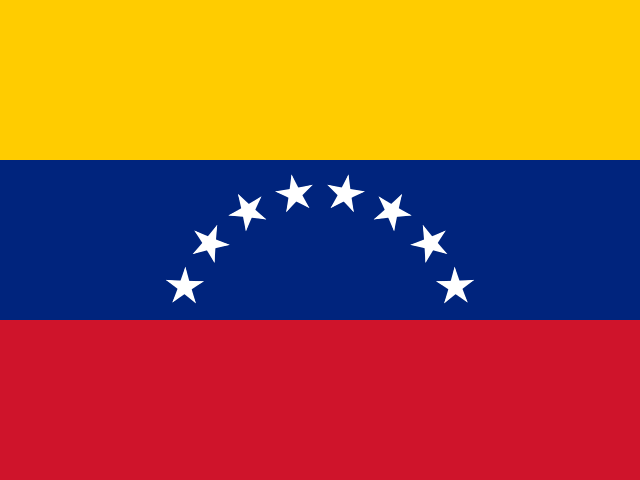 Venezuela
Earlier Report Observations
The paddy rice market in South America began the period at 24.8 million tons in 2018 but contracted to 23.3 million tons in 2019 as farmers reduced planted area due to low profitability compared to soybeans and adverse weather conditions. In 2020, the COVID-19 pandemic triggered increased domestic demand for rice as a staple, while the temporary suspension of import duties boosted imports, helping the market recover to 24.5 million tons despite continued area reduction.
Market volume reached a peak of 25.7 million tons in 2021, driven by higher productivity in Rio Grande do Sul, the main producing state, even as La Niña brought below-average rains and production costs rose. Planted area shrank further under climatic and economic pressures in 2022, leading to a sharp drop in production and a market decline to 23.1 million tons, exacerbated by strong export volumes. In 2023, the market edged up to 23.6 million tons as exports moderated, but planted area kept falling due to unattractive prices and persistent adverse weather.
Table of content
- 1. Disclaimer
- 2. Terms of use of the report
- 3. Product codes in the statistical classifications used in the report
-
4. Key Market Indicators and Trends
-
4.1. Key Market Indicators
-
4.1.1. In kind
- 4.1.1.1. Production, 2018-2023
- 4.1.1.2. Imports, 2018-2024
- 4.1.1.3. Exports, 2018-2024
- 4.1.1.4. Market size, 2018-2023
-
4.1.1. In kind
- 4.2. Market Trends and Factors
-
4.1. Key Market Indicators
-
5. Production
-
5.1. Production in South America
- 5.1.1. Annual dynamics of production in South America in kind, 2018-2023, K t
-
5.2. Global production by Country, 2018-2023
- 5.2.1. Annual dynamics of production by macroregions in kind, 2018-2023, K t
- 5.2.2. Dynamics of production structure by macroregions in kind, 2018-2023
- 5.2.3. Annual dynamics of production by country in kind, 2018-2023, K t
- 5.2.4. Structure of production by countries in kind, 2018-2023
- 5.2.5. Dynamics of peoduction structure by countries in kind, 2018-2023
-
5.1. Production in South America
-
6. Imports
-
6.1. Imports (Direct Data*)
- 6.1.1. Imports - Total information
-
6.1.2. Imports in kind, K t
- 6.1.2.1. Annual dynamics of product's imports to Argentina in kind, 2018-2024, K t
- 6.1.2.2. Dynamics of product's imports in kind to Argentina by countries, 2018-2024, K t
- 6.1.2.3. Structure of product's imports in kind by countries, 2018-2024
-
6.1.3. Imports in value, M $ US
- 6.1.3.1. Annual dynamics of product's imports to Argentina in value, 2018-2024, M $ US
- 6.1.3.2. Dynamics of product's imports in value to Argentina by countries, 2018-2024, M $ US
- 6.1.3.3. Structure of product's imports in value by countries, 2018-2024
-
6.1.4. Average price of product's imports, $ US/t
- 6.1.4.1. Annual dynamics of average price of product's imports to Argentina, 2018-2024, $ US/t
- 6.1.4.2. Dynamics of average price of product's imports to Argentina by countries, 2018-2024, $ US/t
-
6.2. Imports (Mirror Data)
- 6.2.1. Imports - Total information
-
6.2.2. Imports in kind, K t
- 6.2.2.1. Annual dynamics of product's imports to Argentina in kind, 2018-2024, K t
- 6.2.2.2. Dynamics of product's imports in kind to Argentina by countries, 2018-2024, K t
- 6.2.2.3. Structure of product's imports in kind by countries, 2018-2024
-
6.2.3. Imports in value, M $ US
- 6.2.3.1. Annual dynamics of product's imports to Argentina in value, 2018-2024, M $ US
- 6.2.3.2. Dynamics of product's imports in value to Argentina by countries, 2018-2024, M $ US
- 6.2.3.3. Structure of product's imports in value by countries, 2018-2024
-
6.2.4. Average price of product's imports, $ US/t
- 6.2.4.1. Annual dynamics of average price of product's imports to Argentina, 2018-2024, $ US/t
- 6.2.4.2. Dynamics of average price of product's imports to Argentina by countries, 2018-2024, $ US/t
-
6.1. Imports (Direct Data*)
-
7. Exports
-
7.1. Exports (Direct Data*)
- 7.1.1. Exports - Total information
-
7.1.2. Exports in kind, K t
- 7.1.2.1. Annual dynamics of product's exports from Argentina in kind, 2018-2024, K t
- 7.1.2.2. Dynamics of product's exports in kind from Argentina by countries, 2018-2024, K t
- 7.1.2.3. Structure of product's exports in kind by countries, 2018-2024
-
7.1.3. Exports in value, M $ US
- 7.1.3.1. Annual dynamics of product's exports from Argentina in value, 2018-2024, M $ US
- 7.1.3.2. Dynamics of product's exports in value from Argentina by countries, 2018-2024, M $ US
- 7.1.3.3. Structure of product's exports in value by countries, 2018-2024
-
7.1.4. Average price of product's exports, $ US/t
- 7.1.4.1. Annual dynamics of average price of product's exports from Argentina, 2018-2024, $ US/t
- 7.1.4.2. Dynamics of average price of product's exports from Argentina by countries, 2018-2024, $ US/t
-
7.2. Exports (Mirror Data)
- 7.2.1. Exports - Total information
-
7.2.2. Exports in kind, K t
- 7.2.2.1. Annual dynamics of product's exports from Argentina in kind, 2018-2024, K t
- 7.2.2.2. Dynamics of product's exports in kind from Argentina by countries, 2018-2024, K t
- 7.2.2.3. Structure of product's exports in kind by countries, 2018-2024
-
7.2.3. Exports in value, M $ US
- 7.2.3.1. Annual dynamics of product's exports from Argentina in value, 2018-2024, M $ US
- 7.2.3.2. Dynamics of product's exports in value from Argentina by countries, 2018-2024, M $ US
- 7.2.3.3. Structure of product's exports in value by countries, 2018-2024
-
7.2.4. Average price of product's exports, $ US/t
- 7.2.4.1. Annual dynamics of average price of product's exports from Argentina, 2018-2024, $ US/t
- 7.2.4.2. Dynamics of average price of product's exports from Argentina by countries, 2018-2024, $ US/t
-
7.1. Exports (Direct Data*)
-
8. Trade balance
-
8.1. Trade balance (Direct Data)
- 8.1.1. In kind, K t
- 8.1.2. In value, M $ US
-
8.2. Trade balance (Mirror Data)
- 8.2.1. In kind, K t
- 8.2.2. In value, M $ US
-
8.1. Trade balance (Direct Data)
-
9. Top buying and selling countries, 2018-2024
-
9.1. Direct Data
- 9.1.1. Import in Value by Countries-buyers
- 9.1.2. Export in Value by Countries-suppliers
-
9.2. Mirror Data
- 9.2.1. Import in Value by Countries-buyers
- 9.2.2. Export in Value by Countries-suppliers
-
9.1. Direct Data
Production paddy rice in South America
In kind, 2017-2020, K t
Top producers of paddy rice, 2017-2020
World map of production of paddy rice, 2017-2020
After two years of decline, paddy rice production in South America rebounded. In 2020, South America produced 24 925 K t of paddy rice, representing a 7.6% year-over-year increase. Over the 2017-2020 period, production decreased by 3.1%, with a compound annual growth rate of 1.1%. The lowest production level was recorded in 2019 at 23 156 K t, which also saw the largest decline of 7.4%.
Annual dynamics of production in South America in kind, 2017-2020, K t
| Parameter | 2018 | 2019 | 2020 | CAGR | |
|---|---|---|---|---|---|
| 1 | Change from last year | (2.8%) | (7.4%) | 7.6% | (1.1%) |
Exports paddy rice from South America
Exports in kind, K t
The market exhibited volatility during the observed period. Export volumes reached their lowest point in 2017 and peaked in 2020, showing a fourfold increase between these years. In 2020, South America exported 859.2 K t of paddy rice, a substantial 274.8% increase compared to 2019. The largest decline occurred in 2019, dropping by 60.9%.
Annual dynamics of product's exports from South America in kind, 2017-2020, K t
| Parameter | 2018 | 2019 | 2020 | CAGR | |
|---|---|---|---|---|---|
| 1 | Change from last year | 175.1% | (60.9%) | 274.8% | 59.1% |
From 2017 to 2020, Mexico (12.3% of exports in kind), Costa Rica (9.1%), and Nicaragua (7.1%) were significant buyers of paddy rice from South America. However, their combined share accounted for only 28.5% of total exports in kind, with the remaining 71.5% distributed among numerous other trading partners.
Structure of product's exports in kind by countries, 2017-2020
World map of product's exports from South America in kind, 2017-2020
Exports in value, M $ US
The data shows irregular fluctuations, indicating a volatile market environment. Export values hit their lowest point in 2017 and reached their peak in 2020, with a 3.3-fold swing between these years. In 2020, paddy rice exports from South America totaled 314.3 M $ US, marking a 92.8% increase from 2019. The largest decline occurred in 2019 at 41.7%, while the largest increase was recorded in 2018 at 197.9%.
Annual dynamics of product's exports from South America in value, 2017-2020, M $ US
| Parameter | 2018 | 2019 | 2020 | CAGR | |
|---|---|---|---|---|---|
| 1 | Change from last year | 197.9% | (41.7%) | 92.8% | 49.6% |
During 2017-2020, Mexico (12.9% of exports in value terms), Costa Rica (8.6%), and Nicaragua (6.9%) were the largest but not dominant buyers of paddy rice from South America. Together, they accounted for 28.4% of total export value, with the remaining share distributed among a wide range of smaller partners.
Structure of product's exports in value by countries, 2017-2020
World map of product's exports from South America in value, 2017-2020
Imports paddy rice to South America
Imports in kind, K t
South America imported approximately 435.4 K t of paddy rice in 2020, showing a solid 24.3% increase compared to the previous year. Between 2017 and 2020, imports grew by 26.9%, equivalent to an 8.3% annualized rate. The largest decline was recorded in 2019 at 0.1%.
Annual dynamics of product's imports to South America in kind, 2017-2020, K t
| Parameter | 2018 | 2019 | 2020 | CAGR | |
|---|---|---|---|---|---|
| 1 | Change from last year | 2.2% | (0.1%) | 24.3% | 8.3% |
From 2017 to 2020, the United States was the principal source of paddy rice imports to South America, accounting for 38.3% of total imports in kind.
Structure of product's imports in kind by countries, 2017-2020
World map of product's imports to South America in kind, 2017-2020
Imports in value, M $ US
Market behavior during these years was characterized by volatility. Import values reached their lowest point in 2017 and peaked in 2020, with a 2.2-fold difference between these years. In 2020, South America imported 272.9 M $ US worth of paddy rice, a 35.2% increase from 2019. The largest decline occurred in 2019 at 11.7%, while the largest increase was recorded in 2018 at 81.1%.
Annual dynamics of product's imports to South America in value, 2017-2020, M $ US
| Parameter | 2018 | 2019 | 2020 | CAGR | |
|---|---|---|---|---|---|
| 1 | Change from last year | 81.1% | (11.7%) | 35.2% | 29.3% |
Over the 2017-2020 period, the United States led as the primary supplier of paddy rice to South America, representing 45.2% of total imports in value terms.
Structure of product's imports in value by countries, 2017-2020
World map of product's imports to South America in value, 2017-2020
Related Reports

2026-03-28
2026-03-28
2026-03-28
Paddy rice market in Eastern Africa
2026-03-28

Sorghum market in South America
2026-03-28


2026-03-28

Broken rice market in South America
2026-03-28
Why Choose Us?
Only Verified Data
No Hidden Costs or Separate Fees
Smarter Subscription Pricing
Contact Our Team
Submit your inquiry using the form below — our team will get back to you within 24 hours.