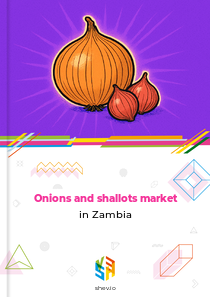







Earlier Report Observations
The market volume for fresh onions and shallots in Zambia stood at 43 231 t in 2018. The following year, it declined to 42 333 t, a drop that coincided with the introduction of the Food Safety Act No. 7 of 2019. This legislation strengthened food safety standards, likely restricting import flows and temporarily reducing overall market supply. After a period of stabilization around 42 574 t in 2020, the market expanded significantly to 45 248 t in 2021.
From 2022 onward, the market volume contracted, falling to 40 093 t by 2023. During the 2023/2024 farming season, drought conditions posed challenges to agricultural output, including for onions and shallots. Concurrently, the government's Farmer Input Support Programme (FISP) provided inputs to producers, helping to sustain domestic production levels. Into 2024, the ongoing implementation of FISP and the publication of monthly market bulletins by the Ministry of Agriculture indicated continued efforts to monitor supply conditions and support the market.
Table of content
- 1. Disclaimer
- 2. Terms of use of the report
- 3. Product codes in the statistical classifications used in the report
-
4. Key Market Indicators and Trends
-
4.1. Key Market Indicators
-
4.1.1. In kind
- 4.1.1.1. Production, 2018-2023
- 4.1.1.2. Imports, 2018-2024
- 4.1.1.3. Exports, 2018-2024
- 4.1.1.4. Market size, 2018-2023
-
4.1.1. In kind
- 4.2. Market Trends and Factors
-
4.1. Key Market Indicators
-
5. Production
-
5.1. Production in Zambia
- 5.1.1. Annual dynamics of production in Zambia in kind, 2018-2023, t
- 5.1.2. Annual dynamics of production in Zambia in value, 2018-2023, $ US
-
5.2. Global production by Country, 2018-2023
- 5.2.1. Annual dynamics of production by macroregions in kind, 2018-2023, t
- 5.2.2. Dynamics of production structure by macroregions in kind, 2018-2023
- 5.2.3. Annual dynamics of production by country in kind, 2018-2023, t
- 5.2.4. Structure of production by countries in kind, 2018-2023
- 5.2.5. Dynamics of peoduction structure by countries in kind, 2018-2023
-
5.1. Production in Zambia
-
6. Exports
-
6.1. Exports (Direct Data)
- 6.1.1. Exports - Total information
-
6.1.2. Exports in kind, t
- 6.1.2.1. Annual dynamics of product's exports from Zambia in kind, 2018-2024, t
- 6.1.2.2. Dynamics of product's exports in kind from Zambia by countries, 2018-2024, t
- 6.1.2.3. Structure of product's exports in kind by countries, 2018-2024
-
6.1.3. Exports in value, K $ US
- 6.1.3.1. Annual dynamics of product's exports from Zambia in value, 2018-2024, K $ US
- 6.1.3.2. Dynamics of product's exports in value from Zambia by countries, 2018-2024, K $ US
- 6.1.3.3. Structure of product's exports in value by countries, 2018-2024
-
6.1.4. Average price of product's exports, $ US/t
- 6.1.4.1. Annual dynamics of average price of product's exports from Zambia, 2018-2024, $ US/t
- 6.1.4.2. Dynamics of average price of product's exports from Zambia by countries, 2018-2024, $ US/t
-
6.2. Exports (Mirror Data)
- 6.2.1. Exports - Total information
-
6.2.2. Exports in kind, t
- 6.2.2.1. Annual dynamics of product's exports from Zambia in kind, 2018-2024, t
- 6.2.2.2. Dynamics of product's exports in kind from Zambia by countries, 2018-2024, t
- 6.2.2.3. Structure of product's exports in kind by countries, 2018-2024
-
6.2.3. Exports in value, K $ US
- 6.2.3.1. Annual dynamics of product's exports from Zambia in value, 2018-2024, K $ US
- 6.2.3.2. Dynamics of product's exports in value from Zambia by countries, 2018-2024, K $ US
- 6.2.3.3. Structure of product's exports in value by countries, 2018-2024
-
6.2.4. Average price of product's exports, $ US/t
- 6.2.4.1. Annual dynamics of average price of product's exports from Zambia, 2018-2024, $ US/t
- 6.2.4.2. Dynamics of average price of product's exports from Zambia by countries, 2018-2024, $ US/t
-
6.1. Exports (Direct Data)
-
7. Imports
-
7.1. Imports (Direct Data)
- 7.1.1. Imports - Total information
-
7.1.2. Imports in kind, t
- 7.1.2.1. Annual dynamics of product's imports to Zambia in kind, 2018-2024, t
- 7.1.2.2. Dynamics of product's imports in kind to Zambia by countries, 2018-2024, t
- 7.1.2.3. Structure of product's imports in kind by countries, 2018-2024
-
7.1.3. Imports in value, K $ US
- 7.1.3.1. Annual dynamics of product's imports to Zambia in value, 2018-2024, K $ US
- 7.1.3.2. Dynamics of product's imports in value to Zambia by countries, 2018-2024, K $ US
- 7.1.3.3. Structure of product's imports in value by countries, 2018-2024
-
7.1.4. Average price of product's imports, $ US/t
- 7.1.4.1. Annual dynamics of average price of product's imports to Zambia, 2018-2024, $ US/t
- 7.1.4.2. Dynamics of average price of product's imports to Zambia by countries, 2018-2024, $ US/t
-
7.2. Imports (Mirror Data)
- 7.2.1. Imports - Total information
-
7.2.2. Imports in kind, t
- 7.2.2.1. Annual dynamics of product's imports to Zambia in kind, 2018-2024, t
- 7.2.2.2. Dynamics of product's imports in kind to Zambia by countries, 2018-2024, t
- 7.2.2.3. Structure of product's imports in kind by countries, 2018-2024
-
7.2.3. Imports in value, K $ US
- 7.2.3.1. Annual dynamics of product's imports to Zambia in value, 2018-2024, K $ US
- 7.2.3.2. Dynamics of product's imports in value to Zambia by countries, 2018-2024, K $ US
- 7.2.3.3. Structure of product's imports in value by countries, 2018-2024
-
7.2.4. Average price of product's imports, $ US/t
- 7.2.4.1. Annual dynamics of average price of product's imports to Zambia, 2018-2024, $ US/t
- 7.2.4.2. Dynamics of average price of product's imports to Zambia by countries, 2018-2024, $ US/t
-
7.1. Imports (Direct Data)
-
8. Trade balance
-
8.1. Trade balance (Direct Data)
- 8.1.1. In kind, t
- 8.1.2. In value, K $ US
-
8.2. Trade balance (Mirror Data)
- 8.2.1. In kind, t
- 8.2.2. In value, K $ US
-
8.1. Trade balance (Direct Data)
-
9. Top buying and selling countries, 2018-2024
-
9.1. Direct Data
- 9.1.1. Import in Value by Countries-buyers
- 9.1.2. Export in Value by Countries-suppliers
-
9.2. Mirror Data
- 9.2.1. Import in Value by Countries-buyers
- 9.2.2. Export in Value by Countries-suppliers
-
9.1. Direct Data
Production onions and shallots in Zambia
In kind, 2017-2020, t
Top producers of onions and shallots, 2017-2020
World map of production of onions and shallots, 2017-2020
Zambia's production of onions and shallots has increased for the third consecutive year. In 2019, production remained relatively stable, with little change from the previous year. By 2020, output reached 40 275 tonnes, showing continued growth in this agricultural sector.
Annual dynamics of production in Zambia in kind, 2017-2020, t
| Parameter | 2018 | 2019 | 2020 | CAGR | |
|---|---|---|---|---|---|
| 1 | Change from last year | 0.8% | 0.7% | 0.2% | 0.6% |
Exports onions and shallots from Zambia
Exports in kind, t
The export market for onions and shallots from Zambia displayed significant volatility during the observed period. Exports reached their lowest point in 2019, then surged dramatically to a peak in 2017, with a remarkable 195-fold difference between these years. In 2020, exports stood at 23 tonnes, representing an extraordinary year-on-year increase of 1 013.4%.
Annual dynamics of product's exports from Zambia in kind, 2017-2020, t
| Parameter | 2018 | 2019 | 2020 | CAGR | |
|---|---|---|---|---|---|
| 1 | Change from last year | n/a | n/a | 1 013.4% | (61.5%) |
Between 2017 and 2020, Zambia's onion and shallot exports were overwhelmingly concentrated in the Democratic Republic of the Congo, which accounted for 93.9% of all shipments in volume terms.
Structure of product's exports in kind by countries, 2017-2020
World map of product's exports from Zambia in kind, 2017-2020
Exports in value, K $ US
The export market in value terms showed considerable volatility throughout these years. Exports declined to their lowest point in 2019, then recovered to reach a peak in 2017, with a 152-fold difference between these periods. In 2020, exports reached 12 thousand US dollars, marking a substantial 946.5% increase compared to the previous year.
Annual dynamics of product's exports from Zambia in value, 2017-2020, K $ US
| Parameter | 2018 | 2019 | 2020 | CAGR | |
|---|---|---|---|---|---|
| 1 | Change from last year | n/a | n/a | 946.5% | (59.1%) |
From 2017 to 2020, the export market structure remained highly concentrated, with the Democratic Republic of the Congo alone responsible for 92.9% of total export value.
Structure of product's exports in value by countries, 2017-2020
World map of product's exports from Zambia in value, 2017-2020
Imports onions and shallots to Zambia
Imports in kind, t
After declining for two consecutive years, Zambia's imports of onions and shallots began to recover. Imports reached their lowest point in 2019 at 2 135 tonnes, then increased to 2 323 tonnes in 2020, reflecting a measured 8.8% rise compared to the previous year. Over the entire 2017-2020 period, imports decreased by 56.2%, representing an average annual decline of 24.0%. The most significant drop occurred in 2018, when imports fell by 37.7%.
Annual dynamics of product's imports to Zambia in kind, 2017-2020, t
| Parameter | 2018 | 2019 | 2020 | CAGR | |
|---|---|---|---|---|---|
| 1 | Change from last year | (37.7%) | (35.3%) | 8.8% | (24.0%) |
Between 2017 and 2020, South Africa was effectively the sole source of onion and shallot imports to Zambia, accounting for 100.0% of all imports in volume terms.
Structure of product's imports in kind by countries, 2017-2020
World map of product's imports to Zambia in kind, 2017-2020
Imports in value, K $ US
Following two years of decline, Zambia's imports of onions and shallots in value terms showed signs of recovery. Imports reached their lowest point in 2019 at 1 238 thousand US dollars, then increased to 1 286 thousand US dollars in 2020, representing a modest 3.9% rise compared to the previous year. Between 2017 and 2020, imports decreased by 55.9%, equating to an average annual decline of 23.9%. The most substantial decrease occurred in 2019, when imports fell by 34.9%.
Annual dynamics of product's imports to Zambia in value, 2017-2020, K $ US
| Parameter | 2018 | 2019 | 2020 | CAGR | |
|---|---|---|---|---|---|
| 1 | Change from last year | (34.7%) | (34.9%) | 3.9% | (23.9%) |
From 2017 to 2020, South Africa served as the nearly exclusive supplier of onions and shallots to Zambia, capturing 100.0% of total import value.
Structure of product's imports in value by countries, 2017-2020
World map of product's imports to Zambia in value, 2017-2020
Related Reports

Onions and shallots market in South America
2026-03-27
Onions and shallots market in South Korea
2026-03-27
Onions and shallots market in Sweden
2026-03-27

Dried shelled bambara beans market in Zambia
2026-03-27
Dried shelled beans market in Zambia
2026-03-27
Dried shelled legumes market in Zambia
2026-03-27
Why Choose Us?
Only Verified Data
No Hidden Costs or Separate Fees
Smarter Subscription Pricing
Contact Our Team
Submit your inquiry using the form below — our team will get back to you within 24 hours.