






"South America" region includes following countries:
 Argentina
 Bolivia
 Brazil
 Chile
Chile Colombia
 Ecuador
 Falkland Islands (Malvinas)
 French Guiana
 Guyana
 Paraguay
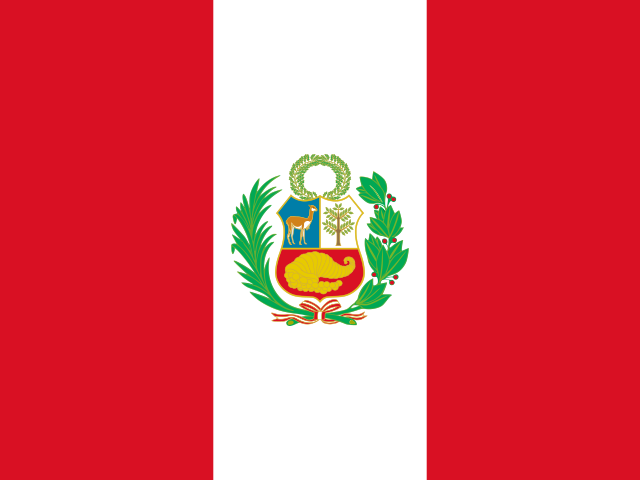 Peru
Peru Suriname
 Uruguay
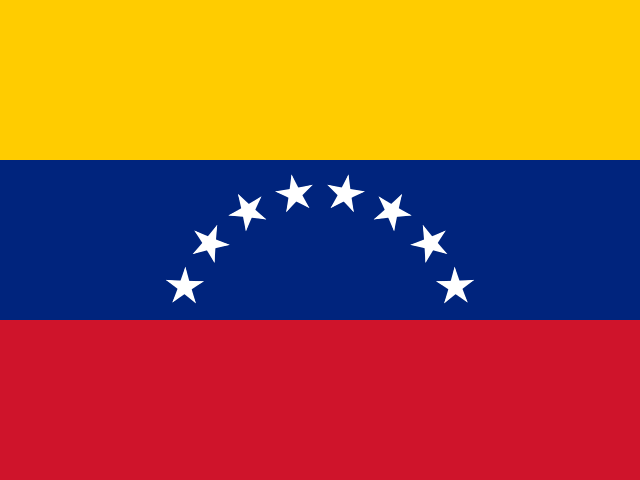 Venezuela
Earlier Report Observations
The market volume for not defatted cocoa paste in South America showed a volatile trend from 2018 to 2023, starting at 339.6 thousand tons and reaching 361.4 thousand tons by the end of the period. After a rise to 363.7 thousand tons in 2019, it dropped sharply to 331.6 thousand tons in 2020, then recovered strongly to a peak of 372.6 thousand tons in 2021. Another decline followed in 2022 to 338.9 thousand tons, before a final uptick in 2023.
These fluctuations were driven by changes in production and trade flows. Domestic production varied between 347.4 and 384.1 thousand tons, while exports saw significant swings, notably a jump to 29.6 thousand tons in 2020 that contributed to the market contraction that year. Imports remained relatively stable, averaging around 11 thousand tons, but their decline in 2022 coincided with a smaller market size.
In 2024, the region faced new challenges as irregular rains, droughts, and excessive rainfall in key growing areas, along with cocoa diseases like swollen shoot virus in Ghana, tightened global cocoa supply. This led to record-high cocoa prices, with increases of over 170% in Brazil. Despite high prices, domestic chocolate consumption continued to grow, and Brazilian exports to the United States surged by 60.8% due to zero tariffs for cocoa and cocoa butter under trade agreements.
Table of content
- 1. Disclaimer
- 2. Terms of use of the report
- 3. Product codes in the statistical classifications used in the report
-
4. Key Market Indicators and Trends
-
4.1. Key Market Indicators
-
4.1.1. In kind
- 4.1.1.1. Production, 2018-2023
- 4.1.1.2. Imports, 2018-2024
- 4.1.1.3. Exports, 2018-2024
- 4.1.1.4. Market size, 2018-2023
-
4.1.1. In kind
- 4.2. Market Trends and Factors
-
4.1. Key Market Indicators
-
5. Production
-
5.1. Production in South America
- 5.1.1. Annual dynamics of production in South America in kind, 2018-2023, K t
-
5.2. Global production by Country, 2018-2023
- 5.2.1. Annual dynamics of production by macroregions in kind, 2018-2023, K t
- 5.2.2. Dynamics of production structure by macroregions in kind, 2018-2023
- 5.2.3. Annual dynamics of production by country in kind, 2018-2023, K t
- 5.2.4. Structure of production by countries in kind, 2018-2023
- 5.2.5. Dynamics of peoduction structure by countries in kind, 2018-2023
-
5.1. Production in South America
-
6. Imports
-
6.1. Imports (Direct Data*)
- 6.1.1. Imports - Total information
-
6.1.2. Imports in kind, t
- 6.1.2.1. Annual dynamics of product's imports to Argentina in kind, 2018-2024, t
- 6.1.2.2. Dynamics of product's imports in kind to Argentina by countries, 2018-2024, t
- 6.1.2.3. Structure of product's imports in kind by countries, 2018-2024
-
6.1.3. Imports in value, M $ US
- 6.1.3.1. Annual dynamics of product's imports to Argentina in value, 2018-2024, M $ US
- 6.1.3.2. Dynamics of product's imports in value to Argentina by countries, 2018-2024, M $ US
- 6.1.3.3. Structure of product's imports in value by countries, 2018-2024
-
6.1.4. Average price of product's imports, $ US/kg
- 6.1.4.1. Annual dynamics of average price of product's imports to Argentina, 2018-2024, $ US/kg
- 6.1.4.2. Dynamics of average price of product's imports to Argentina by countries, 2018-2024, $ US/kg
-
6.2. Imports (Mirror Data)
- 6.2.1. Imports - Total information
-
6.2.2. Imports in kind, t
- 6.2.2.1. Annual dynamics of product's imports to Argentina in kind, 2018-2024, t
- 6.2.2.2. Dynamics of product's imports in kind to Argentina by countries, 2018-2024, t
- 6.2.2.3. Structure of product's imports in kind by countries, 2018-2024
-
6.2.3. Imports in value, M $ US
- 6.2.3.1. Annual dynamics of product's imports to Argentina in value, 2018-2024, M $ US
- 6.2.3.2. Dynamics of product's imports in value to Argentina by countries, 2018-2024, M $ US
- 6.2.3.3. Structure of product's imports in value by countries, 2018-2024
-
6.2.4. Average price of product's imports, $ US/kg
- 6.2.4.1. Annual dynamics of average price of product's imports to Argentina, 2018-2024, $ US/kg
- 6.2.4.2. Dynamics of average price of product's imports to Argentina by countries, 2018-2024, $ US/kg
-
6.1. Imports (Direct Data*)
-
7. Exports
-
7.1. Exports (Direct Data*)
- 7.1.1. Exports - Total information
-
7.1.2. Exports in kind, t
- 7.1.2.1. Annual dynamics of product's exports from Argentina in kind, 2018-2024, t
- 7.1.2.2. Dynamics of product's exports in kind from Argentina by countries, 2018-2024, t
- 7.1.2.3. Structure of product's exports in kind by countries, 2018-2024
-
7.1.3. Exports in value, M $ US
- 7.1.3.1. Annual dynamics of product's exports from Argentina in value, 2018-2024, M $ US
- 7.1.3.2. Dynamics of product's exports in value from Argentina by countries, 2018-2024, M $ US
- 7.1.3.3. Structure of product's exports in value by countries, 2018-2024
-
7.1.4. Average price of product's exports, $ US/kg
- 7.1.4.1. Annual dynamics of average price of product's exports from Argentina, 2018-2024, $ US/kg
- 7.1.4.2. Dynamics of average price of product's exports from Argentina by countries, 2018-2024, $ US/kg
-
7.2. Exports (Mirror Data)
- 7.2.1. Exports - Total information
-
7.2.2. Exports in kind, t
- 7.2.2.1. Annual dynamics of product's exports from Argentina in kind, 2018-2024, t
- 7.2.2.2. Dynamics of product's exports in kind from Argentina by countries, 2018-2024, t
- 7.2.2.3. Structure of product's exports in kind by countries, 2018-2024
-
7.2.3. Exports in value, M $ US
- 7.2.3.1. Annual dynamics of product's exports from Argentina in value, 2018-2024, M $ US
- 7.2.3.2. Dynamics of product's exports in value from Argentina by countries, 2018-2024, M $ US
- 7.2.3.3. Structure of product's exports in value by countries, 2018-2024
-
7.2.4. Average price of product's exports, $ US/kg
- 7.2.4.1. Annual dynamics of average price of product's exports from Argentina, 2018-2024, $ US/kg
- 7.2.4.2. Dynamics of average price of product's exports from Argentina by countries, 2018-2024, $ US/kg
-
7.1. Exports (Direct Data*)
-
8. Trade balance
-
8.1. Trade balance (Direct Data)
- 8.1.1. In kind, t
- 8.1.2. In value, M $ US
-
8.2. Trade balance (Mirror Data)
- 8.2.1. In kind, t
- 8.2.2. In value, M $ US
-
8.1. Trade balance (Direct Data)
-
9. Top buying and selling countries, 2018-2024
-
9.1. Direct Data
- 9.1.1. Import in Value by Countries-buyers
- 9.1.2. Export in Value by Countries-suppliers
-
9.2. Mirror Data
- 9.2.1. Import in Value by Countries-buyers
- 9.2.2. Export in Value by Countries-suppliers
-
9.1. Direct Data
Production not defatted cocoa paste in South America
In kind, 2017-2020, K t
Top producers of not defatted cocoa paste, 2017-2020
World map of production of not defatted cocoa paste, 2017-2020
South America's production of not defatted cocoa paste declined in 2020, following two consecutive years of growth. The region produced 351.6 thousand tons that year, marking a 5.5% decrease from 2019. Over the 2017-2020 period, production grew by 5.6%, with an average annual growth rate of 1.8%. The highest production level was recorded in 2019 at 372.0 thousand tons, which also saw the largest annual increase of 7.1%.
Annual dynamics of production in South America in kind, 2017-2020, K t
| Parameter | 2018 | 2019 | 2020 | CAGR | |
|---|---|---|---|---|---|
| 1 | Change from last year | 4.4% | 7.1% | (5.5%) | 1.8% |
In value, 2017-2020, M $ US
In 2020, the value of not defatted cocoa paste production in South America stood at 1 324 million US dollars, representing a significant 22.5% decline from the previous year. Over the 2017-2020 period, production value decreased by 19.7%, with an average annual decline of 7.1%. The lowest value was recorded in 2018 at 1 299 million US dollars, while the peak occurred in 2019 at 1 708 million US dollars. The largest annual increase was observed in 2019, when production value rose by 31.4%.
Annual dynamics of production in South America in value, 2017-2020, M $ US
| Parameter | 2018 | 2019 | 2020 | CAGR | |
|---|---|---|---|---|---|
| 1 | Change from last year | (21.2%) | 31.4% | (22.5%) | (7.1%) |
Exports not defatted cocoa paste from South America
Exports in kind, t
Export volumes of not defatted cocoa paste from South America showed considerable fluctuations during the period. In 2020, the region exported 29 561 tons, representing a substantial 72.1% increase from 2019. The lowest export volume was recorded in 2017, while the highest occurred in 2020, creating a 2.3-fold difference between these years. The largest decline was observed in 2019, when exports fell by 5.8%.
Annual dynamics of product's exports from South America in kind, 2017-2020, t
| Parameter | 2018 | 2019 | 2020 | CAGR | |
|---|---|---|---|---|---|
| 1 | Change from last year | 44.4% | (5.8%) | 72.1% | 32.8% |
Between 2017 and 2020, South America's exports of not defatted cocoa paste were distributed across multiple markets without a single dominant partner. The United States accounted for 23.9% of exports, Japan for 8.1%, and Australia for 3.0%. Together, these three countries represented just 35.0% of total export flows, with the remaining 65.0% spread across numerous other destinations.
Structure of product's exports in kind by countries, 2017-2020
World map of product's exports from South America in kind, 2017-2020
Exports in value, M $ US
South America's export value of not defatted cocoa paste increased for the third consecutive year in 2020, reaching 111.3 million US dollars. This represented a sharp 41.1% increase compared to the previous year. Over the 2017-2020 period, export value grew by 78%, with an average annual growth rate of 21.2%.
Annual dynamics of product's exports from South America in value, 2017-2020, M $ US
| Parameter | 2018 | 2019 | 2020 | CAGR | |
|---|---|---|---|---|---|
| 1 | Change from last year | 9.0% | 15.7% | 41.1% | 21.2% |
From 2017 to 2020, South America's export value of not defatted cocoa paste showed a diversified market structure. The United States accounted for 24.3% of export value, Japan for 7.2%, and Australia for 3.3%. These three markets together captured only 34.8% of total export value, with the remaining 65.2% distributed across multiple other partners.
Structure of product's exports in value by countries, 2017-2020
World map of product's exports from South America in value, 2017-2020
Imports not defatted cocoa paste to South America
Imports in kind, t
In 2020, South America imported 9 639 tons of not defatted cocoa paste, representing a moderate 9.0% increase from the previous year. Over the 2017-2020 period, imports decreased by 4.6%, with an average annual decline of 1.5%. The lowest import volume was recorded in 2019 at 8 845 tons, while the highest occurred in 2018 at 10 466 tons. The largest annual decline was observed in 2019, when imports fell by 15.5%.
Annual dynamics of product's imports to South America in kind, 2017-2020, t
| Parameter | 2018 | 2019 | 2020 | CAGR | |
|---|---|---|---|---|---|
| 1 | Change from last year | 3.6% | (15.5%) | 9.0% | (1.5%) |
Between 2017 and 2020, South America's imports of not defatted cocoa paste showed a balanced distribution across multiple suppliers. Côte d'Ivoire accounted for 3.9% of imports, Italy for 2.8%, and Mexico for 1.2%. Together, these three countries represented just 7.9% of total import flows, with the remaining 92.1% coming from numerous other sources.
Structure of product's imports in kind by countries, 2017-2020
World map of product's imports to South America in kind, 2017-2020
Imports in value, M $ US
South America's import value of not defatted cocoa paste reached 47.1 million US dollars in 2020, marking a strong 13.2% increase from the previous year. The lowest import value was recorded in 2019 at 41.6 million US dollars, while the highest occurred in 2018 at 48.5 million US dollars. The largest annual decline was observed in 2019, when import value fell by 14.2%.
Annual dynamics of product's imports to South America in value, 2017-2020, M $ US
| Parameter | 2018 | 2019 | 2020 | CAGR | |
|---|---|---|---|---|---|
| 1 | Change from last year | 1.7% | (14.2%) | 13.2% | (0.4%) |
Analysis of import values from 2017 to 2020 reveals a broad distribution across multiple markets. Côte d'Ivoire accounted for 4.1% of import value, Italy for 3.4%, and the United States for 1.2%. Together, these three countries represented just 8.7% of total import flows, with the remaining 91.3% coming from numerous other trading partners.
Structure of product's imports in value by countries, 2017-2020
World map of product's imports to South America in value, 2017-2020
Related Reports

Not defatted cocoa paste market in Peru
2026-03-29
Not defatted cocoa paste market in Nigeria
2026-03-29
Not defatted cocoa paste market in ASEAN
2026-03-29

Cocoa butter market in South America
2026-03-29


Why Choose Us?
Only Verified Data
No Hidden Costs or Separate Fees
Smarter Subscription Pricing
Contact Our Team
Submit your inquiry using the form below — our team will get back to you within 24 hours.