






"SADC" region includes following countries:
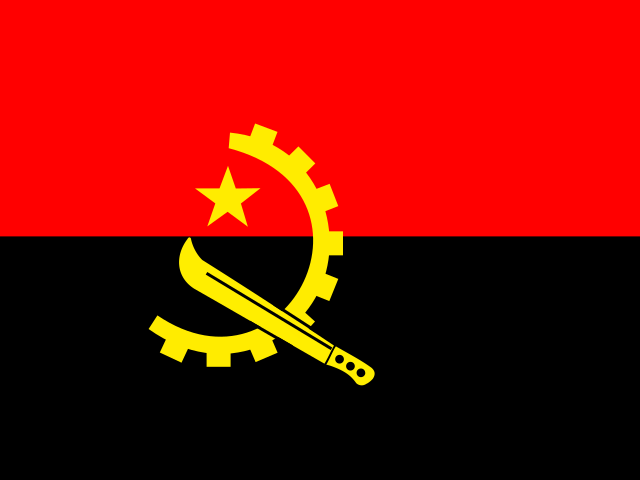 Angola
 Botswana
 Comoros
 Democratic Republic of the Congo
 Eswatini
 Lesotho
 Madagascar
 Malawi
 Mauritius
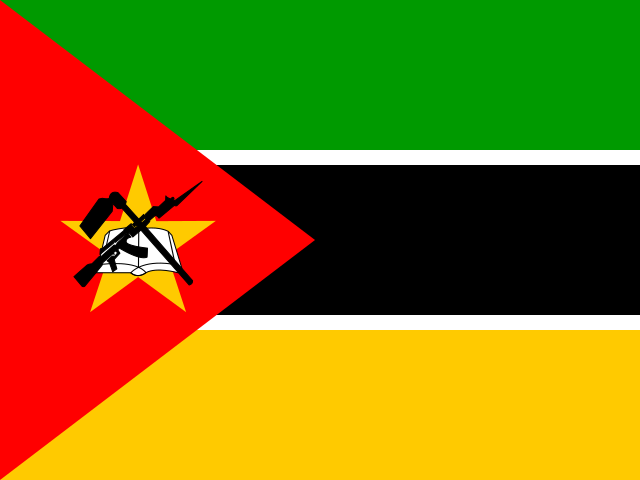 Mozambique
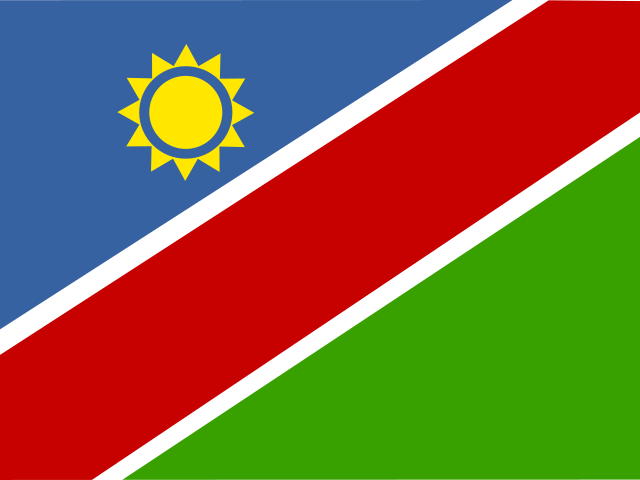 Namibia
 Seychelles
 South Africa
 Tanzania
 Zambia
 Zimbabwe
Earlier Report Observations
The market for fresh or chilled mushrooms and truffles in SADC demonstrated steady expansion from 2018 to 2023, with total volume increasing from 25 348 t to 39 347 t. This growth was underpinned by a consistent rise in domestic production, which climbed from 24 414 t to 39 533 t over the same period, reducing reliance on imports.
A key development in 2022 was a 78% surge in export prices for mushrooms within the region, which heightened the economic incentive for local producers to expand output. This price movement occurred alongside Zambia's established dominance in domestic production and consumption and South Africa's position as the leading supplier of dried mushrooms in SADC, highlighting the region's substantial but fragmented production base.
Market growth continued into 2023, reaching 39 347 t. Broader industry trends, such as a global consumer shift toward organic and unprocessed foods and ongoing advancements in packaging and cold chain logistics, are relevant factors that support the market's development by improving product shelf life and access.
Table of content
- 1. Disclaimer
- 2. Terms of use of the report
- 3. Product codes in the statistical classifications used in the report
-
4. Key Market Indicators and Trends
-
4.1. Key Market Indicators
-
4.1.1. In kind
- 4.1.1.1. Production, 2018-2023
- 4.1.1.2. Imports, 2018-2024
- 4.1.1.3. Exports, 2018-2024
- 4.1.1.4. Market size, 2018-2023
-
4.1.1. In kind
- 4.2. Market Trends and Factors
-
4.1. Key Market Indicators
-
5. Production
-
5.1. Production in SADC
- 5.1.1. Annual dynamics of production in SADC in kind, 2018-2023, t
-
5.2. Global production by Country, 2018-2023
- 5.2.1. Annual dynamics of production by macroregions in kind, 2018-2023, t
- 5.2.2. Dynamics of production structure by macroregions in kind, 2018-2023
- 5.2.3. Annual dynamics of production by country in kind, 2018-2023, t
- 5.2.4. Structure of production by countries in kind, 2018-2023
- 5.2.5. Dynamics of peoduction structure by countries in kind, 2018-2023
-
5.1. Production in SADC
-
6. Imports
-
6.1. Imports (Direct Data*)
- 6.1.1. Imports - Total information
-
6.1.2. Imports in kind, t
- 6.1.2.1. Annual dynamics of product's imports to Angola in kind, 2018-2024, t
- 6.1.2.2. Dynamics of product's imports in kind to Angola by countries, 2018-2024, t
- 6.1.2.3. Structure of product's imports in kind by countries, 2018-2024
-
6.1.3. Imports in value, K $ US
- 6.1.3.1. Annual dynamics of product's imports to Angola in value, 2018-2024, K $ US
- 6.1.3.2. Dynamics of product's imports in value to Angola by countries, 2018-2024, K $ US
- 6.1.3.3. Structure of product's imports in value by countries, 2018-2024
-
6.1.4. Average price of product's imports, $ US/kg
- 6.1.4.1. Annual dynamics of average price of product's imports to Angola, 2018-2024, $ US/kg
- 6.1.4.2. Dynamics of average price of product's imports to Angola by countries, 2018-2024, $ US/kg
-
6.2. Imports (Mirror Data)
- 6.2.1. Imports - Total information
-
6.2.2. Imports in kind, t
- 6.2.2.1. Annual dynamics of product's imports to Angola in kind, 2018-2024, t
- 6.2.2.2. Dynamics of product's imports in kind to Angola by countries, 2018-2024, t
- 6.2.2.3. Structure of product's imports in kind by countries, 2018-2024
-
6.2.3. Imports in value, K $ US
- 6.2.3.1. Annual dynamics of product's imports to Angola in value, 2018-2024, K $ US
- 6.2.3.2. Dynamics of product's imports in value to Angola by countries, 2018-2024, K $ US
- 6.2.3.3. Structure of product's imports in value by countries, 2018-2024
-
6.2.4. Average price of product's imports, $ US/kg
- 6.2.4.1. Annual dynamics of average price of product's imports to Angola, 2018-2024, $ US/kg
- 6.2.4.2. Dynamics of average price of product's imports to Angola by countries, 2018-2024, $ US/kg
-
6.1. Imports (Direct Data*)
-
7. Exports
-
7.1. Exports (Direct Data*)
- 7.1.1. Exports - Total information
-
7.1.2. Exports in kind, t
- 7.1.2.1. Annual dynamics of product's exports from Angola in kind, 2018-2024, t
- 7.1.2.2. Dynamics of product's exports in kind from Angola by countries, 2018-2024, t
- 7.1.2.3. Structure of product's exports in kind by countries, 2018-2024
-
7.1.3. Exports in value, K $ US
- 7.1.3.1. Annual dynamics of product's exports from Angola in value, 2018-2024, K $ US
- 7.1.3.2. Dynamics of product's exports in value from Angola by countries, 2018-2024, K $ US
- 7.1.3.3. Structure of product's exports in value by countries, 2018-2024
-
7.1.4. Average price of product's exports, $ US/kg
- 7.1.4.1. Annual dynamics of average price of product's exports from Angola, 2018-2024, $ US/kg
- 7.1.4.2. Dynamics of average price of product's exports from Angola by countries, 2018-2024, $ US/kg
-
7.2. Exports (Mirror Data)
- 7.2.1. Exports - Total information
-
7.2.2. Exports in kind, t
- 7.2.2.1. Annual dynamics of product's exports from Angola in kind, 2018-2024, t
- 7.2.2.2. Dynamics of product's exports in kind from Angola by countries, 2018-2024, t
- 7.2.2.3. Structure of product's exports in kind by countries, 2018-2024
-
7.2.3. Exports in value, K $ US
- 7.2.3.1. Annual dynamics of product's exports from Angola in value, 2018-2024, K $ US
- 7.2.3.2. Dynamics of product's exports in value from Angola by countries, 2018-2024, K $ US
- 7.2.3.3. Structure of product's exports in value by countries, 2018-2024
-
7.2.4. Average price of product's exports, $ US/kg
- 7.2.4.1. Annual dynamics of average price of product's exports from Angola, 2018-2024, $ US/kg
- 7.2.4.2. Dynamics of average price of product's exports from Angola by countries, 2018-2024, $ US/kg
-
7.1. Exports (Direct Data*)
-
8. Trade balance
-
8.1. Trade balance (Direct Data)
- 8.1.1. In kind, t
- 8.1.2. In value, K $ US
-
8.2. Trade balance (Mirror Data)
- 8.2.1. In kind, t
- 8.2.2. In value, K $ US
-
8.1. Trade balance (Direct Data)
-
9. Top buying and selling countries, 2018-2024
-
9.1. Direct Data
- 9.1.1. Import in Value by Countries-buyers
- 9.1.2. Export in Value by Countries-suppliers
-
9.2. Mirror Data
- 9.2.1. Import in Value by Countries-buyers
- 9.2.2. Export in Value by Countries-suppliers
-
9.1. Direct Data
Production mushrooms and truffles in SADC
In kind, 2017-2020, t
Top producers of mushrooms and truffles, 2017-2020
World map of production of mushrooms and truffles, 2017-2020
Production of mushrooms and truffles in SADC has increased for the third year in a row. In 2019, the region produced 27 860 tonnes, which grew by 7.8% to reach 30 042 tonnes in 2020. Looking at the period from 2017 to 2020, overall production rose by 32.7%, translating to an average annual growth rate of 9.9%.
Annual dynamics of production in SADC in kind, 2017-2020, t
| Parameter | 2018 | 2019 | 2020 | CAGR | |
|---|---|---|---|---|---|
| 1 | Change from last year | 7.9% | 14.1% | 7.8% | 9.9% |
In value, 2017-2020, M $ US
Following two years of growth, the value of mushroom and truffle production in SADC fell. In 2019, output was valued at 383.8 million US dollars, but this dropped sharply by 16.5% to 320.3 million US dollars in 2020. Over the 2017-2020 period, production value still increased by 24.8%, with an average annual rate of 7.7%. The peak value occurred in 2019, which also saw the largest annual increase of 32.0%.
Annual dynamics of production in SADC in value, 2017-2020, M $ US
| Parameter | 2018 | 2019 | 2020 | CAGR | |
|---|---|---|---|---|---|
| 1 | Change from last year | 13.3% | 32.0% | (16.5%) | 7.7% |
Exports mushrooms and truffles from SADC
Exports in kind, t
Exports of mushrooms and truffles from SADC have risen for the third consecutive year. In 2019, the region exported 532 tonnes, and this grew by 9.1% to 580 tonnes in 2020. From 2017 to 2020, exports increased by 40.8%, averaging an annual growth rate of 12.1%.
Annual dynamics of product's exports from SADC in kind, 2017-2020, t
| Parameter | 2018 | 2019 | 2020 | CAGR | |
|---|---|---|---|---|---|
| 1 | Change from last year | 6.0% | 21.9% | 9.1% | 12.1% |
Between 2017 and 2020, the export market for mushrooms and truffles in kind was highly diversified. The top three partners—the Netherlands (7.9% of exports), Italy (2.9%), and France (2.8%)—combined accounted for just 13.5% of total flows, with the remaining 86.5% going to numerous other countries.
Structure of product's exports in kind by countries, 2017-2020
World map of product's exports from SADC in kind, 2017-2020
Exports in value, K $ US
After two years of growth, the value of mushroom and truffle exports from SADC declined. In 2019, exports reached a peak of 7 325 thousand US dollars, but fell by 15.6% to 6 186 thousand US dollars in 2020. Over the 2017-2020 period, export value still increased by 32.4%, with an average annual rate of 9.8%. The largest annual increase was recorded in 2019 at 40.9%.
Annual dynamics of product's exports from SADC in value, 2017-2020, K $ US
| Parameter | 2018 | 2019 | 2020 | CAGR | |
|---|---|---|---|---|---|
| 1 | Change from last year | 11.3% | 40.9% | (15.6%) | 9.8% |
From 2017 to 2020, the value-based export structure for mushrooms and truffles remained fragmented. The Netherlands (14.2% of exports), Switzerland (8.4%), and Italy (6.5%) together made up only 29.1% of total flows, with no single country emerging as a dominant partner.
Structure of product's exports in value by countries, 2017-2020
World map of product's exports from SADC in value, 2017-2020
Imports mushrooms and truffles to SADC
Imports in kind, t
Imports of mushrooms and truffles into SADC declined in 2020. After reaching a high of 1 801 tonnes in 2019, imports fell by 35.6% to 1 160 tonnes in 2020. Over the 2017-2020 period, imports decreased by 28.9%, averaging an annual decline of 10.8%. The largest annual increase occurred in 2019 at 31.4%.
Annual dynamics of product's imports to SADC in kind, 2017-2020, t
| Parameter | 2018 | 2019 | 2020 | CAGR | |
|---|---|---|---|---|---|
| 1 | Change from last year | (16.1%) | 31.4% | (35.6%) | (10.8%) |
During 2017-2020, imports of mushrooms and truffles in kind were spread across a wide range of countries. China (7.4% of imports), the Netherlands (2.3%), and France (2.0%) together accounted for just 11.7% of total flows, indicating a highly diversified sourcing pattern.
Structure of product's imports in kind by countries, 2017-2020
World map of product's imports to SADC in kind, 2017-2020
Imports in value, K $ US
The value of mushroom and truffle imports into SADC has fallen for the third year in a row. In 2019, imports stood at 5 080 thousand US dollars, but dropped sharply by 36.8% to 3 208 thousand US dollars in 2020. From 2017 to 2020, import value decreased by 42.3%, with an average annual decline of 16.7%.
Annual dynamics of product's imports to SADC in value, 2017-2020, K $ US
| Parameter | 2018 | 2019 | 2020 | CAGR | |
|---|---|---|---|---|---|
| 1 | Change from last year | (6.0%) | (2.8%) | (36.8%) | (16.7%) |
Between 2017 and 2020, the import structure in value terms was highly varied. The Netherlands (6.3% of imports), France (5.8%), and China (3.3%) combined represented only 15.5% of total flows, while the remaining 84.5% came from a long list of smaller markets.
Structure of product's imports in value by countries, 2017-2020
World map of product's imports to SADC in value, 2017-2020
Related Reports

Mushrooms and truffles market in Japan
2026-03-27
Mushrooms and truffles market in Montenegro
2026-03-27
Mushrooms and truffles market in Vietnam
2026-03-27

2026-03-27
Dried shelled cow peas market in SADC
2026-03-27

2026-03-30

Lettuce and chicory market in SADC
2026-03-27
Why Choose Us?
Only Verified Data
No Hidden Costs or Separate Fees
Smarter Subscription Pricing
Contact Our Team
Submit your inquiry using the form below — our team will get back to you within 24 hours.