






"Latin America and the Caribbean" region includes following countries:
 Argentina
 Bolivia
 Brazil
 Chile
Chile Colombia
 Ecuador
 Falkland Islands (Malvinas)
 French Guiana
 Guyana
 Paraguay
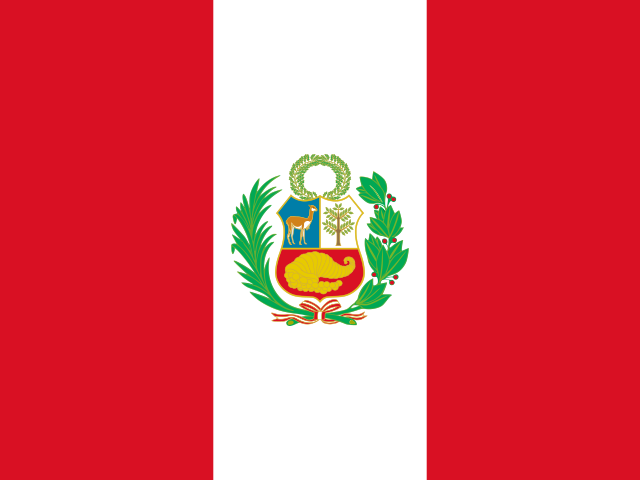 Peru
Peru Suriname
 Uruguay
 Venezuela
 Belize
 Costa Rica
 El Salvador
 Guatemala
 Honduras
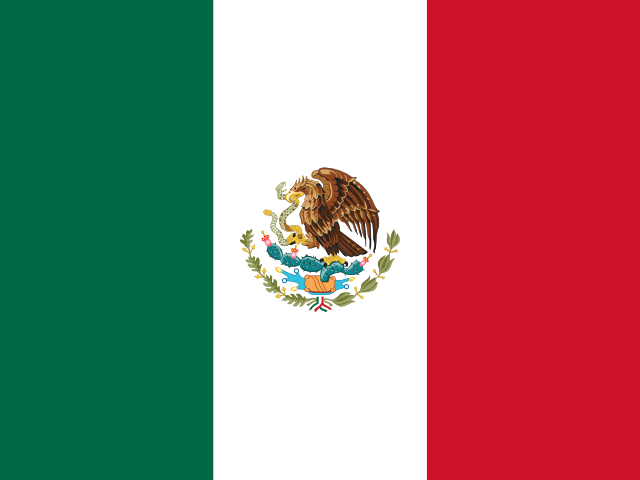 Mexico
 Nicaragua
 Panama
 Antigua and Barbuda
 the Bahamas
 Barbados
 British Virgin Islands
 Cayman Islands
 Cuba
Cuba Dominica
 Dominican Republic
 Grenada
 Guadeloupe
 Haiti
Haiti Jamaica
 Martinique
 Montserrat
 Curacao
 Aruba
Aruba Saint Maarten (Dutch part)
 Bonaire
 Puerto Rico
 Saint Kitts and Nevis
 Anguilla
 Saint Lucia
 Saint-Martin (French Part)
 Saint Vincent and the Grenadines
 Trinidad and Tobago
 Turks and Caicos Islands
 United States Virgin Islands
Earlier Report Observations
Between 2018 and 2023, the fresh melon market in Latin America and the Caribbean expanded in volume from 1.7 million tonnes to 2.2 million tonnes, while its value nearly doubled from $876 million to $1.5 billion. The initial growth period saw production facing challenges such as limited access to financing and a reliance on intermediaries, which producers aimed to counter through careful planting planning to avoid oversupply and price volatility. The market also benefited from a sustained global shift in consumer preference towards fresh and healthy foods.
A sharp acceleration in market size occurred in 2022 and 2023, driven by concrete developments in key producing countries. Mexico reported an 11.2% increase in national melon production, while Brazilian output also expanded. This supply growth was amplified by adverse weather in Spain, which reduced European production and increased global prices, thereby boosting demand for Latin American exports. Concurrently, producers in the region adopted new technologies, such as tools to measure fruit sweetness, to meet stringent quality standards for premium export markets like Japan and enhance overall competitiveness.
Table of content
- 1. Disclaimer
- 2. Terms of use of the report
- 3. Product codes in the statistical classifications used in the report
-
4. Key Market Indicators and Trends
-
4.1. Key Market Indicators
-
4.1.1. In kind
- 4.1.1.1. Production, 2018-2023
- 4.1.1.2. Imports, 2018-2024
- 4.1.1.3. Exports, 2018-2024
- 4.1.1.4. Market size, 2018-2023
-
4.1.2. In value
- 4.1.2.1. Production, 2018-2023
- 4.1.2.2. Imports, 2018-2024
- 4.1.2.3. Exports, 2018-2024
- 4.1.2.4. Market size, 2018-2023
-
4.1.1. In kind
- 4.2. Market Trends and Factors
-
4.1. Key Market Indicators
-
5. Production
-
5.1. Production in Latin America and the Caribbean
- 5.1.1. Annual dynamics of production in Latin America and the Caribbean in kind, 2018-2023, K t
-
5.2. Global production by Country, 2018-2023
- 5.2.1. Annual dynamics of production by macroregions in kind, 2018-2023, K t
- 5.2.2. Dynamics of production structure by macroregions in kind, 2018-2023
- 5.2.3. Annual dynamics of production by country in kind, 2018-2023, K t
- 5.2.4. Structure of production by countries in kind, 2018-2023
- 5.2.5. Dynamics of peoduction structure by countries in kind, 2018-2023
-
5.1. Production in Latin America and the Caribbean
-
6. Exports
-
6.1. Exports (Direct Data*)
- 6.1.1. Exports - Total information
-
6.1.2. Exports in kind, K t
- 6.1.2.1. Annual dynamics of product's exports from Argentina in kind, 2018-2024, K t
- 6.1.2.2. Dynamics of product's exports in kind from Argentina by countries, 2018-2024, K t
- 6.1.2.3. Structure of product's exports in kind by countries, 2018-2024
-
6.1.3. Exports in value, M $ US
- 6.1.3.1. Annual dynamics of product's exports from Argentina in value, 2018-2024, M $ US
- 6.1.3.2. Dynamics of product's exports in value from Argentina by countries, 2018-2024, M $ US
- 6.1.3.3. Structure of product's exports in value by countries, 2018-2024
-
6.1.4. Average price of product's exports, $ US/t
- 6.1.4.1. Annual dynamics of average price of product's exports from Argentina, 2018-2024, $ US/t
- 6.1.4.2. Dynamics of average price of product's exports from Argentina by countries, 2018-2024, $ US/t
-
6.2. Exports (Mirror Data)
- 6.2.1. Exports - Total information
-
6.2.2. Exports in kind, K t
- 6.2.2.1. Annual dynamics of product's exports from Argentina in kind, 2018-2024, K t
- 6.2.2.2. Dynamics of product's exports in kind from Argentina by countries, 2018-2024, K t
- 6.2.2.3. Structure of product's exports in kind by countries, 2018-2024
-
6.2.3. Exports in value, M $ US
- 6.2.3.1. Annual dynamics of product's exports from Argentina in value, 2018-2024, M $ US
- 6.2.3.2. Dynamics of product's exports in value from Argentina by countries, 2018-2024, M $ US
- 6.2.3.3. Structure of product's exports in value by countries, 2018-2024
-
6.2.4. Average price of product's exports, $ US/t
- 6.2.4.1. Annual dynamics of average price of product's exports from Argentina, 2018-2024, $ US/t
- 6.2.4.2. Dynamics of average price of product's exports from Argentina by countries, 2018-2024, $ US/t
-
6.1. Exports (Direct Data*)
-
7. Imports
-
7.1. Imports (Direct Data*)
- 7.1.1. Imports - Total information
-
7.1.2. Imports in kind, K t
- 7.1.2.1. Annual dynamics of product's imports to Argentina in kind, 2018-2024, K t
- 7.1.2.2. Dynamics of product's imports in kind to Argentina by countries, 2018-2024, K t
- 7.1.2.3. Structure of product's imports in kind by countries, 2018-2024
-
7.1.3. Imports in value, M $ US
- 7.1.3.1. Annual dynamics of product's imports to Argentina in value, 2018-2024, M $ US
- 7.1.3.2. Dynamics of product's imports in value to Argentina by countries, 2018-2024, M $ US
- 7.1.3.3. Structure of product's imports in value by countries, 2018-2024
-
7.1.4. Average price of product's imports, $ US/t
- 7.1.4.1. Annual dynamics of average price of product's imports to Argentina, 2018-2024, $ US/t
- 7.1.4.2. Dynamics of average price of product's imports to Argentina by countries, 2018-2024, $ US/t
-
7.2. Imports (Mirror Data)
- 7.2.1. Imports - Total information
-
7.2.2. Imports in kind, K t
- 7.2.2.1. Annual dynamics of product's imports to Argentina in kind, 2018-2024, K t
- 7.2.2.2. Dynamics of product's imports in kind to Argentina by countries, 2018-2024, K t
- 7.2.2.3. Structure of product's imports in kind by countries, 2018-2024
-
7.2.3. Imports in value, M $ US
- 7.2.3.1. Annual dynamics of product's imports to Argentina in value, 2018-2024, M $ US
- 7.2.3.2. Dynamics of product's imports in value to Argentina by countries, 2018-2024, M $ US
- 7.2.3.3. Structure of product's imports in value by countries, 2018-2024
-
7.2.4. Average price of product's imports, $ US/t
- 7.2.4.1. Annual dynamics of average price of product's imports to Argentina, 2018-2024, $ US/t
- 7.2.4.2. Dynamics of average price of product's imports to Argentina by countries, 2018-2024, $ US/t
-
7.1. Imports (Direct Data*)
-
8. Trade balance
-
8.1. Trade balance (Direct Data)
- 8.1.1. In kind, K t
- 8.1.2. In value, M $ US
-
8.2. Trade balance (Mirror Data)
- 8.2.1. In kind, K t
- 8.2.2. In value, M $ US
-
8.1. Trade balance (Direct Data)
-
9. Top buying and selling countries, 2018-2024
-
9.1. Direct Data
- 9.1.1. Import in Value by Countries-buyers
- 9.1.2. Export in Value by Countries-suppliers
-
9.2. Mirror Data
- 9.2.1. Import in Value by Countries-buyers
- 9.2.2. Export in Value by Countries-suppliers
-
9.1. Direct Data
Production melons in Latin America and the Caribbean
In kind, 2017-2020, K t
Top producers of melons, 2017-2020
World map of production of melons, 2017-2020
In Latin America and the Caribbean, melon production reached 2 819 thousand tonnes in 2020, showing little change from the 2 820 thousand tonnes recorded in 2019. Over the 2017-2020 period, production grew by 7.6%, with an average annual growth rate of 2.5%. The highest production level was achieved in 2019, which also saw the largest annual increase of 6.0%.
Annual dynamics of production in Latin America and the Caribbean in kind, 2017-2020, K t
| Parameter | 2018 | 2019 | 2020 | CAGR | |
|---|---|---|---|---|---|
| 1 | Change from last year | 1.5% | 6.0% | (0.0%) | 2.5% |
In value, 2017-2020, M $ US
Following two consecutive years of growth, melon production value in Latin America and the Caribbean declined in 2020. The output was valued at 1 427 million US dollars, representing a 3.7% decrease from 2019. Between 2017 and 2020, production value increased by 5.6%, with an average annual growth rate of 1.8%. The peak value of 1 483 million US dollars was recorded in 2019, which also experienced the largest annual increase of 9.5%.
Annual dynamics of production in Latin America and the Caribbean in value, 2017-2020, M $ US
| Parameter | 2018 | 2019 | 2020 | CAGR | |
|---|---|---|---|---|---|
| 1 | Change from last year | 0.1% | 9.5% | (3.7%) | 1.8% |
Exports melons from Latin America and the Caribbean
Exports in kind, K t
In 2020, melon exports from Latin America and the Caribbean amounted to 922 thousand tonnes, marking a gradual decline of 7.1% compared to the previous year. Over the 2017-2020 period, exports decreased by 9.9%, with an average annual decline of 3.4%. The largest annual increase occurred in 2019, at 4.0%.
Annual dynamics of product's exports from Latin America and the Caribbean in kind, 2017-2020, K t
| Parameter | 2018 | 2019 | 2020 | CAGR | |
|---|---|---|---|---|---|
| 1 | Change from last year | (6.7%) | 4.0% | (7.1%) | (3.4%) |
Between 2017 and 2020, three key markets—the United States, the Netherlands, and the United Kingdom—collectively accounted for 82.5% of total melon exports in volume from Latin America and the Caribbean.
Structure of product's exports in kind by countries, 2017-2020
World map of product's exports from Latin America and the Caribbean in kind, 2017-2020
Exports in value, M $ US
In 2020, melon shipments from Latin America and the Caribbean totaled 467.0 million US dollars, down 10.5% year-on-year. From 2017 to 2020, export value decreased by 11.5%, equivalent to an average annual decline of 4.0%. The largest annual increase was recorded in 2019, at 7.4%.
Annual dynamics of product's exports from Latin America and the Caribbean in value, 2017-2020, M $ US
| Parameter | 2018 | 2019 | 2020 | CAGR | |
|---|---|---|---|---|---|
| 1 | Change from last year | (8.0%) | 7.4% | (10.5%) | (4.0%) |
During 2017-2020, the United States (53.9% of export value), the Netherlands (17.7%), and the United Kingdom (10.5%) remained the primary buyers of melons from Latin America and the Caribbean, together constituting 82.0% of total export value.
Structure of product's exports in value by countries, 2017-2020
World map of product's exports from Latin America and the Caribbean in value, 2017-2020
Imports melons to Latin America and the Caribbean
Imports in kind, K t
Melon imports into Latin America and the Caribbean showed noticeable fluctuations during the period. In 2020, imports stood at 12 thousand tonnes, a 29.2% decrease from the previous year. The lowest volume was recorded in 2018 at 6 thousand tonnes, which also saw the largest annual decline of 70.0%. In contrast, 2019 experienced the largest annual increase of 178.5%. From 2017 to 2018, imports varied significantly, with a 3.3-fold difference between the peak and trough.
Annual dynamics of product's imports to Latin America and the Caribbean in kind, 2017-2020, K t
| Parameter | 2018 | 2019 | 2020 | CAGR | |
|---|---|---|---|---|---|
| 1 | Change from last year | (70.0%) | 178.5% | (29.2%) | (16.0%) |
From 2017 to 2020, the United States was the leading source for melon imports into Latin America and the Caribbean, accounting for 29.4% of total import volume.
Structure of product's imports in kind by countries, 2017-2020
World map of product's imports to Latin America and the Caribbean in kind, 2017-2020
Imports in value, M $ US
Melon import values into Latin America and the Caribbean displayed volatility over the observed period. In 2020, imports amounted to 13.2 million US dollars, a 26.1% decrease from the prior year. The lowest value was recorded in 2018 at 8.4 million US dollars, which also saw the largest annual decline of 61.3%. Conversely, 2019 experienced the largest annual increase of 112.7%. Between 2017 and 2018, values shifted by a factor of 2.6, reaching a maximum in 2017 and a minimum in 2018.
Annual dynamics of product's imports to Latin America and the Caribbean in value, 2017-2020, M $ US
| Parameter | 2018 | 2019 | 2020 | CAGR | |
|---|---|---|---|---|---|
| 1 | Change from last year | (61.3%) | 112.7% | (26.1%) | (15.3%) |
Between 2017 and 2020, the United States and the Netherlands were the main suppliers of melons to Latin America and the Caribbean, together representing 74.5% of total import value.
Structure of product's imports in value by countries, 2017-2020
World map of product's imports to Latin America and the Caribbean in value, 2017-2020
Related Reports

2026-03-28
2026-03-28
2026-03-28
2026-03-28




Why Choose Us?
Only Verified Data
No Hidden Costs or Separate Fees
Smarter Subscription Pricing
Contact Our Team
Submit your inquiry using the form below — our team will get back to you within 24 hours.