






"MENA" region includes following countries:
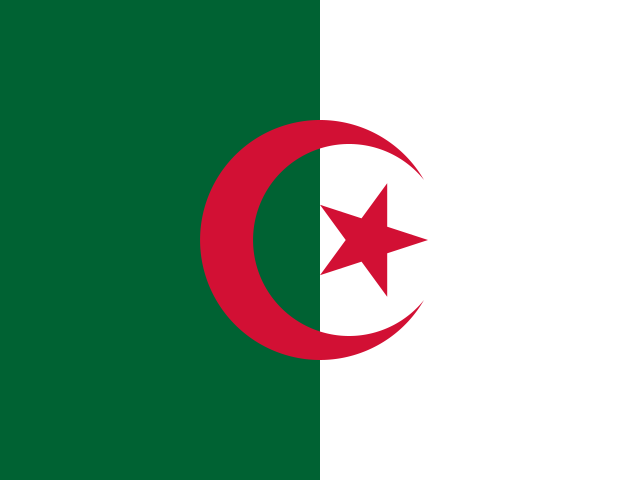 Algeria
 Bahrain
 Djibouti
 Egypt
Egypt Israel
 Jordan
 Iran
Iran Iraq
Iraq Qatar
Qatar Kuwait
 Lebanon
 Libya
Libya Malta
Malta Morocco
 the United Arab Emirates
 Oman
Oman Saudi Arabia
 Syria
Syria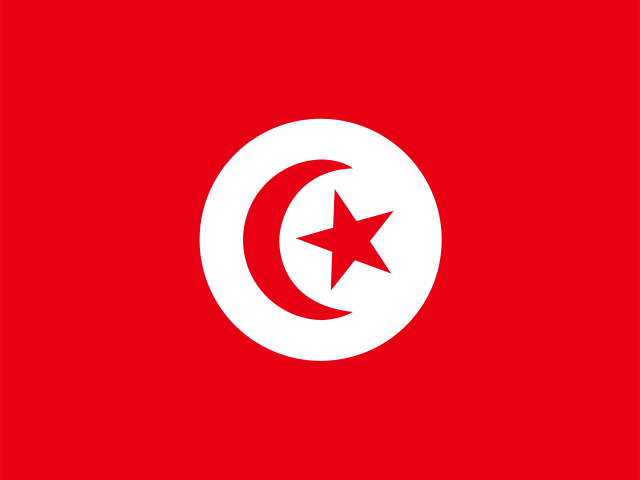 Tunisia
 Yemen
YemenEarlier Report Observations
The malt market in the MENA region contracted from 182 thousand tons in 2018 to 156 thousand tons in 2020. This decline was primarily driven by the COVID-19 pandemic in 2020, which imposed strict measures and disrupted supply chains across the agricultural sector. Prior to the pandemic, a regulatory change in Saudi Arabia allowed the private sector to import feed barley for trade, increasing trading activity by 44% in 2019, though overall market volume decreased.
Market volume rebounded strongly to 191 thousand tons in 2021 and continued growing to reach 216 thousand tons in 2023. The initial recovery in 2021 was supported by improved agricultural production in North Africa. In 2022, the Egyptian government invested approximately $2.73 billion in integrated agricultural development programs to boost local output. By 2023, further expansion was fueled by climate change and rising demand for barley from fermentation and food industries, alongside growing e-commerce and increased tourism in Saudi Arabia and the UAE, which boosted demand for food services and related agricultural products.
Table of content
- 1. Disclaimer
- 2. Terms of use of the report
- 3. Product codes in the statistical classifications used in the report
-
4. Key Market Indicators and Trends
-
4.1. Key Market Indicators
-
4.1.1. In kind
- 4.1.1.1. Production, 2018-2023
- 4.1.1.2. Imports, 2018-2024
- 4.1.1.3. Exports, 2018-2024
- 4.1.1.4. Market size, 2018-2023
-
4.1.1. In kind
- 4.2. Market Trends and Factors
-
4.1. Key Market Indicators
-
5. Production
-
5.1. Production in MENA
- 5.1.1. Annual dynamics of production in MENA in kind, 2018-2023, K t
-
5.2. Global production by Country, 2018-2023
- 5.2.1. Annual dynamics of production by macroregions in kind, 2018-2023, K t
- 5.2.2. Dynamics of production structure by macroregions in kind, 2018-2023
- 5.2.3. Annual dynamics of production by country in kind, 2018-2023, K t
- 5.2.4. Structure of production by countries in kind, 2018-2023
- 5.2.5. Dynamics of peoduction structure by countries in kind, 2018-2023
-
5.1. Production in MENA
-
6. Imports
-
6.1. Imports (Direct Data*)
- 6.1.1. Imports - Total information
-
6.1.2. Imports in kind, t
- 6.1.2.1. Annual dynamics of product's imports to Algeria in kind, 2018-2024, t
- 6.1.2.2. Dynamics of product's imports in kind to Algeria by countries, 2018-2024, t
- 6.1.2.3. Structure of product's imports in kind by countries, 2018-2024
-
6.1.3. Imports in value, K $ US
- 6.1.3.1. Annual dynamics of product's imports to Algeria in value, 2018-2024, K $ US
- 6.1.3.2. Dynamics of product's imports in value to Algeria by countries, 2018-2024, K $ US
- 6.1.3.3. Structure of product's imports in value by countries, 2018-2024
-
6.1.4. Average price of product's imports, $ US/t
- 6.1.4.1. Annual dynamics of average price of product's imports to Algeria, 2018-2024, $ US/t
- 6.1.4.2. Dynamics of average price of product's imports to Algeria by countries, 2018-2024, $ US/t
-
6.2. Imports (Mirror Data)
- 6.2.1. Imports - Total information
-
6.2.2. Imports in kind, t
- 6.2.2.1. Annual dynamics of product's imports to Algeria in kind, 2018-2024, t
- 6.2.2.2. Dynamics of product's imports in kind to Algeria by countries, 2018-2024, t
- 6.2.2.3. Structure of product's imports in kind by countries, 2018-2024
-
6.2.3. Imports in value, K $ US
- 6.2.3.1. Annual dynamics of product's imports to Algeria in value, 2018-2024, K $ US
- 6.2.3.2. Dynamics of product's imports in value to Algeria by countries, 2018-2024, K $ US
- 6.2.3.3. Structure of product's imports in value by countries, 2018-2024
-
6.2.4. Average price of product's imports, $ US/t
- 6.2.4.1. Annual dynamics of average price of product's imports to Algeria, 2018-2024, $ US/t
- 6.2.4.2. Dynamics of average price of product's imports to Algeria by countries, 2018-2024, $ US/t
-
6.1. Imports (Direct Data*)
-
7. Exports
-
7.1. Exports (Direct Data*)
- 7.1.1. Exports - Total information
-
7.1.2. Exports in kind, t
- 7.1.2.1. Annual dynamics of product's exports from Algeria in kind, 2018-2024, t
- 7.1.2.2. Dynamics of product's exports in kind from Algeria by countries, 2018-2024, t
- 7.1.2.3. Structure of product's exports in kind by countries, 2018-2024
-
7.1.3. Exports in value, K $ US
- 7.1.3.1. Annual dynamics of product's exports from Algeria in value, 2018-2024, K $ US
- 7.1.3.2. Dynamics of product's exports in value from Algeria by countries, 2018-2024, K $ US
- 7.1.3.3. Structure of product's exports in value by countries, 2018-2024
-
7.1.4. Average price of product's exports, $ US/t
- 7.1.4.1. Annual dynamics of average price of product's exports from Algeria, 2018-2024, $ US/t
- 7.1.4.2. Dynamics of average price of product's exports from Algeria by countries, 2018-2024, $ US/t
-
7.2. Exports (Mirror Data)
- 7.2.1. Exports - Total information
-
7.2.2. Exports in kind, t
- 7.2.2.1. Annual dynamics of product's exports from Algeria in kind, 2018-2024, t
- 7.2.2.2. Dynamics of product's exports in kind from Algeria by countries, 2018-2024, t
- 7.2.2.3. Structure of product's exports in kind by countries, 2018-2024
-
7.2.3. Exports in value, K $ US
- 7.2.3.1. Annual dynamics of product's exports from Algeria in value, 2018-2024, K $ US
- 7.2.3.2. Dynamics of product's exports in value from Algeria by countries, 2018-2024, K $ US
- 7.2.3.3. Structure of product's exports in value by countries, 2018-2024
-
7.2.4. Average price of product's exports, $ US/t
- 7.2.4.1. Annual dynamics of average price of product's exports from Algeria, 2018-2024, $ US/t
- 7.2.4.2. Dynamics of average price of product's exports from Algeria by countries, 2018-2024, $ US/t
-
7.1. Exports (Direct Data*)
-
8. Trade balance
-
8.1. Trade balance (Direct Data)
- 8.1.1. In kind, t
- 8.1.2. In value, K $ US
-
8.2. Trade balance (Mirror Data)
- 8.2.1. In kind, t
- 8.2.2. In value, K $ US
-
8.1. Trade balance (Direct Data)
-
9. Top buying and selling countries, 2018-2024
-
9.1. Direct Data
- 9.1.1. Import in Value by Countries-buyers
- 9.1.2. Export in Value by Countries-suppliers
-
9.2. Mirror Data
- 9.2.1. Import in Value by Countries-buyers
- 9.2.2. Export in Value by Countries-suppliers
-
9.1. Direct Data
Production malt in MENA
In kind, 2017-2020, K t
Top producers of malt, 2017-2020
World map of production of malt, 2017-2020
Malt production in the MENA region has declined for the third year in a row. In 2020, production reached 93.9 K t, showing little change from the previous year. Looking at the period from 2017 to 2020, production fell by 19.4%, which translates to an average annual decrease of 6.9%.
Annual dynamics of production in MENA in kind, 2017-2020, K t
| Parameter | 2018 | 2019 | 2020 | CAGR | |
|---|---|---|---|---|---|
| 1 | Change from last year | (18.0%) | (1.4%) | (0.3%) | (6.9%) |
Exports malt from MENA
Exports in kind, t
The market experienced volatility during the observed period. From 2017 to 2018, exports fluctuated significantly, with a peak-to-trough amplitude of 3.2 times. In 2018, exports hit their lowest point at 1 477 t, marking a 69.0% decline. By 2020, MENA's malt exports had recovered to 4 174 t, representing an 89.6% year-on-year increase.
Annual dynamics of product's exports from MENA in kind, 2017-2020, t
| Parameter | 2018 | 2019 | 2020 | CAGR | |
|---|---|---|---|---|---|
| 1 | Change from last year | (69.0%) | 49.0% | 89.6% | (4.3%) |
Between 2017 and 2020, the main buyers of malt from MENA were Burundi, Rwanda, and Ethiopia. Burundi accounted for 10.3% of exports in kind, Rwanda for 7.8%, and Ethiopia for 6.2%. Together, these three countries made up 24.3% of total exports in kind.
Structure of product's exports in kind by countries, 2017-2020
World map of product's exports from MENA in kind, 2017-2020
Exports in value, K $ US
The market showed an unstable trend over this timeframe. Exports peaked in 2017 and reached their lowest point in 2018, with a 4.6-fold difference between these years. In 2018, exports dropped to 1 341 K $ US, a 78.5% decline. However, they rebounded in 2019 with a 60.5% increase, and by 2020, malt exports in MENA amounted to 3 157 K $ US, up 46.6% year-on-year.
Annual dynamics of product's exports from MENA in value, 2017-2020, K $ US
| Parameter | 2018 | 2019 | 2020 | CAGR | |
|---|---|---|---|---|---|
| 1 | Change from last year | (78.5%) | 60.5% | 46.6% | (20.3%) |
From 2017 to 2020, exports in value terms were relatively evenly distributed. Burundi accounted for 11.2% of exports in value terms, Rwanda for 8.8%, and Ethiopia for 6.9%. Combined, these three countries represented 26.9% of total flows.
Structure of product's exports in value by countries, 2017-2020
World map of product's exports from MENA in value, 2017-2020
Imports malt to MENA
Imports in kind, t
Malt imports into MENA declined for the second consecutive year. In 2018, imports peaked at 87 992 t, with a 5.0% increase. By 2020, imports had fallen to 66 622 t, a sharp 18.9% drop from the previous year. Over the period from 2017 to 2020, imports decreased by 20.5%, averaging a 7.4% annual decline.
Annual dynamics of product's imports to MENA in kind, 2017-2020, t
| Parameter | 2018 | 2019 | 2020 | CAGR | |
|---|---|---|---|---|---|
| 1 | Change from last year | 5.0% | (6.7%) | (18.9%) | (7.4%) |
Between 2017 and 2020, the primary suppliers of malt to MENA were Belgium, France, and the Netherlands. Belgium contributed 20.4% of imports in kind, France 19.5%, and the Netherlands 12.6%. Together, these three countries accounted for 52.6% of total imports in kind.
Structure of product's imports in kind by countries, 2017-2020
World map of product's imports to MENA in kind, 2017-2020
Imports in value, K $ US
Malt deliveries to MENA declined for the second year in a row. In 2018, imports reached their highest value at 45 327 K $ US, with a 7.0% increase. By 2020, imports had dropped to 3 157 K $ US, marking a strong 13.8% decrease from the previous year. Between 2017 and 2020, imports fell by 9.5%, equivalent to an annualized rate of 3.3%.
Annual dynamics of product's imports to MENA in value, 2017-2020, K $ US
| Parameter | 2018 | 2019 | 2020 | CAGR | |
|---|---|---|---|---|---|
| 1 | Change from last year | 7.0% | (1.8%) | (13.8%) | (3.3%) |
Throughout 2017 to 2020, Belgium, France, and the Netherlands were the core suppliers in value terms. Belgium accounted for 19.9% of imports in value terms, France for 18.8%, and the Netherlands for 12.2%. Collectively, these three countries made up 50.8% of total flows.
Structure of product's imports in value by countries, 2017-2020
World map of product's imports to MENA in value, 2017-2020
Related Reports

2026-03-28
2026-03-28
2026-03-28
2026-03-28


2026-03-28

2026-03-28
In-depth market research on this product
Global Malt Market 2021–2031: Size, Share, Trends and Forecast
Global market report: size, trends and forecast to 2031 · 186 pages
Why Choose Us?
Only Verified Data
No Hidden Costs or Separate Fees
Smarter Subscription Pricing
Contact Our Team
Submit your inquiry using the form below — our team will get back to you within 24 hours.