






"Northern Africa" region includes following countries:
 Algeria
 Libya
Libya Morocco
 Sudan
Sudan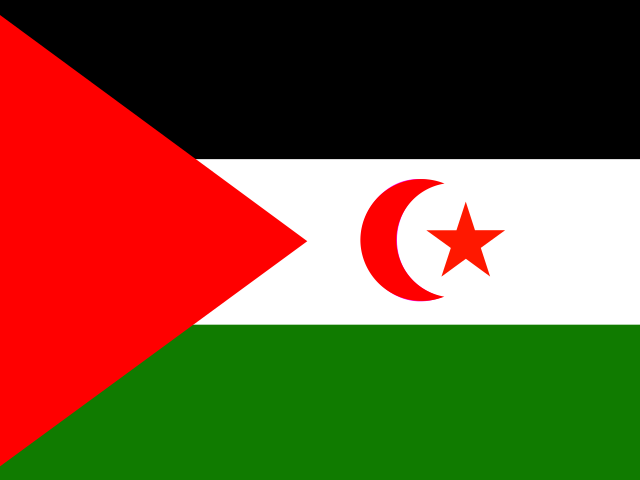 Western Sahara
 Tunisia
 Egypt
EgyptEarlier Report Observations
The market for linseed oil and its fractions in Northern Africa experienced a multi-year contraction from 9 722 t in 2018 to a low of 6 965 t in 2022, driven by consistent declines in both domestic production and import volumes. This downward trend reversed in 2023, with the total market volume recovering to 8 356 t, supported by a significant rebound in production to 7 832 t.
By 2024, import volumes rose to 600 t, aligning with broader trends of increasing health awareness and a preference for plant-based diets, which elevated global demand for flaxseed products. The market's evolution was further shaped by the growing availability of organic and local linseed oil through expanded e-commerce distribution channels in the region.
Table of content
- 1. Disclaimer
- 2. Terms of use of the report
- 3. Product codes in the statistical classifications used in the report
-
4. Key Market Indicators and Trends
-
4.1. Key Market Indicators
-
4.1.1. In kind
- 4.1.1.1. Production, 2018-2023
- 4.1.1.2. Imports, 2018-2024
- 4.1.1.3. Exports, 2018-2024
- 4.1.1.4. Market size, 2018-2023
-
4.1.1. In kind
- 4.2. Market Trends and Factors
-
4.1. Key Market Indicators
-
5. Production
-
5.1. Production in Northern Africa
- 5.1.1. Annual dynamics of production in Northern Africa in kind, 2018-2023, t
-
5.2. Global production by Country, 2018-2023
- 5.2.1. Annual dynamics of production by macroregions in kind, 2018-2023, t
- 5.2.2. Dynamics of production structure by macroregions in kind, 2018-2023
- 5.2.3. Annual dynamics of production by country in kind, 2018-2023, t
- 5.2.4. Structure of production by countries in kind, 2018-2023
- 5.2.5. Dynamics of peoduction structure by countries in kind, 2018-2023
-
5.1. Production in Northern Africa
-
6. Imports
-
6.1. Imports (Direct Data*)
- 6.1.1. Imports - Total information
-
6.1.2. Imports in kind, t
- 6.1.2.1. Annual dynamics of product's imports to Algeria in kind, 2018-2024, t
- 6.1.2.2. Dynamics of product's imports in kind to Algeria by countries, 2018-2024, t
- 6.1.2.3. Structure of product's imports in kind by countries, 2018-2024
-
6.1.3. Imports in value, K $ US
- 6.1.3.1. Annual dynamics of product's imports to Algeria in value, 2018-2024, K $ US
- 6.1.3.2. Dynamics of product's imports in value to Algeria by countries, 2018-2024, K $ US
- 6.1.3.3. Structure of product's imports in value by countries, 2018-2024
-
6.1.4. Average price of product's imports, $ US/t
- 6.1.4.1. Annual dynamics of average price of product's imports to Algeria, 2018-2024, $ US/t
- 6.1.4.2. Dynamics of average price of product's imports to Algeria by countries, 2018-2024, $ US/t
-
6.2. Imports (Mirror Data)
- 6.2.1. Imports - Total information
-
6.2.2. Imports in kind, t
- 6.2.2.1. Annual dynamics of product's imports to Algeria in kind, 2018-2024, t
- 6.2.2.2. Dynamics of product's imports in kind to Algeria by countries, 2018-2024, t
- 6.2.2.3. Structure of product's imports in kind by countries, 2018-2024
-
6.2.3. Imports in value, K $ US
- 6.2.3.1. Annual dynamics of product's imports to Algeria in value, 2018-2024, K $ US
- 6.2.3.2. Dynamics of product's imports in value to Algeria by countries, 2018-2024, K $ US
- 6.2.3.3. Structure of product's imports in value by countries, 2018-2024
-
6.2.4. Average price of product's imports, $ US/t
- 6.2.4.1. Annual dynamics of average price of product's imports to Algeria, 2018-2024, $ US/t
- 6.2.4.2. Dynamics of average price of product's imports to Algeria by countries, 2018-2024, $ US/t
-
6.1. Imports (Direct Data*)
-
7. Exports
-
7.1. Exports (Direct Data*)
- 7.1.1. Exports - Total information
-
7.1.2. Exports in kind, t
- 7.1.2.1. Annual dynamics of product's exports from Algeria in kind, 2018-2024, t
- 7.1.2.2. Dynamics of product's exports in kind from Algeria by countries, 2018-2024, t
- 7.1.2.3. Structure of product's exports in kind by countries, 2018-2024
-
7.1.3. Exports in value, K $ US
- 7.1.3.1. Annual dynamics of product's exports from Algeria in value, 2018-2024, K $ US
- 7.1.3.2. Dynamics of product's exports in value from Algeria by countries, 2018-2024, K $ US
- 7.1.3.3. Structure of product's exports in value by countries, 2018-2024
-
7.1.4. Average price of product's exports, $ US/t
- 7.1.4.1. Annual dynamics of average price of product's exports from Algeria, 2018-2024, $ US/t
- 7.1.4.2. Dynamics of average price of product's exports from Algeria by countries, 2018-2024, $ US/t
-
7.2. Exports (Mirror Data)
- 7.2.1. Exports - Total information
-
7.2.2. Exports in kind, t
- 7.2.2.1. Annual dynamics of product's exports from Algeria in kind, 2018-2024, t
- 7.2.2.2. Dynamics of product's exports in kind from Algeria by countries, 2018-2024, t
- 7.2.2.3. Structure of product's exports in kind by countries, 2018-2024
-
7.2.3. Exports in value, K $ US
- 7.2.3.1. Annual dynamics of product's exports from Algeria in value, 2018-2024, K $ US
- 7.2.3.2. Dynamics of product's exports in value from Algeria by countries, 2018-2024, K $ US
- 7.2.3.3. Structure of product's exports in value by countries, 2018-2024
-
7.2.4. Average price of product's exports, $ US/t
- 7.2.4.1. Annual dynamics of average price of product's exports from Algeria, 2018-2024, $ US/t
- 7.2.4.2. Dynamics of average price of product's exports from Algeria by countries, 2018-2024, $ US/t
-
7.1. Exports (Direct Data*)
-
8. Trade balance
-
8.1. Trade balance (Direct Data)
- 8.1.1. In kind, t
- 8.1.2. In value, K $ US
-
8.2. Trade balance (Mirror Data)
- 8.2.1. In kind, t
- 8.2.2. In value, K $ US
-
8.1. Trade balance (Direct Data)
-
9. Top buying and selling countries, 2018-2024
-
9.1. Direct Data
- 9.1.1. Import in Value by Countries-buyers
- 9.1.2. Export in Value by Countries-suppliers
-
9.2. Mirror Data
- 9.2.1. Import in Value by Countries-buyers
- 9.2.2. Export in Value by Countries-suppliers
-
9.1. Direct Data
Production linseed oil and fractions in Northern Africa
In kind, 2017-2020, t
Top producers of linseed oil and fractions, 2017-2020
World map of production of linseed oil and fractions, 2017-2020
Linseed oil and fractions production in Northern Africa has declined for the second year in a row. In 2020, production reached 6 884 tonnes, marking a 1.6% decrease compared to the previous year. Looking at the period from 2017 to 2020, overall production grew by 3.9%, which translates to an average annual increase of 1.3%. The highest production level was recorded in 2018 at 8 672 tonnes, when output surged by 30.9%. However, the following year saw the sharpest decline, with production dropping by 19.3% in 2019.
Annual dynamics of production in Northern Africa in kind, 2017-2020, t
| Parameter | 2018 | 2019 | 2020 | CAGR | |
|---|---|---|---|---|---|
| 1 | Change from last year | 30.9% | (19.3%) | (1.6%) | 1.3% |
In value, 2017-2020, K $ US
In 2020, the value of linseed oil and fractions production in Northern Africa stood at 9 251 thousand US dollars, representing a significant year-over-year increase of 25.3%. The lowest value was recorded in 2019 at 7 384 thousand US dollars, which marked a substantial decline of 42.5% from the previous year. Conversely, the peak value occurred in 2018 at 12 845 thousand US dollars, reflecting a strong increase of 38.2%.
Annual dynamics of production in Northern Africa in value, 2017-2020, K $ US
| Parameter | 2018 | 2019 | 2020 | CAGR | |
|---|---|---|---|---|---|
| 1 | Change from last year | 38.2% | (42.5%) | 25.3% | (0.2%) |
Exports linseed oil and fractions from Northern Africa
Exports in kind, t
The data shows irregular fluctuations, pointing to a volatile market environment. Exports varied significantly, with the lowest point in 2017 and the highest in 2019, resulting in a 2.4-fold difference between these years. In 2020, Northern Africa exported 20 tonnes of linseed oil and fractions, which represents a 44.5% decrease compared to the previous year. The maximum export volume was recorded in 2019 at 37 tonnes, when exports surged by 134.5%.
Annual dynamics of product's exports from Northern Africa in kind, 2017-2020, t
| Parameter | 2018 | 2019 | 2020 | CAGR | |
|---|---|---|---|---|---|
| 1 | Change from last year | 1.2% | 134.5% | (44.5%) | 9.7% |
From 2017 to 2020, the export partner landscape for linseed oil and fractions in kind was quite diverse. The United States accounted for 29.1% of exports, Mauritania for 10.5%, and Nigeria for 8.0%. Together, these three countries represented only 47.5% of total export flows, while the remaining 52.5% was distributed among numerous other countries, indicating a broad spread of trade partners.
Structure of product's exports in kind by countries, 2017-2020
World map of product's exports from Northern Africa in kind, 2017-2020
Exports in value, K $ US
After two consecutive years of growth, exports of linseed oil and fractions from Northern Africa declined. In 2020, export value amounted to 27 thousand US dollars, reflecting a sharp decrease of 29.3% compared to the previous year. Over the period from 2017 to 2020, exports increased by 26.3% overall, with a compound annual growth rate of 8.1%. The highest export value was recorded in 2019 at 39 thousand US dollars, when exports rose by 67.1%.
Annual dynamics of product's exports from Northern Africa in value, 2017-2020, K $ US
| Parameter | 2018 | 2019 | 2020 | CAGR | |
|---|---|---|---|---|---|
| 1 | Change from last year | 6.9% | 67.1% | (29.3%) | 8.1% |
During 2017–2020, exports of linseed oil and fractions from Northern Africa in value terms were relatively evenly distributed. The United States accounted for 23.2% of export value, Mauritania for 13.8%, and France for 7.9%. Combined, these three countries represented only 44.9% of total export flows, highlighting a diversified trade structure.
Structure of product's exports in value by countries, 2017-2020
World map of product's exports from Northern Africa in value, 2017-2020
Imports linseed oil and fractions to Northern Africa
Imports in kind, t
Imports of linseed oil and fractions into Northern Africa have declined for the third consecutive year. In 2020, imports reached 622 tonnes, down by 24.7% year-over-year. Between 2017 and 2020, imports decreased by 96.6% overall, equating to an average annual decline of 67.6%.
Annual dynamics of product's imports to Northern Africa in kind, 2017-2020, t
| Parameter | 2018 | 2019 | 2020 | CAGR | |
|---|---|---|---|---|---|
| 1 | Change from last year | (94.2%) | (22.5%) | (24.7%) | (67.6%) |
Over the period 2017–2020, imports of linseed oil and fractions in kind to Northern Africa were characterized by a broad spread across markets. The United Arab Emirates accounted for 39.2% of imports, Belgium for 5.7%, and Germany for 2.6%. Together, these three countries represented only 47.5% of total import flows, indicating a diversified sourcing pattern.
Structure of product's imports in kind by countries, 2017-2020
World map of product's imports to Northern Africa in kind, 2017-2020
Imports in value, K $ US
Imports of linseed oil and fractions into Northern Africa have declined for the third year in a row. In 2020, import value was recorded at 858 thousand US dollars, which is 11.2% lower compared to the previous year. Over the period from 2017 to 2020, imports decreased by 97.5% overall, with a compound annual decline of 70.6%.
Annual dynamics of product's imports to Northern Africa in value, 2017-2020, K $ US
| Parameter | 2018 | 2019 | 2020 | CAGR | |
|---|---|---|---|---|---|
| 1 | Change from last year | (95.7%) | (33.6%) | (11.2%) | (70.6%) |
From 2017 to 2020, the United Arab Emirates was the largest supplier of linseed oil and fractions to Northern Africa in value terms, accounting for 40.1% of imports. Belgium contributed 4.4%, and the United States 2.4%. However, their combined share was limited to 46.8% of total import value, reflecting a diversified country structure with many other suppliers involved.
Structure of product's imports in value by countries, 2017-2020
World map of product's imports to Northern Africa in value, 2017-2020
Related Reports

Linseed oil and fractions market in Ethiopia
2026-03-28




Why Choose Us?
Only Verified Data
No Hidden Costs or Separate Fees
Smarter Subscription Pricing
Contact Our Team
Submit your inquiry using the form below — our team will get back to you within 24 hours.