






"South America" region includes following countries:
 Argentina
 Bolivia
 Brazil
 Chile
Chile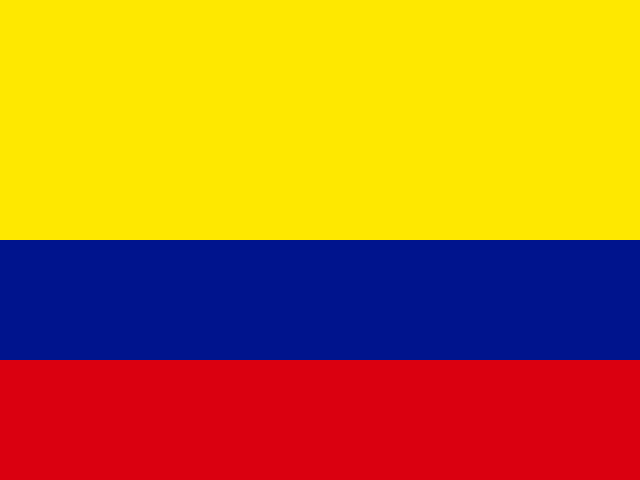 Colombia
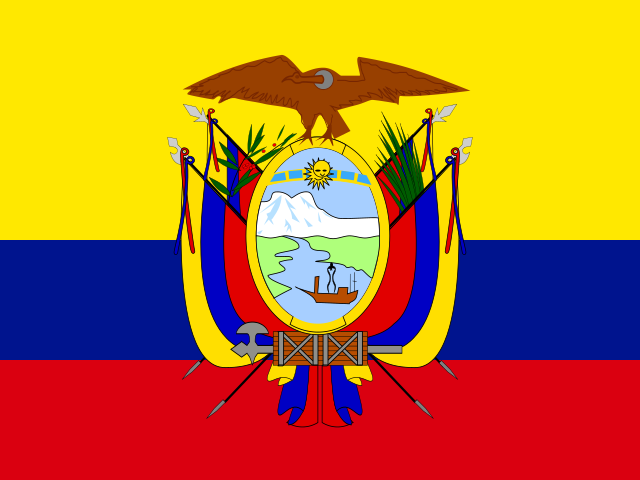 Ecuador
 Falkland Islands (Malvinas)
 French Guiana
 Guyana
 Paraguay
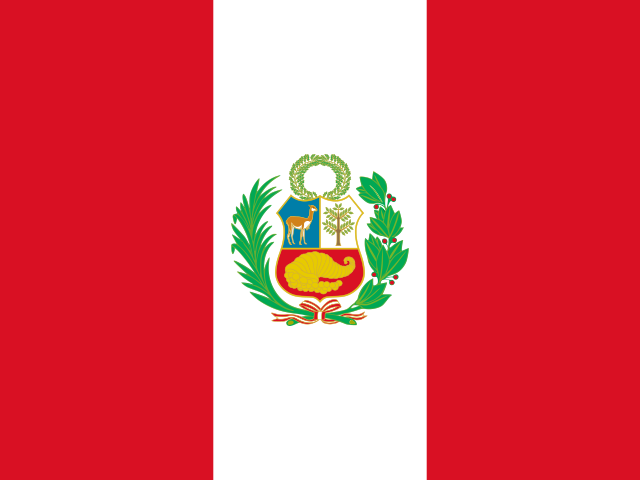 Peru
Peru Suriname
 Uruguay
 Venezuela
Earlier Report Observations
From 2018 to 2023, honey production in South America increased from 152.5 thousand tons to 169.0 thousand tons, supported by favorable climatic conditions and floral diversity in Argentina, the declaration of beekeeping as a national interest in Peru, and continuous output gains in Brazil's Northeast region. The market volume for domestic consumption showed volatility, initially growing to 42.6 thousand tons in 2019 before contracting sharply to 29.1 thousand tons in 2020.
The 2020 market decline coincided with a surge in exports to 132.5 thousand tons, as producers capitalized on strong international demand and a favorable U.S. dollar exchange rate that made South American honey more competitive. The subsequent rebound to 44.6 thousand tons in 2021 was driven by record production in Brazil and Argentina, alongside a moderation in export growth.
Market volume expanded further to 58.1 thousand tons by 2023, aided by a reduction in export volumes and increased domestic availability. This period saw heightened local consumption, promoted by health trends during the COVID-19 pandemic in Chile, and the development of value-added segments like organic honey and products with geographical indications, exemplified by the relaunch of the Lito's brand in Peru.
Table of content
- 1. Disclaimer
- 2. Terms of use of the report
- 3. Product codes in the statistical classifications used in the report
-
4. Key Market Indicators and Trends
-
4.1. Key Market Indicators
-
4.1.1. In kind
- 4.1.1.1. Production, 2018-2023
- 4.1.1.2. Imports, 2018-2024
- 4.1.1.3. Exports, 2018-2024
- 4.1.1.4. Market size, 2018-2023
-
4.1.1. In kind
- 4.2. Market Trends and Factors
-
4.1. Key Market Indicators
-
5. Production
-
5.1. Production in South America
- 5.1.1. Annual dynamics of production in South America in kind, 2018-2023, K t
-
5.2. Global production by Country, 2018-2023
- 5.2.1. Annual dynamics of production by macroregions in kind, 2018-2023, K t
- 5.2.2. Dynamics of production structure by macroregions in kind, 2018-2023
- 5.2.3. Annual dynamics of production by country in kind, 2018-2023, K t
- 5.2.4. Structure of production by countries in kind, 2018-2023
- 5.2.5. Dynamics of peoduction structure by countries in kind, 2018-2023
-
5.1. Production in South America
-
6. Exports
-
6.1. Exports (Direct Data*)
- 6.1.1. Exports - Total information
-
6.1.2. Exports in kind, K t
- 6.1.2.1. Annual dynamics of product's exports from Argentina in kind, 2018-2024, K t
- 6.1.2.2. Dynamics of product's exports in kind from Argentina by countries, 2018-2024, K t
- 6.1.2.3. Structure of product's exports in kind by countries, 2018-2024
-
6.1.3. Exports in value, M $ US
- 6.1.3.1. Annual dynamics of product's exports from Argentina in value, 2018-2024, M $ US
- 6.1.3.2. Dynamics of product's exports in value from Argentina by countries, 2018-2024, M $ US
- 6.1.3.3. Structure of product's exports in value by countries, 2018-2024
-
6.1.4. Average price of product's exports, $ US/t
- 6.1.4.1. Annual dynamics of average price of product's exports from Argentina, 2018-2024, $ US/t
- 6.1.4.2. Dynamics of average price of product's exports from Argentina by countries, 2018-2024, $ US/t
-
6.2. Exports (Mirror Data)
- 6.2.1. Exports - Total information
-
6.2.2. Exports in kind, K t
- 6.2.2.1. Annual dynamics of product's exports from Argentina in kind, 2018-2024, K t
- 6.2.2.2. Dynamics of product's exports in kind from Argentina by countries, 2018-2024, K t
- 6.2.2.3. Structure of product's exports in kind by countries, 2018-2024
-
6.2.3. Exports in value, M $ US
- 6.2.3.1. Annual dynamics of product's exports from Argentina in value, 2018-2024, M $ US
- 6.2.3.2. Dynamics of product's exports in value from Argentina by countries, 2018-2024, M $ US
- 6.2.3.3. Structure of product's exports in value by countries, 2018-2024
-
6.2.4. Average price of product's exports, $ US/t
- 6.2.4.1. Annual dynamics of average price of product's exports from Argentina, 2018-2024, $ US/t
- 6.2.4.2. Dynamics of average price of product's exports from Argentina by countries, 2018-2024, $ US/t
-
6.1. Exports (Direct Data*)
-
7. Imports
-
7.1. Imports (Direct Data*)
- 7.1.1. Imports - Total information
-
7.1.2. Imports in kind, K t
- 7.1.2.1. Annual dynamics of product's imports to Argentina in kind, 2018-2024, K t
- 7.1.2.2. Dynamics of product's imports in kind to Argentina by countries, 2018-2024, K t
- 7.1.2.3. Structure of product's imports in kind by countries, 2018-2024
-
7.1.3. Imports in value, M $ US
- 7.1.3.1. Annual dynamics of product's imports to Argentina in value, 2018-2024, M $ US
- 7.1.3.2. Dynamics of product's imports in value to Argentina by countries, 2018-2024, M $ US
- 7.1.3.3. Structure of product's imports in value by countries, 2018-2024
-
7.1.4. Average price of product's imports, $ US/t
- 7.1.4.1. Annual dynamics of average price of product's imports to Argentina, 2018-2024, $ US/t
- 7.1.4.2. Dynamics of average price of product's imports to Argentina by countries, 2018-2024, $ US/t
-
7.2. Imports (Mirror Data)
- 7.2.1. Imports - Total information
-
7.2.2. Imports in kind, K t
- 7.2.2.1. Annual dynamics of product's imports to Argentina in kind, 2018-2024, K t
- 7.2.2.2. Dynamics of product's imports in kind to Argentina by countries, 2018-2024, K t
- 7.2.2.3. Structure of product's imports in kind by countries, 2018-2024
-
7.2.3. Imports in value, M $ US
- 7.2.3.1. Annual dynamics of product's imports to Argentina in value, 2018-2024, M $ US
- 7.2.3.2. Dynamics of product's imports in value to Argentina by countries, 2018-2024, M $ US
- 7.2.3.3. Structure of product's imports in value by countries, 2018-2024
-
7.2.4. Average price of product's imports, $ US/t
- 7.2.4.1. Annual dynamics of average price of product's imports to Argentina, 2018-2024, $ US/t
- 7.2.4.2. Dynamics of average price of product's imports to Argentina by countries, 2018-2024, $ US/t
-
7.1. Imports (Direct Data*)
-
8. Trade balance
-
8.1. Trade balance (Direct Data)
- 8.1.1. In kind, K t
- 8.1.2. In value, M $ US
-
8.2. Trade balance (Mirror Data)
- 8.2.1. In kind, K t
- 8.2.2. In value, M $ US
-
8.1. Trade balance (Direct Data)
-
9. Top buying and selling countries, 2018-2024
-
9.1. Direct Data
- 9.1.1. Import in Value by Countries-buyers
- 9.1.2. Export in Value by Countries-suppliers
-
9.2. Mirror Data
- 9.2.1. Import in Value by Countries-buyers
- 9.2.2. Export in Value by Countries-suppliers
-
9.1. Direct Data
Production honey in South America
In kind, 2017-2020, K t
Top producers of honey, 2017-2020
World map of production of honey, 2017-2020
In 2020, South America produced 160.7 thousand tons of honey, marking a moderate increase of 8.6% compared to 2019. Production reached its lowest point in 2019 at 147.9 thousand tons, which represented the largest decline of 3.0% during the period. Over the four-year span from 2017 to 2020, overall production grew by 6.2%, translating to an average annual growth rate of 2.0%.
Annual dynamics of production in South America in kind, 2017-2020, K t
| Parameter | 2018 | 2019 | 2020 | CAGR | |
|---|---|---|---|---|---|
| 1 | Change from last year | 0.7% | (3.0%) | 8.6% | 2.0% |
In value, 2017-2020, M $ US
Following a two-year decline, South America's honey production rebounded in value terms. In 2020, the output was valued at 363.9 million US dollars, showing a modest increase of 8.6% compared to 2019. The lowest value was recorded in 2019 at 335.0 million US dollars, which also saw the largest decline of 20.6%. From 2017 to 2020, production value decreased by 22.5%, equivalent to an annualized decline rate of 8.2%.
Annual dynamics of production in South America in value, 2017-2020, M $ US
| Parameter | 2018 | 2019 | 2020 | CAGR | |
|---|---|---|---|---|---|
| 1 | Change from last year | (10.1%) | (20.6%) | 8.6% | (8.2%) |
Exports honey from South America
Exports in kind, K t
After a two-year decline, South America's honey exports recovered in volume. In 2020, the region exported 132.5 thousand tons of honey, representing a significant increase of 25.5% compared to the previous year. Exports hit their lowest point in 2019 at 105.6 thousand tons, which experienced the largest decline of 5.2%. Over the period from 2017 to 2020, export volumes grew by 18.7%, averaging an annual growth rate of 5.9%.
Annual dynamics of product's exports from South America in kind, 2017-2020, K t
| Parameter | 2018 | 2019 | 2020 | CAGR | |
|---|---|---|---|---|---|
| 1 | Change from last year | (0.2%) | (5.2%) | 25.5% | 5.9% |
From 2017 to 2020, the United States, Germany, and Spain remained the top buyers of South American honey by volume. The United States accounted for 57.1% of exports, Germany for 18.6%, and Spain for 4.5%. Together, these three countries represented 80.2% of total honey exports from South America during this period.
Structure of product's exports in kind by countries, 2017-2020
World map of product's exports from South America in kind, 2017-2020
Exports in value, M $ US
Following a two-year drop, South America's honey exports rebounded in value. In 2020, exports totaled 300.1 million US dollars, indicating a substantial rise of 25.5% from 2019. The lowest value was recorded in 2019 at 239.2 million US dollars, which saw the largest decline of 22.4%. Over the 2017-2020 period, export value decreased by 13.4%, with a compound annual growth rate of -4.7%.
Annual dynamics of product's exports from South America in value, 2017-2020, M $ US
| Parameter | 2018 | 2019 | 2020 | CAGR | |
|---|---|---|---|---|---|
| 1 | Change from last year | (11.0%) | (22.4%) | 25.5% | (4.7%) |
From 2017 to 2020, the United States, Germany, and Japan were the principal destinations for South American honey exports by value. The United States accounted for 56.2% of export value, Germany for 19.9%, and Japan for 4.1%. Collectively, these three markets represented 80.1% of total export flows during this timeframe.
Structure of product's exports in value by countries, 2017-2020
World map of product's exports from South America in value, 2017-2020
Imports honey to South America
Imports in kind, K t
The import market for honey in South America showed considerable volatility during this period. Imports reached their lowest point in 2019 at 0.3 thousand tons, which experienced the largest decline of 29.7%. In 2020, imports surged to 0.9 thousand tons, representing a dramatic increase of 177.1% compared to the previous year. Between 2019 and 2020, import volumes varied by a factor of 2.8, highlighting the market's instability.
Annual dynamics of product's imports to South America in kind, 2017-2020, K t
| Parameter | 2018 | 2019 | 2020 | CAGR | |
|---|---|---|---|---|---|
| 1 | Change from last year | (23.2%) | (29.7%) | 177.1% | 14.3% |
From 2017 to 2020, honey imports to South America were distributed across multiple countries without significant concentration. Mexico accounted for 19.5% of imports by volume, Spain for 13.9%, and the United States for 4.9%. Together, these three countries represented only 38.4% of total import flows, indicating a diverse sourcing pattern.
Structure of product's imports in kind by countries, 2017-2020
World map of product's imports to South America in kind, 2017-2020
Imports in value, M $ US
The import market for honey in South America demonstrated significant fluctuations in value terms. Imports reached their lowest point in 2019 at 1.0 million US dollars, which saw the largest decline of 44.0%. In 2020, import value jumped to 2.9 million US dollars, representing a substantial increase of 174.9% compared to the previous year. Between 2019 and 2020, import values varied by a factor of 2.7, underscoring the market's volatility.
Annual dynamics of product's imports to South America in value, 2017-2020, M $ US
| Parameter | 2018 | 2019 | 2020 | CAGR | |
|---|---|---|---|---|---|
| 1 | Change from last year | (29.8%) | (44.0%) | 174.9% | 2.6% |
Data from 2017 to 2020 show that honey imports to South America in value terms were not heavily concentrated among a few key suppliers. Mexico accounted for 18.0% of import value, Spain for 16.1%, and the United States for 3.9%. Collectively, these three countries represented only 38.0% of total import flows, reflecting a relatively diversified import structure.
Structure of product's imports in value by countries, 2017-2020
World map of product's imports to South America in value, 2017-2020
Related Reports

2026-03-27
2026-03-27
2026-03-27
2026-03-27



2026-03-27

Milk and cream market in South America
2026-03-27
Why Choose Us?
Only Verified Data
No Hidden Costs or Separate Fees
Smarter Subscription Pricing
Contact Our Team
Submit your inquiry using the form below — our team will get back to you within 24 hours.