






"MERCOSUR" region includes following countries:
 Brazil
 Argentina
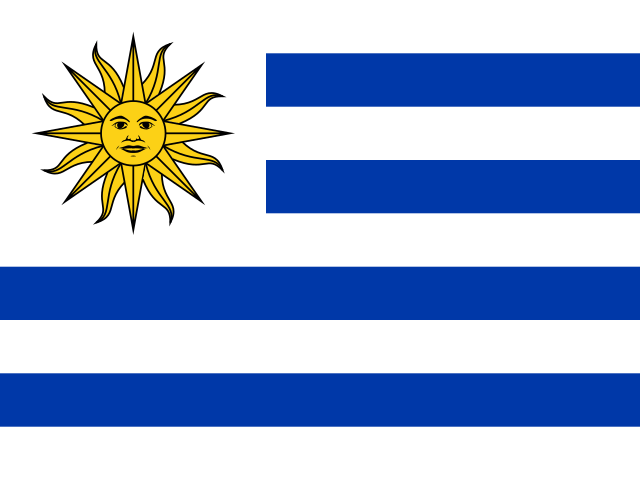 Uruguay
 Paraguay
Earlier Report Observations
The frozen potato market in MERCOSUR expanded steadily from 195.8 thousand tons in 2018 to 256.2 thousand tons in 2021. This growth was primarily driven by the rapid expansion of fast-food and casual dining chains, which increasingly included potato-based dishes in their menus. Urbanization and rising demand for convenient, processed foods further supported market expansion. In 2020, the COVID-19 pandemic reinforced this trend as consumers turned to ready-to-cook frozen potatoes during supply chain disruptions, boosting demand. Post-pandemic recovery in 2021 continued to lift sales through fast-food and supermarket channels.
After reaching a peak in 2021, the market volume contracted to 250.0 thousand tons in 2022 and then fell more sharply to 205.8 thousand tons in 2023. The slight dip in 2022 coincided with product innovation efforts, such as low-fat variants and new cooking processes, while the steeper decline in 2023 occurred despite ongoing investments in cold-chain infrastructure and the introduction of organic and sustainable product lines.
Table of content
- 1. Disclaimer
- 2. Terms of use of the report
- 3. Product codes in the statistical classifications used in the report
-
4. Key Market Indicators and Trends
-
4.1. Key Market Indicators
-
4.1.1. In kind
- 4.1.1.1. Production, 2018-2023
- 4.1.1.2. Imports, 2018-2024
- 4.1.1.3. Exports, 2018-2024
- 4.1.1.4. Market size, 2018-2023
-
4.1.1. In kind
- 4.2. Market Trends and Factors
-
4.1. Key Market Indicators
-
5. Production
-
5.1. Production in MERCOSUR
- 5.1.1. Annual dynamics of production in MERCOSUR in kind, 2018-2023, K t
-
5.2. Global production by Country, 2018-2023
- 5.2.1. Annual dynamics of production by macroregions in kind, 2018-2023, K t
- 5.2.2. Dynamics of production structure by macroregions in kind, 2018-2023
- 5.2.3. Annual dynamics of production by country in kind, 2018-2023, K t
- 5.2.4. Structure of production by countries in kind, 2018-2023
- 5.2.5. Dynamics of peoduction structure by countries in kind, 2018-2023
-
5.1. Production in MERCOSUR
-
6. Imports
-
6.1. Imports (Direct Data)
- 6.1.1. Imports - Total information
-
6.1.2. Imports in kind, t
- 6.1.2.1. Annual dynamics of product's imports to Brazil in kind, 2018-2024, t
- 6.1.2.2. Dynamics of product's imports in kind to Brazil by countries, 2018-2024, t
- 6.1.2.3. Structure of product's imports in kind by countries, 2018-2024
-
6.1.3. Imports in value, K $ US
- 6.1.3.1. Annual dynamics of product's imports to Brazil in value, 2018-2024, K $ US
- 6.1.3.2. Dynamics of product's imports in value to Brazil by countries, 2018-2024, K $ US
- 6.1.3.3. Structure of product's imports in value by countries, 2018-2024
-
6.1.4. Average price of product's imports, $ US/t
- 6.1.4.1. Annual dynamics of average price of product's imports to Brazil, 2018-2024, $ US/t
- 6.1.4.2. Dynamics of average price of product's imports to Brazil by countries, 2018-2024, $ US/t
-
6.2. Imports (Mirror Data)
- 6.2.1. Imports - Total information
-
6.2.2. Imports in kind, t
- 6.2.2.1. Annual dynamics of product's imports to Brazil in kind, 2018-2024, t
- 6.2.2.2. Dynamics of product's imports in kind to Brazil by countries, 2018-2024, t
- 6.2.2.3. Structure of product's imports in kind by countries, 2018-2024
-
6.2.3. Imports in value, K $ US
- 6.2.3.1. Annual dynamics of product's imports to Brazil in value, 2018-2024, K $ US
- 6.2.3.2. Dynamics of product's imports in value to Brazil by countries, 2018-2024, K $ US
- 6.2.3.3. Structure of product's imports in value by countries, 2018-2024
-
6.2.4. Average price of product's imports, $ US/t
- 6.2.4.1. Annual dynamics of average price of product's imports to Brazil, 2018-2024, $ US/t
- 6.2.4.2. Dynamics of average price of product's imports to Brazil by countries, 2018-2024, $ US/t
-
6.1. Imports (Direct Data)
-
7. Exports
-
7.1. Exports (Direct Data)
- 7.1.1. Exports - Total information
-
7.1.2. Exports in kind, t
- 7.1.2.1. Annual dynamics of product's exports from Brazil in kind, 2018-2024, t
- 7.1.2.2. Dynamics of product's exports in kind from Brazil by countries, 2018-2024, t
- 7.1.2.3. Structure of product's exports in kind by countries, 2018-2024
-
7.1.3. Exports in value, K $ US
- 7.1.3.1. Annual dynamics of product's exports from Brazil in value, 2018-2024, K $ US
- 7.1.3.2. Dynamics of product's exports in value from Brazil by countries, 2018-2024, K $ US
- 7.1.3.3. Structure of product's exports in value by countries, 2018-2024
-
7.1.4. Average price of product's exports, $ US/t
- 7.1.4.1. Annual dynamics of average price of product's exports from Brazil, 2018-2024, $ US/t
- 7.1.4.2. Dynamics of average price of product's exports from Brazil by countries, 2018-2024, $ US/t
-
7.2. Exports (Mirror Data)
- 7.2.1. Exports - Total information
-
7.2.2. Exports in kind, t
- 7.2.2.1. Annual dynamics of product's exports from Brazil in kind, 2018-2024, t
- 7.2.2.2. Dynamics of product's exports in kind from Brazil by countries, 2018-2024, t
- 7.2.2.3. Structure of product's exports in kind by countries, 2018-2024
-
7.2.3. Exports in value, K $ US
- 7.2.3.1. Annual dynamics of product's exports from Brazil in value, 2018-2024, K $ US
- 7.2.3.2. Dynamics of product's exports in value from Brazil by countries, 2018-2024, K $ US
- 7.2.3.3. Structure of product's exports in value by countries, 2018-2024
-
7.2.4. Average price of product's exports, $ US/t
- 7.2.4.1. Annual dynamics of average price of product's exports from Brazil, 2018-2024, $ US/t
- 7.2.4.2. Dynamics of average price of product's exports from Brazil by countries, 2018-2024, $ US/t
-
7.1. Exports (Direct Data)
-
8. Trade balance
-
8.1. Trade balance (Direct Data)
- 8.1.1. In kind, t
- 8.1.2. In value, K $ US
-
8.2. Trade balance (Mirror Data)
- 8.2.1. In kind, t
- 8.2.2. In value, K $ US
-
8.1. Trade balance (Direct Data)
-
9. Top buying and selling countries, 2018-2024
-
9.1. Direct Data
- 9.1.1. Import in Value by Countries-buyers
- 9.1.2. Export in Value by Countries-suppliers
-
9.2. Mirror Data
- 9.2.1. Import in Value by Countries-buyers
- 9.2.2. Export in Value by Countries-suppliers
-
9.1. Direct Data
Production frozen potatoes in MERCOSUR
In kind, 2017-2020, K t
Top producers of frozen potatoes, 2017-2020
World map of production of frozen potatoes, 2017-2020
MERCOSUR's frozen potato production increased for the second consecutive year. In 2020, the region produced 249.6 thousand tons of frozen potatoes, marking an 11.4% year-over-year rise. Production grew by 19.3% between 2017 and 2020, equivalent to an annualized growth rate of 6.1%. The lowest production volume was recorded in 2018 at 195.7 thousand tons, which also saw the largest decline of 6.5%. In contrast, 2019 experienced the largest increase of 14.5%.
Annual dynamics of production in MERCOSUR in kind, 2017-2020, K t
| Parameter | 2018 | 2019 | 2020 | CAGR | |
|---|---|---|---|---|---|
| 1 | Change from last year | (6.5%) | 14.5% | 11.4% | 6.1% |
Exports frozen potatoes from MERCOSUR
Exports in kind, t
The market displayed volatility during the observed period. Exports reached their lowest point in 2017 and peaked in 2019, showing an eightfold swing between these years. In 2020, MERCOSUR exported 97.9 tons of frozen potatoes, representing a slight decline of 1.4% compared to the previous year. The highest export volume was recorded in 2019 at 99.3 tons, while the largest increase occurred in 2018 with a 553.6% surge.
Annual dynamics of product's exports from MERCOSUR in kind, 2017-2020, t
| Parameter | 2018 | 2019 | 2020 | CAGR | |
|---|---|---|---|---|---|
| 1 | Change from last year | 553.6% | 22.8% | (1.4%) | 99.3% |
From 2017 to 2020, the partner portfolio for frozen potato exports from MERCOSUR was quite broad. Angola accounted for 19.5% of exports in kind, Liberia for 9.6%, and the Marshall Islands for 8.8%. Together, these three countries represented only 37.8% of total export flows.
Structure of product's exports in kind by countries, 2017-2020
World map of product's exports from MERCOSUR in kind, 2017-2020
Exports in value, K $ US
The market exhibited an unstable trend throughout the timeframe. Exports fluctuated significantly, with a low in 2017 and a peak in 2019, showing an elevenfold change between these years. In 2020, MERCOSUR exported 97.8 thousand US dollars worth of frozen potatoes, marking a strong reduction of 13.5% year-over-year. The maximum value was recorded in 2019 at 113.1 thousand US dollars, which also saw the largest increase of 233.0%.
Annual dynamics of product's exports from MERCOSUR in value, 2017-2020, K $ US
| Parameter | 2018 | 2019 | 2020 | CAGR | |
|---|---|---|---|---|---|
| 1 | Change from last year | 229.4% | 233.0% | (13.5%) | 111.7% |
The country composition of exports in value terms from 2017 to 2020 was dispersed. The Marshall Islands accounted for 11.8% of exports in value terms, Liberia for 10.5%, and Malta for 7.8%. Together, these three countries formed just 30.1% of total flows, with the remaining 69.9% distributed among a wide range of other destinations.
Structure of product's exports in value by countries, 2017-2020
World map of product's exports from MERCOSUR in value, 2017-2020
Imports frozen potatoes to MERCOSUR
Imports in kind, t
In 2020, MERCOSUR imported 183.0 tons of frozen potatoes, constituting a steep improvement of 62.4% year-over-year. Over the period from 2017 to 2020, imports increased by 91.2%, with a compound annual growth rate of 24.1%. The largest decline was recorded in 2019 at 23.2%.
Annual dynamics of product's imports to MERCOSUR in kind, 2017-2020, t
| Parameter | 2018 | 2019 | 2020 | CAGR | |
|---|---|---|---|---|---|
| 1 | Change from last year | 53.3% | (23.2%) | 62.4% | 24.1% |
Throughout 2017 to 2020, Belgium and Spain continued to lead the list of markets for frozen potato imports to MERCOSUR, together accounting for 58.5% of total import flows.
Structure of product's imports in kind by countries, 2017-2020
World map of product's imports to MERCOSUR in kind, 2017-2020
Imports in value, K $ US
Volatility characterized the market behavior during these years. Import levels fluctuated 2.3 times between the low of 2017 and the high of 2020. In 2020, MERCOSUR's frozen potato import volume came to 158.8 thousand US dollars, indicating an increase of 87.5% compared to the previous year. The largest decline was recorded in 2019 at 17.6%.
Annual dynamics of product's imports to MERCOSUR in value, 2017-2020, K $ US
| Parameter | 2018 | 2019 | 2020 | CAGR | |
|---|---|---|---|---|---|
| 1 | Change from last year | 49.0% | (17.6%) | 87.5% | 32.0% |
Throughout 2017 to 2020, Belgium dominated the partner structure for imports in value terms, with a share of 72.3% of total flows. Other markets had comparatively modest shares.
Structure of product's imports in value by countries, 2017-2020
World map of product's imports to MERCOSUR in value, 2017-2020
Related Reports

Frozen potatoes market in Africa
2026-03-27
Frozen potatoes market in Western Asia
2026-03-27
Frozen potatoes market in New Zealand
2026-03-27

2026-03-27

2026-03-27

2026-03-27

2026-03-27
Why Choose Us?
Only Verified Data
No Hidden Costs or Separate Fees
Smarter Subscription Pricing
Contact Our Team
Submit your inquiry using the form below — our team will get back to you within 24 hours.