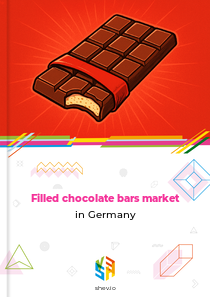







Earlier Report Observations
The market volume for filled chocolate bars in Germany experienced a notable contraction in 2019, falling to 249.1 thousand tons from 271.4 thousand tons the previous year. Over the following years, consumption gradually recovered, reaching 266.5 thousand tons by 2024, with a period of stabilization observed around 2022.
In value terms, the market showed greater volatility, declining sharply to 391 million USD in 2019 before rebounding to 585 million USD in 2024. This occurred against a backdrop of substantial overall chocolate production in Germany, which exceeded 870 000 tons in 2022 and reached approximately 1.07 million tons of cocoa-containing chocolate products in 2024.
Table of content
- 1. Disclaimer
- 2. Terms of use of the report
- 3. Product codes in the statistical classifications used in the report
-
4. Key Market Indicators and Trends
-
4.1. Key Market Indicators
-
4.1.1. In kind
- 4.1.1.1. Production, 2018-2022, 2024
- 4.1.1.2. Imports, 2018-2024
- 4.1.1.3. Exports, 2018-2024
- 4.1.1.4. Market size, 2018-2022, 2024
-
4.1.2. In value
- 4.1.2.1. Production, 2018-2022, 2024
- 4.1.2.2. Imports, 2018-2024
- 4.1.2.3. Exports, 2018-2024
- 4.1.2.4. Market size, 2018-2022, 2024
-
4.1.1. In kind
- 4.2. Market Trends and Factors
-
4.1. Key Market Indicators
-
5. Production
-
5.1. Production in Germany
- 5.1.1. In kind, 2018-2022, 2024, K t
- 5.1.2. In value, 2018-2022, 2024, M $ US
-
5.2. Production in the EU, 2018-2024
- 5.2.1. In kind, 2018-2024, K t
- 5.2.2. In value, 2018-2024, M $ US
-
5.1. Production in Germany
-
6. Imports
-
6.1. Imports (Direct Data)
- 6.1.1. Imports - Total information
-
6.1.2. Imports in kind, K t
- 6.1.2.1. Annual dynamics of product's imports to Germany in kind, 2018-2024, K t
- 6.1.2.2. Dynamics of product's imports in kind to Germany by countries, 2018-2024, K t
- 6.1.2.3. Structure of product's imports in kind by countries, 2018-2024
-
6.1.3. Imports in value, M $ US
- 6.1.3.1. Annual dynamics of product's imports to Germany in value, 2018-2024, M $ US
- 6.1.3.2. Dynamics of product's imports in value to Germany by countries, 2018-2024, M $ US
- 6.1.3.3. Structure of product's imports in value by countries, 2018-2024
-
6.1.4. Average price of product's imports, $ US/t
- 6.1.4.1. Annual dynamics of average price of product's imports to Germany, 2018-2024, $ US/t
- 6.1.4.2. Dynamics of average price of product's imports to Germany by countries, 2018-2024, $ US/t
-
6.2. Imports (Mirror Data)
- 6.2.1. Imports - Total information
-
6.2.2. Imports in kind, K t
- 6.2.2.1. Annual dynamics of product's imports to Germany in kind, 2018-2024, K t
- 6.2.2.2. Dynamics of product's imports in kind to Germany by countries, 2018-2024, K t
- 6.2.2.3. Structure of product's imports in kind by countries, 2018-2024
-
6.2.3. Imports in value, M $ US
- 6.2.3.1. Annual dynamics of product's imports to Germany in value, 2018-2024, M $ US
- 6.2.3.2. Dynamics of product's imports in value to Germany by countries, 2018-2024, M $ US
- 6.2.3.3. Structure of product's imports in value by countries, 2018-2024
-
6.2.4. Average price of product's imports, $ US/t
- 6.2.4.1. Annual dynamics of average price of product's imports to Germany, 2018-2024, $ US/t
- 6.2.4.2. Dynamics of average price of product's imports to Germany by countries, 2018-2024, $ US/t
-
6.1. Imports (Direct Data)
-
7. Exports
-
7.1. Exports (Direct Data)
- 7.1.1. Exports - Total information
-
7.1.2. Exports in kind, K t
- 7.1.2.1. Annual dynamics of product's exports from Germany in kind, 2018-2024, K t
- 7.1.2.2. Dynamics of product's exports in kind from Germany by countries, 2018-2024, K t
- 7.1.2.3. Structure of product's exports in kind by countries, 2018-2024
-
7.1.3. Exports in value, M $ US
- 7.1.3.1. Annual dynamics of product's exports from Germany in value, 2018-2024, M $ US
- 7.1.3.2. Dynamics of product's exports in value from Germany by countries, 2018-2024, M $ US
- 7.1.3.3. Structure of product's exports in value by countries, 2018-2024
-
7.1.4. Average price of product's exports, $ US/t
- 7.1.4.1. Annual dynamics of average price of product's exports from Germany, 2018-2024, $ US/t
- 7.1.4.2. Dynamics of average price of product's exports from Germany by countries, 2018-2024, $ US/t
-
7.2. Exports (Mirror Data)
- 7.2.1. Exports - Total information
-
7.2.2. Exports in kind, K t
- 7.2.2.1. Annual dynamics of product's exports from Germany in kind, 2018-2024, K t
- 7.2.2.2. Dynamics of product's exports in kind from Germany by countries, 2018-2024, K t
- 7.2.2.3. Structure of product's exports in kind by countries, 2018-2024
-
7.2.3. Exports in value, M $ US
- 7.2.3.1. Annual dynamics of product's exports from Germany in value, 2018-2024, M $ US
- 7.2.3.2. Dynamics of product's exports in value from Germany by countries, 2018-2024, M $ US
- 7.2.3.3. Structure of product's exports in value by countries, 2018-2024
-
7.2.4. Average price of product's exports, $ US/t
- 7.2.4.1. Annual dynamics of average price of product's exports from Germany, 2018-2024, $ US/t
- 7.2.4.2. Dynamics of average price of product's exports from Germany by countries, 2018-2024, $ US/t
-
7.1. Exports (Direct Data)
-
8. Trade balance
-
8.1. Trade balance (Direct Data)
- 8.1.1. In kind, K t
- 8.1.2. In value, M $ US
-
8.2. Trade balance (Mirror Data)
- 8.2.1. In kind, K t
- 8.2.2. In value, M $ US
-
8.1. Trade balance (Direct Data)
-
9. Top buying and selling countries, 2018-2024
-
9.1. Direct Data
- 9.1.1. Import in Value by Countries-buyers
- 9.1.2. Export in Value by Countries-suppliers
-
9.2. Mirror Data
- 9.2.1. Import in Value by Countries-buyers
- 9.2.2. Export in Value by Countries-suppliers
-
9.1. Direct Data
Production filled chocolate bars in Germany
In value, 2017-2020, M $ US
In Germany, the production value of filled chocolate bars reached 1 158 million US dollars in 2020, showing a gradual year-over-year increase of 3.6%. Looking at the period from 2017 to 2020, overall production decreased by 3.2%, which translates to an annualized decline of 1.1%. The lowest value was recorded in 2019 at 1 117 million US dollars, while the peak occurred in 2018 at 1 580 million US dollars. The most significant drop happened in 2019 with a 29.3% decrease, whereas the largest rise was in 2018 with a 32.1% increase.
Annual dynamics of production in Germany in value, 2017-2020, M $ US
| Parameter | 2018 | 2019 | 2020 | CAGR | |
|---|---|---|---|---|---|
| 1 | Change from last year | 32.1% | (29.3%) | 3.6% | (1.1%) |
In kind, 2017-2020, K t
Germany produced 360.3 thousand tonnes of filled chocolate bars in 2020, marking a 3.6% increase compared to the previous year. Over the span from 2017 to 2020, production grew by 9%, equivalent to an annualized rate of 2.9%. The highest output was in 2018 at 386.1 thousand tonnes. The most substantial decline occurred in 2019 with a 9.9% drop, while the largest increase was recorded in 2018 with a 16.8% rise.
Annual dynamics of production in Germany in kind, 2017-2020, K t
| Parameter | 2018 | 2019 | 2020 | CAGR | |
|---|---|---|---|---|---|
| 1 | Change from last year | 16.8% | (9.9%) | 3.6% | 2.9% |
Exports filled chocolate bars from Germany
Exports in kind, K t
Exports of filled chocolate bars from Germany fell for the second year in a row. In 2020, exports amounted to 184.0 thousand tonnes, reflecting a 2.3% decrease from the year before. Between 2017 and 2020, exports declined by 4.9%, averaging an annualized drop of 1.6%. The peak export volume was in 2018 at 196.9 thousand tonnes. The most significant reduction happened in 2019 with a 4.4% fall, while the largest increase was in 2018 with a 1.8% gain.
Annual dynamics of product's exports from Germany in kind, 2017-2020, K t
| Parameter | 2018 | 2019 | 2020 | CAGR | |
|---|---|---|---|---|---|
| 1 | Change from last year | 1.8% | (4.4%) | (2.3%) | (1.6%) |
From 2017 to 2020, Germany's exports of filled chocolate bars in volume terms were not heavily concentrated on a few key markets. The top three destinations—the United Kingdom with 12.7% of exports, France with 9.2%, and Poland with 8.5%—collectively accounted for just 30.4% of total flows.
Structure of product's exports in kind by countries, 2017-2020
World map of product's exports from Germany in kind, 2017-2020
Exports in value, M $ US
Exports of filled chocolate bars from Germany continued to decline for the second consecutive year. In 2020, export value reached 1 040 million US dollars, representing a controlled drop of 6.3% compared to the previous year. Over the 2017–2020 period, exports decreased by 10.3%, equating to an annualized decline of 3.6%. The highest value was recorded in 2018 at 1 258 million US dollars. The most substantial decrease occurred in 2019 with an 11.7% fall, while the largest increase was in 2018 with an 8.5% rise.
Annual dynamics of product's exports from Germany in value, 2017-2020, M $ US
| Parameter | 2018 | 2019 | 2020 | CAGR | |
|---|---|---|---|---|---|
| 1 | Change from last year | 8.5% | (11.7%) | (6.3%) | (3.6%) |
Between 2017 and 2020, Germany's exports of filled chocolate bars in value terms were distributed across a wide range of partner countries. The leading markets—France with 10.5% of exports, the United Kingdom with 9.9%, and Poland with 8.0%—together accounted for only 28.4% of total flows.
Structure of product's exports in value by countries, 2017-2020
World map of product's exports from Germany in value, 2017-2020
Imports filled chocolate bars to Germany
Imports in kind, K t
Following a two-year uptick, imports of filled chocolate bars into Germany declined. In 2020, Germany imported 79.8 thousand tonnes, indicating an 11.0% decrease from the previous year. The highest import volume was in 2019 at 89.7 thousand tonnes. The largest increase occurred in 2019 with a 9.0% rise.
Annual dynamics of product's imports to Germany in kind, 2017-2020, K t
| Parameter | 2018 | 2019 | 2020 | CAGR | |
|---|---|---|---|---|---|
| 1 | Change from last year | 3.2% | 9.0% | (11.0%) | 0.0% |
From 2017 to 2020, the Netherlands, Austria, and Spain were the top sources for Germany's imports of filled chocolate bars in volume terms. The Netherlands accounted for 44.2% of imports, Austria for 19.3%, and Spain for 8.0%, together making up 71.6% of total flows.
Structure of product's imports in kind by countries, 2017-2020
World map of product's imports to Germany in kind, 2017-2020
Imports in value, M $ US
After a two-year increase, imports of filled chocolate bars into Germany fell. In 2020, imports stood at 352 million US dollars, which is 8.4% lower compared to 2019. The peak import value was in 2019 at 384 million US dollars. The largest increase was recorded in 2019 with a 6.8% rise.
Annual dynamics of product's imports to Germany in value, 2017-2020, M $ US
| Parameter | 2018 | 2019 | 2020 | CAGR | |
|---|---|---|---|---|---|
| 1 | Change from last year | 3.0% | 6.8% | (8.4%) | 0.3% |
Over the 2017–2020 period, the Netherlands, Austria, and Croatia remained the leading sources in Germany's import structure for filled chocolate bars in value terms. The Netherlands contributed 34.8% of imports, Austria 17.3%, and Croatia 9.4%, with a combined share of 61.5% of total flows.
Structure of product's imports in value by countries, 2017-2020
World map of product's imports to Germany in value, 2017-2020
Related Reports
Filled chocolate bars market in Italy
2026-03-29
Filled chocolate bars market in Greece
2026-03-29
Filled chocolate bars market in Finland
2026-03-29
Filled chocolate bars market in Romania
2026-03-29

Chocolate bars market in Germany
2026-03-29
2026-03-29

Not filled chocolate bars market in Germany
2026-03-29
Why Choose Us?
Only Verified Data
No Hidden Costs or Separate Fees
Smarter Subscription Pricing
Contact Our Team
Submit your inquiry using the form below — our team will get back to you within 24 hours.