






"Middle Africa" region includes following countries:
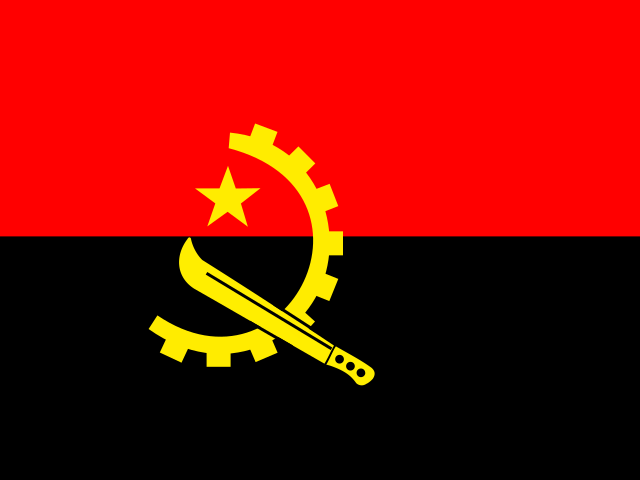 Angola
 Cameroon
 Central African Republic
 Chad
Chad Congo
Congo Democratic Republic of the Congo
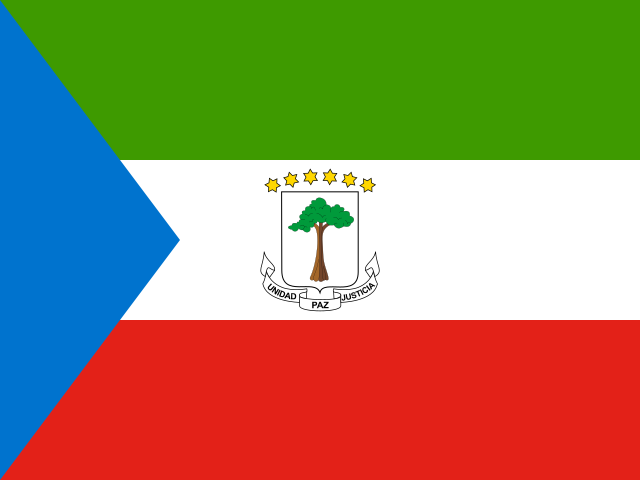 Equatorial Guinea
 Gabon
Gabon Sao Tome and Principe
Earlier Report Observations
The market for fresh or chilled edible brassicas in Middle Africa fluctuated between 2018 and 2023. Volume grew from 379 thousand tons in 2018 to a peak of 393 thousand tons in 2020, then contracted sharply to 352 thousand tons in 2021. A recovery followed, with the market reaching 372 thousand tons by 2023.
Recent developments highlight supporting infrastructure and demand. By 2024, the perishable goods transportation sector in Africa saw expanded refrigerated storage and fleet capacity, improving distribution for fresh vegetables. Consumer studies in Central Africa also confirmed brassicas like cabbage are among the most frequently consumed fresh products, with high weekly purchase frequency.
Table of content
- 1. Disclaimer
- 2. Terms of use of the report
- 3. Product codes in the statistical classifications used in the report
-
4. Key Market Indicators and Trends
-
4.1. Key Market Indicators
-
4.1.1. In kind
- 4.1.1.1. Production, 2018-2023
- 4.1.1.2. Imports, 2018-2024
- 4.1.1.3. Exports, 2018-2024
- 4.1.1.4. Market size, 2018-2023
-
4.1.1. In kind
- 4.2. Market Trends and Factors
-
4.1. Key Market Indicators
-
5. Production
-
5.1. Production in Middle Africa
- 5.1.1. Annual dynamics of production in Middle Africa in kind, 2018-2023, K t
-
5.2. Global production by Country, 2018-2023
- 5.2.1. Annual dynamics of production by macroregions in kind, 2018-2023, K t
- 5.2.2. Dynamics of production structure by macroregions in kind, 2018-2023
- 5.2.3. Annual dynamics of production by country in kind, 2018-2023, K t
- 5.2.4. Structure of production by countries in kind, 2018-2023
- 5.2.5. Dynamics of peoduction structure by countries in kind, 2018-2023
-
5.1. Production in Middle Africa
-
6. Imports
-
6.1. Imports (Direct Data*)
- 6.1.1. Imports - Total information
-
6.1.2. Imports in kind, t
- 6.1.2.1. Annual dynamics of product's imports to Angola in kind, 2018-2024, t
- 6.1.2.2. Dynamics of product's imports in kind to Angola by countries, 2018-2024, t
- 6.1.2.3. Structure of product's imports in kind by countries, 2018-2024
-
6.1.3. Imports in value, K $ US
- 6.1.3.1. Annual dynamics of product's imports to Angola in value, 2018-2024, K $ US
- 6.1.3.2. Dynamics of product's imports in value to Angola by countries, 2018-2024, K $ US
- 6.1.3.3. Structure of product's imports in value by countries, 2018-2024
-
6.1.4. Average price of product's imports, $ US/t
- 6.1.4.1. Annual dynamics of average price of product's imports to Angola, 2018-2024, $ US/t
- 6.1.4.2. Dynamics of average price of product's imports to Angola by countries, 2018-2024, $ US/t
-
6.2. Imports (Mirror Data)
- 6.2.1. Imports - Total information
-
6.2.2. Imports in kind, t
- 6.2.2.1. Annual dynamics of product's imports to Angola in kind, 2018-2024, t
- 6.2.2.2. Dynamics of product's imports in kind to Angola by countries, 2018-2024, t
- 6.2.2.3. Structure of product's imports in kind by countries, 2018-2024
-
6.2.3. Imports in value, K $ US
- 6.2.3.1. Annual dynamics of product's imports to Angola in value, 2018-2024, K $ US
- 6.2.3.2. Dynamics of product's imports in value to Angola by countries, 2018-2024, K $ US
- 6.2.3.3. Structure of product's imports in value by countries, 2018-2024
-
6.2.4. Average price of product's imports, $ US/t
- 6.2.4.1. Annual dynamics of average price of product's imports to Angola, 2018-2024, $ US/t
- 6.2.4.2. Dynamics of average price of product's imports to Angola by countries, 2018-2024, $ US/t
-
6.1. Imports (Direct Data*)
-
7. Exports
-
7.1. Exports (Direct Data*)
- 7.1.1. Exports - Total information
-
7.1.2. Exports in kind, t
- 7.1.2.1. Annual dynamics of product's exports from Angola in kind, 2018-2024, t
- 7.1.2.2. Dynamics of product's exports in kind from Angola by countries, 2018-2024, t
- 7.1.2.3. Structure of product's exports in kind by countries, 2018-2024
-
7.1.3. Exports in value, K $ US
- 7.1.3.1. Annual dynamics of product's exports from Angola in value, 2018-2024, K $ US
- 7.1.3.2. Dynamics of product's exports in value from Angola by countries, 2018-2024, K $ US
- 7.1.3.3. Structure of product's exports in value by countries, 2018-2024
-
7.1.4. Average price of product's exports, $ US/t
- 7.1.4.1. Annual dynamics of average price of product's exports from Angola, 2018-2024, $ US/t
- 7.1.4.2. Dynamics of average price of product's exports from Angola by countries, 2018-2024, $ US/t
-
7.2. Exports (Mirror Data)
- 7.2.1. Exports - Total information
-
7.2.2. Exports in kind, t
- 7.2.2.1. Annual dynamics of product's exports from Angola in kind, 2018-2024, t
- 7.2.2.2. Dynamics of product's exports in kind from Angola by countries, 2018-2024, t
- 7.2.2.3. Structure of product's exports in kind by countries, 2018-2024
-
7.2.3. Exports in value, K $ US
- 7.2.3.1. Annual dynamics of product's exports from Angola in value, 2018-2024, K $ US
- 7.2.3.2. Dynamics of product's exports in value from Angola by countries, 2018-2024, K $ US
- 7.2.3.3. Structure of product's exports in value by countries, 2018-2024
-
7.2.4. Average price of product's exports, $ US/t
- 7.2.4.1. Annual dynamics of average price of product's exports from Angola, 2018-2024, $ US/t
- 7.2.4.2. Dynamics of average price of product's exports from Angola by countries, 2018-2024, $ US/t
-
7.1. Exports (Direct Data*)
-
8. Trade balance
-
8.1. Trade balance (Direct Data)
- 8.1.1. In kind, t
- 8.1.2. In value, K $ US
-
8.2. Trade balance (Mirror Data)
- 8.2.1. In kind, t
- 8.2.2. In value, K $ US
-
8.1. Trade balance (Direct Data)
-
9. Top buying and selling countries, 2018-2024
-
9.1. Direct Data
- 9.1.1. Import in Value by Countries-buyers
- 9.1.2. Export in Value by Countries-suppliers
-
9.2. Mirror Data
- 9.2.1. Import in Value by Countries-buyers
- 9.2.2. Export in Value by Countries-suppliers
-
9.1. Direct Data
Production edible brassicas in Middle Africa
In kind, 2017-2020, K t
Top producers of edible brassicas, 2017-2020
World map of production of edible brassicas, 2017-2020
Middle Africa's edible brassicas production has increased for the third consecutive year. In 2020, the region produced 392.0 K t of edible brassicas, marking a slight 2.9% increase compared to 2019. Between 2017 and 2020, production grew by 6.7%, which translates to an annualized growth rate of 2.2%.
Annual dynamics of production in Middle Africa in kind, 2017-2020, K t
| Parameter | 2018 | 2019 | 2020 | CAGR | |
|---|---|---|---|---|---|
| 1 | Change from last year | 3.0% | 0.6% | 2.9% | 2.2% |
Exports edible brassicas from Middle Africa
Exports in kind, t
The market exhibited volatility during these years. Export volumes reached their lowest point in 2019 and peaked in 2020, showing a 3.4-fold difference. In 2020, Middle Africa's edible brassicas exports were recorded at 81.4 t, which is 241.7% higher than the previous year. The minimum value was 23.8 t in 2019, with the largest decline of 34.0% also occurring that year.
Annual dynamics of product's exports from Middle Africa in kind, 2017-2020, t
| Parameter | 2018 | 2019 | 2020 | CAGR | |
|---|---|---|---|---|---|
| 1 | Change from last year | (32.8%) | (34.0%) | 241.7% | 14.9% |
From 2017 to 2020, Belgium and Nigeria were the leading export markets for edible brassicas from Middle Africa, accounting for 3.8% and 2.1% of total flows, respectively.
Structure of product's exports in kind by countries, 2017-2020
World map of product's exports from Middle Africa in kind, 2017-2020
Exports in value, K $ US
The market showed signs of volatility over the observed period. The lowest value was registered in 2018, while the highest occurred in 2019, with a peak-to-trough ratio of 5.4 times. In 2020, Middle Africa exported 88 K $ US of edible brassicas, which is 51.4% less than the previous year. The minimum value was 34 K $ US in 2018, and the maximum was 182 K $ US in 2019, with the largest increase of 437.7% also recorded in 2019.
Annual dynamics of product's exports from Middle Africa in value, 2017-2020, K $ US
| Parameter | 2018 | 2019 | 2020 | CAGR | |
|---|---|---|---|---|---|
| 1 | Change from last year | (20.4%) | 437.7% | (51.4%) | 27.6% |
Between 2017 and 2020, Nigeria, Belgium, and Spain were the main destinations for edible brassicas exports from Middle Africa in value terms, absorbing 11.1% of total exports. Nigeria accounted for 5.0%, Belgium for 4.2%, and Spain for 1.9% of exports in value terms.
Structure of product's exports in value by countries, 2017-2020
World map of product's exports from Middle Africa in value, 2017-2020
Imports edible brassicas to Middle Africa
Imports in kind, t
There were noticeable fluctuations in market performance during this period. Import volumes hit their lowest point in 2017 and peaked in 2019, with a 2.2-fold difference. In 2020, edible brassicas deliveries to Middle Africa totaled 657.6 t, representing a 24.6% reduction compared to 2019. The maximum value was 872.7 t in 2019, and the largest increase of 77.2% was recorded in 2018.
Annual dynamics of product's imports to Middle Africa in kind, 2017-2020, t
| Parameter | 2018 | 2019 | 2020 | CAGR | |
|---|---|---|---|---|---|
| 1 | Change from last year | 77.2% | 23.2% | (24.6%) | 18.0% |
From 2017 to 2020, Belgium, South Africa, and France were the largest suppliers of edible brassicas to Middle Africa in kind, together forming 85.6% of total imports. Belgium accounted for 47.1%, South Africa for 25.7%, and France for 12.8% of imports in kind.
Structure of product's imports in kind by countries, 2017-2020
World map of product's imports to Middle Africa in kind, 2017-2020
Imports in value, K $ US
Edible brassicas imports to Middle Africa have increased for the third consecutive year. In 2020, imports amounted to 2 130 K $ US, which is 3.4% higher than the previous year. Over the period from 2017 to 2020, imports grew by 174.8%, with a compound annual growth rate of 40.1%.
Annual dynamics of product's imports to Middle Africa in value, 2017-2020, K $ US
| Parameter | 2018 | 2019 | 2020 | CAGR | |
|---|---|---|---|---|---|
| 1 | Change from last year | 112.3% | 25.2% | 3.4% | 40.1% |
Throughout 2017 to 2020, Belgium, South Africa, and France played leading roles in imports of edible brassicas to Middle Africa in value terms, jointly accounting for 88.3% of total flows. Belgium represented 59.0%, South Africa 20.9%, and France 8.3% of imports in value terms.
Structure of product's imports in value by countries, 2017-2020
World map of product's imports to Middle Africa in value, 2017-2020
Related Reports

Edible brassicas market in the Netherlands
2026-03-27
Edible brassicas market in Namibia
2026-03-27
Edible brassicas market in New Zealand
2026-03-30
Edible brassicas market in Romania
2026-03-27

Dried shelled beans market in Middle Africa
2026-03-27

Cabbages market in Middle Africa
2026-03-30

Spinach market in Middle Africa
2026-03-27

Why Choose Us?
Only Verified Data
No Hidden Costs or Separate Fees
Smarter Subscription Pricing
Contact Our Team
Submit your inquiry using the form below — our team will get back to you within 24 hours.