






"MERCOSUR" region includes following countries:
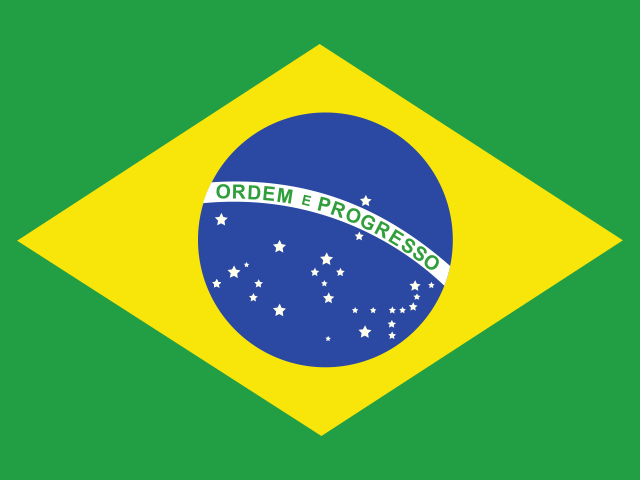 Brazil
 Argentina
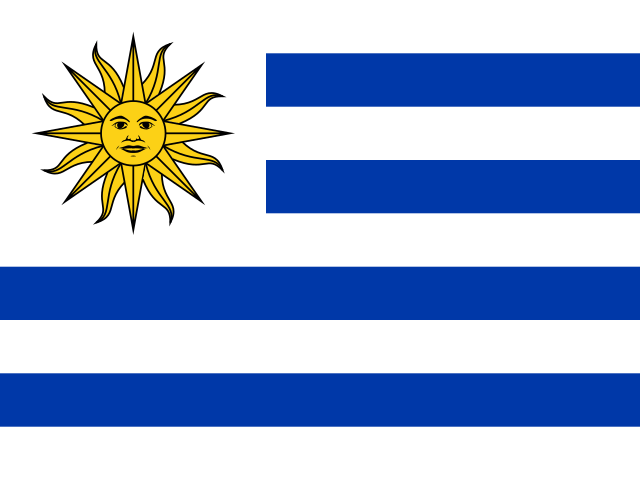 Uruguay
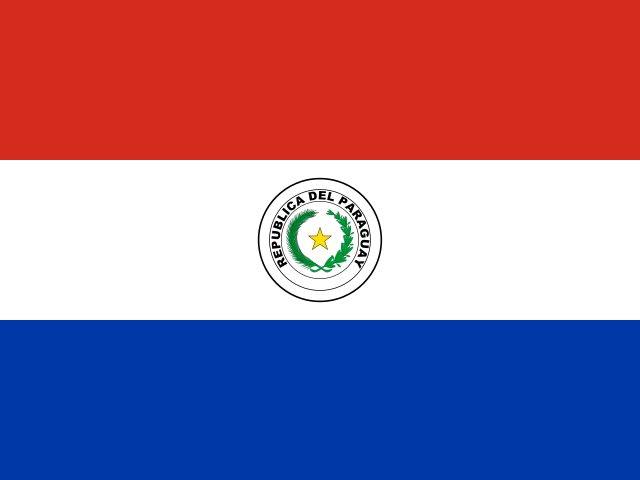 Paraguay
Earlier Report Observations
The duck meat and offal market in MERCOSUR saw a contraction in volume from 2018 to 2020, with consumption falling from 14,871 t to 12,131 t. This period coincided with the bloc's overall growth in meat exports and the opening of new market access, such as the authorization for Paraguay to export chilled and frozen meat to the United States from December 2019, which likely influenced trade flows and contributed to a focus on external markets.
Market volume rebounded from 2021, reaching 13,562 t by 2022. This recovery was supported by the broader global trend of rising demand for protein-rich foods and the increasing consumer preference for the convenience and longer shelf life of frozen meat. The EU-MERCOSUR trade agreement, impacting poultry and frozen product regulations, alongside regional consolidation like Minerva Foods' acquisition of BPU Meat in Uruguay, strengthened processing capacity and market integration.
In 2023, the market faced a new dynamic as a highly pathogenic avian influenza outbreak in Argentina led to bird culls and temporary export suspensions, tightening supply. This contributed to a slight dip in volume to 13,067 t but supported higher market value, even as export demand for Brazilian duck meat remained strong and some trade restrictions, like those from Chile, were lifted.
Table of content
- 1. Disclaimer
- 2. Terms of use of the report
- 3. Product codes in the statistical classifications used in the report
-
4. Key Market Indicators and Trends
-
4.1. Key Market Indicators
-
4.1.1. In kind
- 4.1.1.1. Production, 2018-2023
- 4.1.1.2. Imports, 2018-2024
- 4.1.1.3. Exports, 2018-2024
- 4.1.1.4. Market size, 2018-2023
-
4.1.2. In value
- 4.1.2.1. Production, 2018-2023
- 4.1.2.2. Imports, 2018-2024
- 4.1.2.3. Exports, 2018-2024
- 4.1.2.4. Market size, 2018-2023
-
4.1.1. In kind
- 4.2. Market Trends and Factors
-
4.1. Key Market Indicators
-
5. Production
-
5.1. Production in MERCOSUR
- 5.1.1. Annual dynamics of production in MERCOSUR in kind, 2018-2023, t
-
5.2. Global production by Country, 2018-2023
- 5.2.1. Annual dynamics of production by macroregions in kind, 2018-2023, t
- 5.2.2. Dynamics of production structure by macroregions in kind, 2018-2023
- 5.2.3. Annual dynamics of production by country in kind, 2018-2023, t
- 5.2.4. Structure of production by countries in kind, 2018-2023
- 5.2.5. Dynamics of peoduction structure by countries in kind, 2018-2023
-
5.1. Production in MERCOSUR
-
6. Imports
-
6.1. Imports (Direct Data)
- 6.1.1. Imports - Total information
-
6.1.2. Imports in kind, t
- 6.1.2.1. Annual dynamics of product's imports to Brazil in kind, 2018-2024, t
- 6.1.2.2. Dynamics of product's imports in kind to Brazil by countries, 2018-2024, t
- 6.1.2.3. Structure of product's imports in kind by countries, 2018-2024
-
6.1.3. Imports in value, K $ US
- 6.1.3.1. Annual dynamics of product's imports to Brazil in value, 2018-2024, K $ US
- 6.1.3.2. Dynamics of product's imports in value to Brazil by countries, 2018-2024, K $ US
- 6.1.3.3. Structure of product's imports in value by countries, 2018-2024
-
6.1.4. Average price of product's imports, $ US/kg
- 6.1.4.1. Annual dynamics of average price of product's imports to Brazil, 2018-2024, $ US/kg
- 6.1.4.2. Dynamics of average price of product's imports to Brazil by countries, 2018-2024, $ US/kg
-
6.2. Imports (Mirror Data)
- 6.2.1. Imports - Total information
-
6.2.2. Imports in kind, t
- 6.2.2.1. Annual dynamics of product's imports to Brazil in kind, 2018-2024, t
- 6.2.2.2. Dynamics of product's imports in kind to Brazil by countries, 2018-2024, t
- 6.2.2.3. Structure of product's imports in kind by countries, 2018-2024
-
6.2.3. Imports in value, K $ US
- 6.2.3.1. Annual dynamics of product's imports to Brazil in value, 2018-2024, K $ US
- 6.2.3.2. Dynamics of product's imports in value to Brazil by countries, 2018-2024, K $ US
- 6.2.3.3. Structure of product's imports in value by countries, 2018-2024
-
6.2.4. Average price of product's imports, $ US/kg
- 6.2.4.1. Annual dynamics of average price of product's imports to Brazil, 2018-2024, $ US/kg
- 6.2.4.2. Dynamics of average price of product's imports to Brazil by countries, 2018-2024, $ US/kg
-
6.1. Imports (Direct Data)
-
7. Exports
-
7.1. Exports (Direct Data)
- 7.1.1. Exports - Total information
-
7.1.2. Exports in kind, t
- 7.1.2.1. Annual dynamics of product's exports from Brazil in kind, 2018-2024, t
- 7.1.2.2. Dynamics of product's exports in kind from Brazil by countries, 2018-2024, t
- 7.1.2.3. Structure of product's exports in kind by countries, 2018-2024
-
7.1.3. Exports in value, K $ US
- 7.1.3.1. Annual dynamics of product's exports from Brazil in value, 2018-2024, K $ US
- 7.1.3.2. Dynamics of product's exports in value from Brazil by countries, 2018-2024, K $ US
- 7.1.3.3. Structure of product's exports in value by countries, 2018-2024
-
7.1.4. Average price of product's exports, $ US/kg
- 7.1.4.1. Annual dynamics of average price of product's exports from Brazil, 2018-2024, $ US/kg
- 7.1.4.2. Dynamics of average price of product's exports from Brazil by countries, 2018-2024, $ US/kg
-
7.2. Exports (Mirror Data)
- 7.2.1. Exports - Total information
-
7.2.2. Exports in kind, t
- 7.2.2.1. Annual dynamics of product's exports from Brazil in kind, 2018-2024, t
- 7.2.2.2. Dynamics of product's exports in kind from Brazil by countries, 2018-2024, t
- 7.2.2.3. Structure of product's exports in kind by countries, 2018-2024
-
7.2.3. Exports in value, K $ US
- 7.2.3.1. Annual dynamics of product's exports from Brazil in value, 2018-2024, K $ US
- 7.2.3.2. Dynamics of product's exports in value from Brazil by countries, 2018-2024, K $ US
- 7.2.3.3. Structure of product's exports in value by countries, 2018-2024
-
7.2.4. Average price of product's exports, $ US/kg
- 7.2.4.1. Annual dynamics of average price of product's exports from Brazil, 2018-2024, $ US/kg
- 7.2.4.2. Dynamics of average price of product's exports from Brazil by countries, 2018-2024, $ US/kg
-
7.1. Exports (Direct Data)
-
8. Trade balance
-
8.1. Trade balance (Direct Data)
- 8.1.1. In kind, t
- 8.1.2. In value, K $ US
-
8.2. Trade balance (Mirror Data)
- 8.2.1. In kind, t
- 8.2.2. In value, K $ US
-
8.1. Trade balance (Direct Data)
-
9. Top buying and selling countries, 2018-2024
-
9.1. Direct Data
- 9.1.1. Import in Value by Countries-buyers
- 9.1.2. Export in Value by Countries-suppliers
-
9.2. Mirror Data
- 9.2.1. Import in Value by Countries-buyers
- 9.2.2. Export in Value by Countries-suppliers
-
9.1. Direct Data
Production duck meat and offal in MERCOSUR
In kind, 2017-2020, t
Top producers of duck meat and offal, 2017-2020
World map of production of duck meat and offal, 2017-2020
Duck meat and offal production in MERCOSUR declined for the third consecutive year. In 2020, production reached 15 630 tonnes, marking a 3.2% decrease compared to 2019. Over the period from 2017 to 2020, production fell by 17.3%, with a compound annual growth rate of -6.1%.
Annual dynamics of production in MERCOSUR in kind, 2017-2020, t
| Parameter | 2018 | 2019 | 2020 | CAGR | |
|---|---|---|---|---|---|
| 1 | Change from last year | (5.8%) | (9.4%) | (3.2%) | (6.1%) |
In value, 2017-2020, K $ US
MERCOSUR's duck meat and offal production declined for the third consecutive year. In 2020, the output was valued at 40 933 thousand US dollars, down by 4.4% from the previous year. Between 2017 and 2020, production decreased by 17%, equating to an annualized rate of -6.0%.
Annual dynamics of production in MERCOSUR in value, 2017-2020, K $ US
| Parameter | 2018 | 2019 | 2020 | CAGR | |
|---|---|---|---|---|---|
| 1 | Change from last year | (2.6%) | (10.9%) | (4.4%) | (6.0%) |
Exports duck meat and offal from MERCOSUR
Exports in kind, t
Exported duck meat and offal volumes from MERCOSUR increased for the second consecutive year. In 2020, exports totalled 3 515 tonnes, up by 14.0% compared to 2019. Over the period from 2017 to 2020, exports grew by 2.4%, with a compound annual growth rate of 0.8%. The minimum value was recorded in 2018 at 2 965 tonnes, which saw the largest decline of 13.6%.
Annual dynamics of product's exports from MERCOSUR in kind, 2017-2020, t
| Parameter | 2018 | 2019 | 2020 | CAGR | |
|---|---|---|---|---|---|
| 1 | Change from last year | (13.6%) | 4.0% | 14.0% | 0.8% |
Throughout 2017 to 2020, the United Arab Emirates, Saudi Arabia, and Qatar formed the core of exports in kind, accounting for 77.4% of total flows. Specifically, the United Arab Emirates contributed 35.3% of exports, Saudi Arabia 34.3%, and Qatar 7.8%.
Structure of product's exports in kind by countries, 2017-2020
World map of product's exports from MERCOSUR in kind, 2017-2020
Exports in value, K $ US
Duck meat and offal deliveries from MERCOSUR increased for the second consecutive year. In 2020, MERCOSUR exported 9 205 thousand US dollars worth of duck meat and offal, up by 12.6% year-over-year. Between 2017 and 2020, exports increased by 2.7%, equating to an annualized rate of 0.9%. The minimum value was recorded in 2018 at 8 004 thousand US dollars, which experienced the largest decline of 10.7%.
Annual dynamics of product's exports from MERCOSUR in value, 2017-2020, K $ US
| Parameter | 2018 | 2019 | 2020 | CAGR | |
|---|---|---|---|---|---|
| 1 | Change from last year | (10.7%) | 2.2% | 12.6% | 0.9% |
Over 2017 to 2020, Saudi Arabia, the United Arab Emirates, and Qatar together absorbed 77.8% of total exports in value terms of duck meat and offal from MERCOSUR, making them the main destinations. Saudi Arabia accounted for 36.1% of exports, the United Arab Emirates 33.9%, and Qatar 7.8%.
Structure of product's exports in value by countries, 2017-2020
World map of product's exports from MERCOSUR in value, 2017-2020
Imports duck meat and offal to MERCOSUR
Imports in kind, t
Volatility characterized the market behavior during these years. Imports varied by 3.4-fold, with a low in 2017 and a high in 2019. In 2020, MERCOSUR's duck meat and offal imports amounted to 16 tonnes, which is 48.7% less compared to 2019. The maximum value was recorded in 2019 at 31 tonnes, while the largest increase occurred in 2018 at 230.5%.
Annual dynamics of product's imports to MERCOSUR in kind, 2017-2020, t
| Parameter | 2018 | 2019 | 2020 | CAGR | |
|---|---|---|---|---|---|
| 1 | Change from last year | 230.5% | 2.8% | (48.7%) | 20.3% |
Over 2017 to 2020, the geographical pattern of imports in kind was determined mainly by France and Canada, which together accounted for 87.7% of total flows.
Structure of product's imports in kind by countries, 2017-2020
World map of product's imports to MERCOSUR in kind, 2017-2020
Imports in value, K $ US
There were noticeable fluctuations in market performance during the period. Imports peaked in 2019 and bottomed in 2017, differing by a factor of 2.8. In 2020, foreign duck meat and offal supplies to MERCOSUR stood at 452 thousand US dollars, down by 30.7% year-over-year. The maximum value was recorded in 2019 at 653 thousand US dollars, and the largest increase was recorded in 2018 at 120.0%.
Annual dynamics of product's imports to MERCOSUR in value, 2017-2020, K $ US
| Parameter | 2018 | 2019 | 2020 | CAGR | |
|---|---|---|---|---|---|
| 1 | Change from last year | 120.0% | 25.2% | (30.7%) | 24.1% |
Throughout 2017 to 2020, France and Canada formed the core markets for imports in value terms of duck meat and offal to MERCOSUR, with a combined share of 98.0% of total flows.
Structure of product's imports in value by countries, 2017-2020
World map of product's imports to MERCOSUR in value, 2017-2020
Related Reports
Duck meat and offal market in South Africa
2026-03-27
Duck meat and offal market in Eastern Asia
2026-03-27
Duck meat and offal market in Syria
2026-03-27



Chicken meat and offal market in MERCOSUR
2026-03-27

Beef and buffalo meat market in MERCOSUR
2026-03-30
Why Choose Us?
Only Verified Data
No Hidden Costs or Separate Fees
Smarter Subscription Pricing
Contact Our Team
Submit your inquiry using the form below — our team will get back to you within 24 hours.