






"Latin America and the Caribbean" region includes following countries:
 Argentina
 Bolivia
 Brazil
 Chile
Chile Colombia
 Ecuador
 Falkland Islands (Malvinas)
 French Guiana
 Guyana
 Paraguay
 Peru
Peru Suriname
 Uruguay
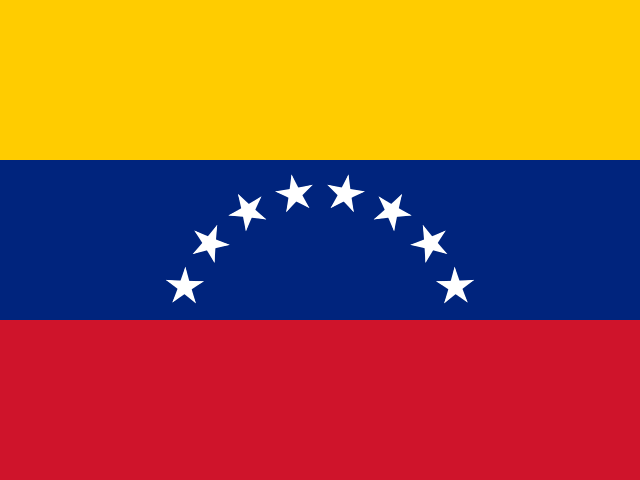 Venezuela
 Belize
 Costa Rica
 El Salvador
 Guatemala
 Honduras
 Mexico
 Nicaragua
 Panama
 Antigua and Barbuda
 the Bahamas
 Barbados
 British Virgin Islands
 Cayman Islands
 Cuba
Cuba Dominica
 Dominican Republic
 Grenada
 Guadeloupe
 Haiti
Haiti Jamaica
 Martinique
 Montserrat
 Curacao
 Aruba
Aruba Saint Maarten (Dutch part)
 Bonaire
 Puerto Rico
 Saint Kitts and Nevis
 Anguilla
 Saint Lucia
 Saint-Martin (French Part)
 Saint Vincent and the Grenadines
 Trinidad and Tobago
 Turks and Caicos Islands
 United States Virgin Islands
Earlier Report Observations
Production of coconuts, Brazil nuts and cashews in Latin America and the Caribbean remained stable around 4.9 million tons between 2018 and 2020. The 2017/2018 harvest of Brazil nuts, cashews and macadamia saw a 53% increase, indicating growth potential for the segment. In 2019, the processed cashew nut (ACC) export share accounted for 58.7% of equivalent production volume, with the remainder supplied domestically, highlighting a concentrated processing industry. The COVID-19 pandemic in 2020 directly impacted global cashew distribution and value addition, though regional production held steady.
Market volume began a sustained rise from 2021, reaching 5.6 million tons by 2023. This growth was supported by a shift toward greater domestic consumption of cashews, with historically low export volumes of ACC and the emergence of small-scale mini-factories offering bulk or branded almonds. Global cashew cultivation underwent significant changes, with Vietnam surpassing India in cashew almond exports due to productivity gains, mechanization and logistics, affecting Brazil's competitiveness and prompting production increases. Additionally, Brazil's coconut exports, particularly coconut water from Ceará state, showed strong growth, contributing to overall output.
By 2024, Brazilian companies and cooperatives were engaging in an Executive Export Table to overcome export barriers with government support, while domestic consumption of cashews absorbed 77.7% of equivalent production, driven by health, convenience and vegan trends. Coconut exports surged by over 95% in value and volume in the first half of 2024, reflecting increased production and international demand.
Table of content
- 1. Disclaimer
- 2. Terms of use of the report
- 3. Product codes in the statistical classifications used in the report
-
4. Key Market Indicators and Trends
-
4.1. Key Market Indicators
-
4.1.1. In kind
- 4.1.1.1. Production, 2018-2023
- 4.1.1.2. Imports, 2018-2024
- 4.1.1.3. Exports, 2018-2024
- 4.1.1.4. Market size, 2018-2023
-
4.1.1. In kind
- 4.2. Market Trends and Factors
-
4.1. Key Market Indicators
-
5. Production
-
5.1. Production in Latin America and the Caribbean
- 5.1.1. Annual dynamics of production in Latin America and the Caribbean in kind, 2018-2023, K t
-
5.2. Global production by Country, 2018-2023
- 5.2.1. Annual dynamics of production by macroregions in kind, 2018-2023, K t
- 5.2.2. Dynamics of production structure by macroregions in kind, 2018-2023
- 5.2.3. Annual dynamics of production by country in kind, 2018-2023, K t
- 5.2.4. Structure of production by countries in kind, 2018-2023
- 5.2.5. Dynamics of peoduction structure by countries in kind, 2018-2023
-
5.1. Production in Latin America and the Caribbean
-
6. Exports
-
6.1. Exports (Direct Data*)
- 6.1.1. Exports - Total information
-
6.1.2. Exports in kind, t
- 6.1.2.1. Annual dynamics of product's exports from Argentina in kind, 2018-2024, t
- 6.1.2.2. Dynamics of product's exports in kind from Argentina by countries, 2018-2024, t
- 6.1.2.3. Structure of product's exports in kind by countries, 2018-2024
-
6.1.3. Exports in value, M $ US
- 6.1.3.1. Annual dynamics of product's exports from Argentina in value, 2018-2024, M $ US
- 6.1.3.2. Dynamics of product's exports in value from Argentina by countries, 2018-2024, M $ US
- 6.1.3.3. Structure of product's exports in value by countries, 2018-2024
-
6.1.4. Average price of product's exports, $ US/t
- 6.1.4.1. Annual dynamics of average price of product's exports from Argentina, 2018-2024, $ US/t
- 6.1.4.2. Dynamics of average price of product's exports from Argentina by countries, 2018-2024, $ US/t
-
6.2. Exports (Mirror Data)
- 6.2.1. Exports - Total information
-
6.2.2. Exports in kind, t
- 6.2.2.1. Annual dynamics of product's exports from Argentina in kind, 2018-2024, t
- 6.2.2.2. Dynamics of product's exports in kind from Argentina by countries, 2018-2024, t
- 6.2.2.3. Structure of product's exports in kind by countries, 2018-2024
-
6.2.3. Exports in value, M $ US
- 6.2.3.1. Annual dynamics of product's exports from Argentina in value, 2018-2024, M $ US
- 6.2.3.2. Dynamics of product's exports in value from Argentina by countries, 2018-2024, M $ US
- 6.2.3.3. Structure of product's exports in value by countries, 2018-2024
-
6.2.4. Average price of product's exports, $ US/t
- 6.2.4.1. Annual dynamics of average price of product's exports from Argentina, 2018-2024, $ US/t
- 6.2.4.2. Dynamics of average price of product's exports from Argentina by countries, 2018-2024, $ US/t
-
6.1. Exports (Direct Data*)
-
7. Imports
-
7.1. Imports (Direct Data*)
- 7.1.1. Imports - Total information
-
7.1.2. Imports in kind, t
- 7.1.2.1. Annual dynamics of product's imports to Argentina in kind, 2018-2024, t
- 7.1.2.2. Dynamics of product's imports in kind to Argentina by countries, 2018-2024, t
- 7.1.2.3. Structure of product's imports in kind by countries, 2018-2024
-
7.1.3. Imports in value, M $ US
- 7.1.3.1. Annual dynamics of product's imports to Argentina in value, 2018-2024, M $ US
- 7.1.3.2. Dynamics of product's imports in value to Argentina by countries, 2018-2024, M $ US
- 7.1.3.3. Structure of product's imports in value by countries, 2018-2024
-
7.1.4. Average price of product's imports, $ US/t
- 7.1.4.1. Annual dynamics of average price of product's imports to Argentina, 2018-2024, $ US/t
- 7.1.4.2. Dynamics of average price of product's imports to Argentina by countries, 2018-2024, $ US/t
-
7.2. Imports (Mirror Data)
- 7.2.1. Imports - Total information
-
7.2.2. Imports in kind, t
- 7.2.2.1. Annual dynamics of product's imports to Argentina in kind, 2018-2024, t
- 7.2.2.2. Dynamics of product's imports in kind to Argentina by countries, 2018-2024, t
- 7.2.2.3. Structure of product's imports in kind by countries, 2018-2024
-
7.2.3. Imports in value, M $ US
- 7.2.3.1. Annual dynamics of product's imports to Argentina in value, 2018-2024, M $ US
- 7.2.3.2. Dynamics of product's imports in value to Argentina by countries, 2018-2024, M $ US
- 7.2.3.3. Structure of product's imports in value by countries, 2018-2024
-
7.2.4. Average price of product's imports, $ US/t
- 7.2.4.1. Annual dynamics of average price of product's imports to Argentina, 2018-2024, $ US/t
- 7.2.4.2. Dynamics of average price of product's imports to Argentina by countries, 2018-2024, $ US/t
-
7.1. Imports (Direct Data*)
-
8. Trade balance
-
8.1. Trade balance (Direct Data)
- 8.1.1. In kind, t
- 8.1.2. In value, M $ US
-
8.2. Trade balance (Mirror Data)
- 8.2.1. In kind, t
- 8.2.2. In value, M $ US
-
8.1. Trade balance (Direct Data)
-
9. Top buying and selling countries, 2018-2024
-
9.1. Direct Data
- 9.1.1. Import in Value by Countries-buyers
- 9.1.2. Export in Value by Countries-suppliers
-
9.2. Mirror Data
- 9.2.1. Import in Value by Countries-buyers
- 9.2.2. Export in Value by Countries-suppliers
-
9.1. Direct Data
Production coconuts, Brazil nuts and cashews in Latin America and the Caribbean
In kind, 2017-2020, K t
Top producers of coconuts, Brazil nuts and cashews, 2017-2020
World map of production of coconuts, Brazil nuts and cashews, 2017-2020
In Latin America and the Caribbean, production of coconuts, Brazil nuts, and cashews reached 4,918 thousand tonnes in 2020, marking a slight year-on-year increase of 0.8%. Over the 2017-2020 period, production grew by 3%, with an average annual growth rate of 1.0%. The highest production level was recorded in 2018 at 4,953 thousand tonnes, which represented a significant increase of 3.7% from the previous year. In contrast, 2019 saw the largest decline of 1.5%.
Annual dynamics of production in Latin America and the Caribbean in kind, 2017-2020, K t
| Parameter | 2018 | 2019 | 2020 | CAGR | |
|---|---|---|---|---|---|
| 1 | Change from last year | 3.7% | (1.5%) | 0.8% | 1.0% |
In value, 2017-2020, M $ US
The value of coconut, Brazil nut, and cashew production in Latin America and the Caribbean declined for the second consecutive year. In 2020, output was valued at 19,076 million US dollars, reflecting a substantial decrease of 21.3% compared to the previous year. Between 2017 and 2020, production value fell by 23.2%, equivalent to an annualized decline of 8.4%. The peak value occurred in 2018 at 32,925 million US dollars, which was a 32.5% increase from 2017. However, 2019 experienced the sharpest drop of 26.4%.
Annual dynamics of production in Latin America and the Caribbean in value, 2017-2020, M $ US
| Parameter | 2018 | 2019 | 2020 | CAGR | |
|---|---|---|---|---|---|
| 1 | Change from last year | 32.5% | (26.4%) | (21.3%) | (8.4%) |
Exports coconuts, Brazil nuts and cashews from Latin America and the Caribbean
Exports in kind, t
Export volumes of coconuts, Brazil nuts, and cashews from Latin America and the Caribbean totaled 78,595 tonnes in 2020, representing a 7.1% year-over-year increase. Over the 2017-2020 period, exports grew by 5.7%, with an average annual growth rate of 1.9%. The lowest export volume was recorded in 2019 at 73,380 tonnes, which marked a decline of 2.4% from the previous year.
Annual dynamics of product's exports from Latin America and the Caribbean in kind, 2017-2020, t
| Parameter | 2018 | 2019 | 2020 | CAGR | |
|---|---|---|---|---|---|
| 1 | Change from last year | 1.1% | (2.4%) | 7.1% | 1.9% |
Between 2017 and 2020, export destinations for coconuts, Brazil nuts, and cashews from Latin America and the Caribbean were highly diversified. The top three markets—the United States (31.3% of export volume), the Netherlands (7.5%), and Canada (4.8%)—collectively accounted for 43.6% of total exports. The remaining 56.4% was distributed among numerous smaller markets.
Structure of product's exports in kind by countries, 2017-2020
World map of product's exports from Latin America and the Caribbean in kind, 2017-2020
Exports in value, M $ US
The value of coconut, Brazil nut, and cashew exports from Latin America and the Caribbean declined for the second consecutive year. In 2020, exports were valued at 304.8 million US dollars, showing a robust reduction of 16.4% compared to the previous year. Over the 2017-2020 period, export value decreased by 21.1%, with an annualized decline of 7.6%. The highest value was recorded in 2018 at 499.7 million US dollars, which was a 29.3% increase from 2017. However, 2019 saw the largest decline of 27.0%.
Annual dynamics of product's exports from Latin America and the Caribbean in value, 2017-2020, M $ US
| Parameter | 2018 | 2019 | 2020 | CAGR | |
|---|---|---|---|---|---|
| 1 | Change from last year | 29.3% | (27.0%) | (16.4%) | (7.6%) |
From 2017 to 2020, the country structure of export value for coconuts, Brazil nuts, and cashews from Latin America and the Caribbean remained highly diversified. The United States (27.6% of export value), the Netherlands (12.8%), and South Korea (9.4%) together accounted for 49.9% of total exports. The remaining 50.1% was spread across a wide range of smaller markets.
Structure of product's exports in value by countries, 2017-2020
World map of product's exports from Latin America and the Caribbean in value, 2017-2020
Imports coconuts, Brazil nuts and cashews to Latin America and the Caribbean
Imports in kind, t
Import volumes of coconuts, Brazil nuts, and cashews into Latin America and the Caribbean declined for the third consecutive year. In 2020, imports totaled 78,595 tonnes, corresponding to a modest decrease of 7.7% from the previous year. Over the 2017-2020 period, imports fell by 31.5%, with an average annual decline of 11.9%.
Annual dynamics of product's imports to Latin America and the Caribbean in kind, 2017-2020, t
| Parameter | 2018 | 2019 | 2020 | CAGR | |
|---|---|---|---|---|---|
| 1 | Change from last year | (16.3%) | (11.3%) | (7.7%) | (11.9%) |
Data from 2017 to 2020 show that import volumes of coconuts, Brazil nuts, and cashews into Latin America and the Caribbean were not concentrated among a few key suppliers. Indonesia (20.5% of import volume), the Philippines (15.2%), and Côte d'Ivoire (12.6%) jointly accounted for 48.2% of total imports, with the remainder distributed among various other countries.
Structure of product's imports in kind by countries, 2017-2020
World map of product's imports to Latin America and the Caribbean in kind, 2017-2020
Imports in value, M $ US
The value of coconut, Brazil nut, and cashew imports into Latin America and the Caribbean declined for the third consecutive year. In 2020, imports were valued at 304.8 million US dollars, remaining stable year-over-year. Between 2017 and 2020, import value decreased by 41.4%, equivalent to an annualized decline of 16.3%.
Annual dynamics of product's imports to Latin America and the Caribbean in value, 2017-2020, M $ US
| Parameter | 2018 | 2019 | 2020 | CAGR | |
|---|---|---|---|---|---|
| 1 | Change from last year | (12.9%) | (32.5%) | (0.3%) | (16.3%) |
From 2017 to 2020, import values of coconuts, Brazil nuts, and cashews into Latin America and the Caribbean were spread across many countries. The Philippines (17.4% of import value), Indonesia (17.4%), and Côte d'Ivoire (11.0%) together accounted for 45.9% of total imports, with the rest coming from a diverse array of other markets.
Structure of product's imports in value by countries, 2017-2020
World map of product's imports to Latin America and the Caribbean in value, 2017-2020
Related Reports





In-depth market research on this product
Global Cashew Market 2021–2031: Size, Share, Trends and Forecast
Global market report: size, trends and forecast to 2031 · 184 pages
Global Brazil Nut Market 2021–2031: Size, Share, Trends and Forecast
Global market report: size, trends and forecast to 2031 · 184 pages
Why Choose Us?
Only Verified Data
No Hidden Costs or Separate Fees
Smarter Subscription Pricing
Contact Our Team
Submit your inquiry using the form below — our team will get back to you within 24 hours.