






"South America" region includes following countries:
 Argentina
 Bolivia
 Brazil
 Chile
Chile Colombia
 Ecuador
 Falkland Islands (Malvinas)
 French Guiana
 Guyana
 Paraguay
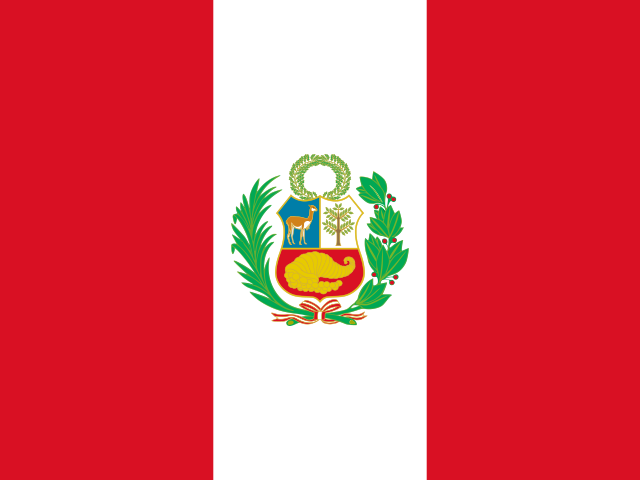 Peru
Peru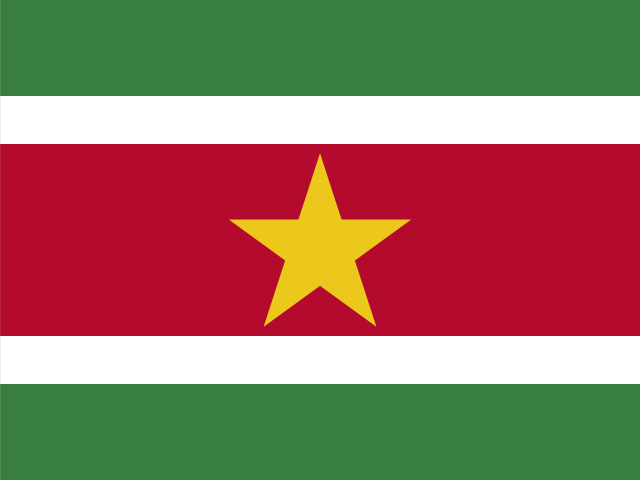 Suriname
 Uruguay
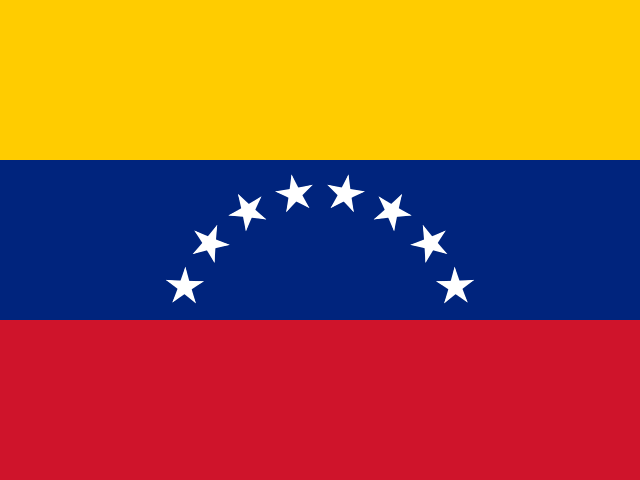 Venezuela
Earlier Report Observations
The South American market for coconut oil and fractions grew from 31 590 tons in 2018 to 37 053 tons in 2020. This expansion was driven by rising demand from the cosmetic, food, and personal care industries, where consumers increasingly favored natural and organic products. The COVID-19 pandemic in 2020 further boosted interest in healthy alternatives, supporting market volume despite initial supply chain disruptions.
After 2020, the market corrected to 31 739 tons in 2021, stabilized near 31 800 tons in 2022, and saw a slight decrease to 31 001 tons in 2023. During this period, new players entered the market, and major companies like Cargill and Wilmar International expanded their production capacities. Consumer preferences continued to shift toward vegan, organic, and non-GMO certified offerings, influencing product development and labeling.
Table of content
- 1. Disclaimer
- 2. Terms of use of the report
- 3. Product codes in the statistical classifications used in the report
-
4. Key Market Indicators and Trends
-
4.1. Key Market Indicators
-
4.1.1. In kind
- 4.1.1.1. Production, 2018-2023
- 4.1.1.2. Imports, 2018-2024
- 4.1.1.3. Exports, 2018-2024
- 4.1.1.4. Market size, 2018-2023
-
4.1.1. In kind
- 4.2. Market Trends and Factors
-
4.1. Key Market Indicators
-
5. Production
-
5.1. Production in South America
- 5.1.1. Annual dynamics of production in South America in kind, 2018-2023, t
-
5.2. Global production by Country, 2018-2023
- 5.2.1. Annual dynamics of production by macroregions in kind, 2018-2023, t
- 5.2.2. Dynamics of production structure by macroregions in kind, 2018-2023
- 5.2.3. Annual dynamics of production by country in kind, 2018-2023, t
- 5.2.4. Structure of production by countries in kind, 2018-2023
- 5.2.5. Dynamics of peoduction structure by countries in kind, 2018-2023
-
5.1. Production in South America
-
6. Imports
-
6.1. Imports (Direct Data*)
- 6.1.1. Imports - Total information
-
6.1.2. Imports in kind, t
- 6.1.2.1. Annual dynamics of product's imports to Argentina in kind, 2018-2024, t
- 6.1.2.2. Dynamics of product's imports in kind to Argentina by countries, 2018-2024, t
- 6.1.2.3. Structure of product's imports in kind by countries, 2018-2024
-
6.1.3. Imports in value, K $ US
- 6.1.3.1. Annual dynamics of product's imports to Argentina in value, 2018-2024, K $ US
- 6.1.3.2. Dynamics of product's imports in value to Argentina by countries, 2018-2024, K $ US
- 6.1.3.3. Structure of product's imports in value by countries, 2018-2024
-
6.1.4. Average price of product's imports, $ US/t
- 6.1.4.1. Annual dynamics of average price of product's imports to Argentina, 2018-2024, $ US/t
- 6.1.4.2. Dynamics of average price of product's imports to Argentina by countries, 2018-2024, $ US/t
-
6.2. Imports (Mirror Data)
- 6.2.1. Imports - Total information
-
6.2.2. Imports in kind, t
- 6.2.2.1. Annual dynamics of product's imports to Argentina in kind, 2018-2024, t
- 6.2.2.2. Dynamics of product's imports in kind to Argentina by countries, 2018-2024, t
- 6.2.2.3. Structure of product's imports in kind by countries, 2018-2024
-
6.2.3. Imports in value, K $ US
- 6.2.3.1. Annual dynamics of product's imports to Argentina in value, 2018-2024, K $ US
- 6.2.3.2. Dynamics of product's imports in value to Argentina by countries, 2018-2024, K $ US
- 6.2.3.3. Structure of product's imports in value by countries, 2018-2024
-
6.2.4. Average price of product's imports, $ US/t
- 6.2.4.1. Annual dynamics of average price of product's imports to Argentina, 2018-2024, $ US/t
- 6.2.4.2. Dynamics of average price of product's imports to Argentina by countries, 2018-2024, $ US/t
-
6.1. Imports (Direct Data*)
-
7. Exports
-
7.1. Exports (Direct Data*)
- 7.1.1. Exports - Total information
-
7.1.2. Exports in kind, t
- 7.1.2.1. Annual dynamics of product's exports from Argentina in kind, 2018-2024, t
- 7.1.2.2. Dynamics of product's exports in kind from Argentina by countries, 2018-2024, t
- 7.1.2.3. Structure of product's exports in kind by countries, 2018-2024
-
7.1.3. Exports in value, K $ US
- 7.1.3.1. Annual dynamics of product's exports from Argentina in value, 2018-2024, K $ US
- 7.1.3.2. Dynamics of product's exports in value from Argentina by countries, 2018-2024, K $ US
- 7.1.3.3. Structure of product's exports in value by countries, 2018-2024
-
7.1.4. Average price of product's exports, $ US/t
- 7.1.4.1. Annual dynamics of average price of product's exports from Argentina, 2018-2024, $ US/t
- 7.1.4.2. Dynamics of average price of product's exports from Argentina by countries, 2018-2024, $ US/t
-
7.2. Exports (Mirror Data)
- 7.2.1. Exports - Total information
-
7.2.2. Exports in kind, t
- 7.2.2.1. Annual dynamics of product's exports from Argentina in kind, 2018-2024, t
- 7.2.2.2. Dynamics of product's exports in kind from Argentina by countries, 2018-2024, t
- 7.2.2.3. Structure of product's exports in kind by countries, 2018-2024
-
7.2.3. Exports in value, K $ US
- 7.2.3.1. Annual dynamics of product's exports from Argentina in value, 2018-2024, K $ US
- 7.2.3.2. Dynamics of product's exports in value from Argentina by countries, 2018-2024, K $ US
- 7.2.3.3. Structure of product's exports in value by countries, 2018-2024
-
7.2.4. Average price of product's exports, $ US/t
- 7.2.4.1. Annual dynamics of average price of product's exports from Argentina, 2018-2024, $ US/t
- 7.2.4.2. Dynamics of average price of product's exports from Argentina by countries, 2018-2024, $ US/t
-
7.1. Exports (Direct Data*)
-
8. Trade balance
-
8.1. Trade balance (Direct Data)
- 8.1.1. In kind, t
- 8.1.2. In value, K $ US
-
8.2. Trade balance (Mirror Data)
- 8.2.1. In kind, t
- 8.2.2. In value, K $ US
-
8.1. Trade balance (Direct Data)
-
9. Top buying and selling countries, 2018-2024
-
9.1. Direct Data
- 9.1.1. Import in Value by Countries-buyers
- 9.1.2. Export in Value by Countries-suppliers
-
9.2. Mirror Data
- 9.2.1. Import in Value by Countries-buyers
- 9.2.2. Export in Value by Countries-suppliers
-
9.1. Direct Data
Production coconut oil and fractions in South America
In kind, 2017-2020, t
Top producers of coconut oil and fractions, 2017-2020
World map of production of coconut oil and fractions, 2017-2020
South America's coconut oil and fractions production has grown for the third year in a row. In 2020, the region produced 27 521 tonnes, marking a significant 10.4% increase from the previous year. Looking at the period from 2017 to 2020, production rose by 26.9%, which translates to an average annual growth rate of 8.3%.
Annual dynamics of production in South America in kind, 2017-2020, t
| Parameter | 2018 | 2019 | 2020 | CAGR | |
|---|---|---|---|---|---|
| 1 | Change from last year | 11.5% | 3.1% | 10.4% | 8.3% |
In value, 2017-2020, K $ US
In 2020, the value of coconut oil and fractions output in South America reached 55 322 thousand US dollars, showing a moderate 9.8% rise compared to 2019. Over the 2017-2020 period, however, production value declined by 4.6%, with a compound annual growth rate of 1.5%. The lowest value was recorded in 2019 at 50 364 thousand US dollars, while the peak occurred in 2018 at 61 258 thousand US dollars. The most substantial drop was in 2019, with a decrease of 17.8%.
Annual dynamics of production in South America in value, 2017-2020, K $ US
| Parameter | 2018 | 2019 | 2020 | CAGR | |
|---|---|---|---|---|---|
| 1 | Change from last year | 5.7% | (17.8%) | 9.8% | (1.5%) |
Exports coconut oil and fractions from South America
Exports in kind, t
Coconut oil and fractions exports from South America have increased for the third consecutive year. In 2020, exports amounted to 1 845 tonnes, representing a sharp 50.1% jump from the previous year. From 2017 to 2020, exports surged by 699.3%, averaging an annual growth rate of 99.9%.
Annual dynamics of product's exports from South America in kind, 2017-2020, t
| Parameter | 2018 | 2019 | 2020 | CAGR | |
|---|---|---|---|---|---|
| 1 | Change from last year | 377.2% | 11.6% | 50.1% | 99.9% |
Between 2017 and 2020, the export structure for coconut oil and fractions in kind was fairly balanced, with no single partner dominating. Trinidad and Tobago accounted for 1.3% of exports, Barbados for 1.2%, and the United States for 0.9%, together making up 3.4% of total flows. The remaining 96.6% was distributed among numerous other countries.
Structure of product's exports in kind by countries, 2017-2020
World map of product's exports from South America in kind, 2017-2020
Exports in value, K $ US
The export market exhibited volatility during the observed period. South America exported 3 710 thousand US dollars worth of coconut oil and fractions in 2020, reflecting a sharp 49.3% year-on-year increase. The largest decline occurred in 2019, with an 11.0% drop, while the biggest rise was in 2018, with a 352.4% surge. Import levels varied significantly, with a sixfold difference between the low in 2017 and the high in 2020.
Annual dynamics of product's exports from South America in value, 2017-2020, K $ US
| Parameter | 2018 | 2019 | 2020 | CAGR | |
|---|---|---|---|---|---|
| 1 | Change from last year | 352.4% | (11.0%) | 49.3% | 81.8% |
From 2017 to 2020, the value-based export structure was highly diversified. The United States contributed 2.1% of exports, Cabo Verde 2.0%, and Trinidad and Tobago 1.3%, collectively accounting for just 5.4% of total flows. The vast majority, 94.6%, was spread across many smaller markets.
Structure of product's exports in value by countries, 2017-2020
World map of product's exports from South America in value, 2017-2020
Imports coconut oil and fractions to South America
Imports in kind, t
South America's imports of coconut oil and fractions have risen for the second year in a row. In 2020, the region imported approximately 11 378 tonnes, which is 29.5% higher than in 2019. Over the 2017-2020 period, imports grew by 31.2%, averaging an annual rate of 9.5%. The lowest volume was recorded in 2018 at 8 516 tonnes, with the largest decline that year at 1.8%.
Annual dynamics of product's imports to South America in kind, 2017-2020, t
| Parameter | 2018 | 2019 | 2020 | CAGR | |
|---|---|---|---|---|---|
| 1 | Change from last year | (1.8%) | 3.1% | 29.5% | 9.5% |
Between 2017 and 2020, the main sources for coconut oil and fractions imports to South America in kind were Malaysia, with a 28.9% share, the Philippines at 27.3%, and Indonesia at 16.8%. Together, these three countries accounted for 73.1% of total import flows.
Structure of product's imports in kind by countries, 2017-2020
World map of product's imports to South America in kind, 2017-2020
Imports in value, K $ US
Following a two-year decline, South America's imports of coconut oil and fractions in value terms rebounded. In 2020, imports totaled 17 813 thousand US dollars, showing a 38.3% increase from the previous year. However, over the 2017-2020 period, imports decreased by 13.2%, with an average annual decline of 4.6%. The lowest value was recorded in 2019 at 17 813 thousand US dollars, which also saw the largest drop of 26.1%.
Annual dynamics of product's imports to South America in value, 2017-2020, K $ US
| Parameter | 2018 | 2019 | 2020 | CAGR | |
|---|---|---|---|---|---|
| 1 | Change from last year | (15.1%) | (26.1%) | 38.3% | (4.6%) |
From 2017 to 2020, the Philippines led as the top source for coconut oil and fractions imports in value terms, with a 31.0% share, followed by Malaysia at 19.6% and Indonesia at 10.5%. These three countries combined represented 61.1% of total import flows.
Structure of product's imports in value by countries, 2017-2020
World map of product's imports to South America in value, 2017-2020
Related Reports

Coconut oil and fractions market in Grenada
2026-03-28
Coconut oil and fractions market in Brazil
2026-03-28




Why Choose Us?
Only Verified Data
No Hidden Costs or Separate Fees
Smarter Subscription Pricing
Contact Our Team
Submit your inquiry using the form below — our team will get back to you within 24 hours.