






"South-eastern Asia" region includes following countries:
 Brunei Darussalam
 Myanmar
 Cambodia
 Indonesia
 Laos
Laos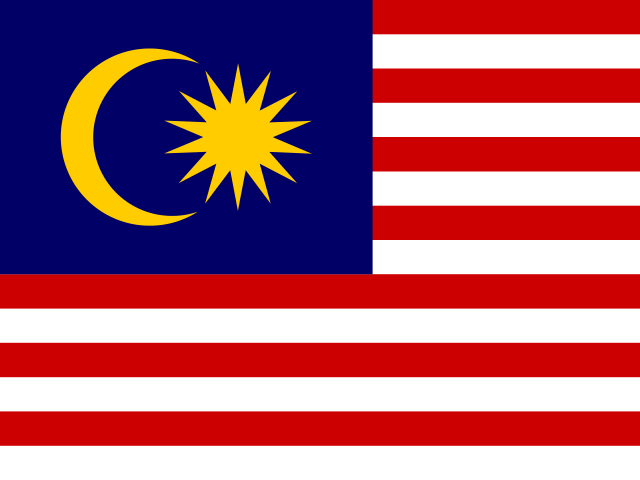 Malaysia
 the Philippines
 Timor-Leste
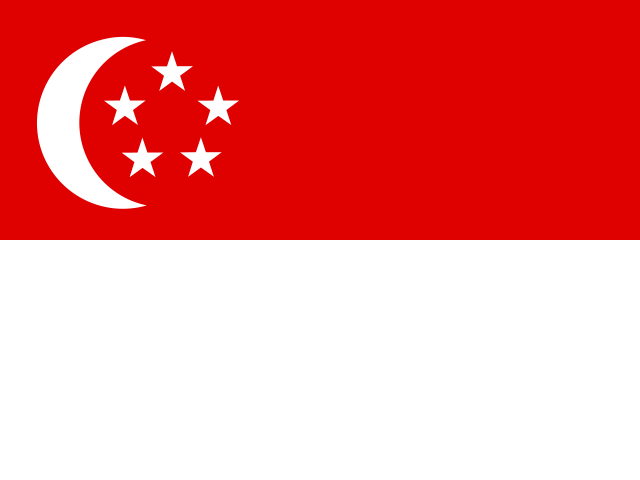 Singapore
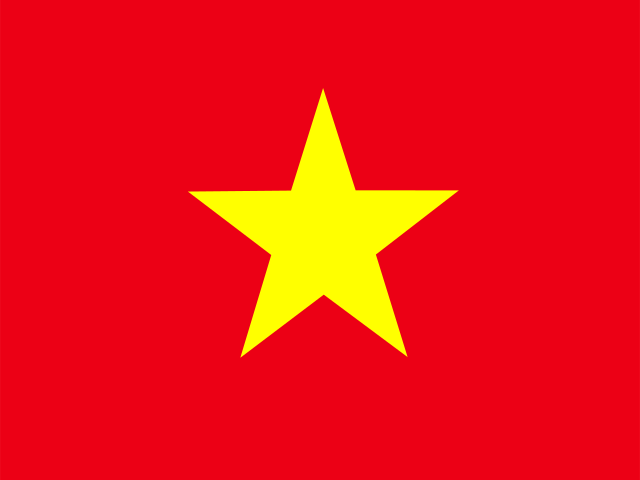 Vietnam
 Thailand
Earlier Report Observations
The market volume for cocoa-free sugar confectionery in South-eastern Asia increased from 341.6 thousand tons in 2018 to 390.3 thousand tons in 2020. This growth was driven by the introduction of new product lineups like Mars' DOVE® Chocolate targeting the Asia Pacific region, which stimulated consumer interest. Rising health awareness and the prevalence of lifestyle diseases also boosted demand for sugar-reduced and functional confectionery. In 2020, the implementation of sugar taxes in countries such as Malaysia discouraged high-sugar consumption and encouraged sugar-free alternatives, while supply constraints for cocoa prompted manufacturers to substitute ingredients and expand cocoa-free offerings.
After peaking in 2020, the market volume moderated, ranging between 384.0 and 355.2 thousand tons from 2021 to 2023. Despite ongoing urbanization, retail expansion, and the emergence of new segments like sugar-free chocolates and gums, overall consumption saw a slight contraction. Regulatory changes, including front-of-pack labeling mandates in India, prompted brands to reformulate products, which may have temporarily affected volumes. By 2023, major companies such as Asher’s Chocolate launched new sugar-free ranges, and Hershey expanded its manufacturing and R&D facilities in Malaysia, indicating sustained investment in healthier confectionery that helped support the market.
In 2024, imports of cocoa-free sugar confectionery rose significantly to 234.1 thousand tons, while exports reached 126.3 thousand tons, reflecting active trade dynamics. Factors such as further implementation of sugar tax policies, the launch of innovative sugar-free products, and the expansion of production capacities by global players like Hershey in Malaysia point to continued evolution in the sector.
Table of content
- 1. Disclaimer
- 2. Terms of use of the report
- 3. Product codes in the statistical classifications used in the report
-
4. Key Market Indicators and Trends
-
4.1. Key Market Indicators
-
4.1.1. In kind
- 4.1.1.1. Production, 2018-2023
- 4.1.1.2. Imports, 2018-2024
- 4.1.1.3. Exports, 2018-2024
- 4.1.1.4. Market size, 2018-2023
-
4.1.1. In kind
- 4.2. Market Trends and Factors
-
4.1. Key Market Indicators
-
5. Production
-
5.1. Production in South-eastern Asia
- 5.1.1. Annual dynamics of production in South-eastern Asia in kind, 2018-2023, K t
-
5.2. Global production by Country, 2018-2023
- 5.2.1. Annual dynamics of production by macroregions in kind, 2018-2023, K t
- 5.2.2. Dynamics of production structure by macroregions in kind, 2018-2023
- 5.2.3. Annual dynamics of production by country in kind, 2018-2023, K t
- 5.2.4. Structure of production by countries in kind, 2018-2023
- 5.2.5. Dynamics of peoduction structure by countries in kind, 2018-2023
-
5.1. Production in South-eastern Asia
-
6. Imports
-
6.1. Imports (Direct Data*)
- 6.1.1. Imports - Total information
-
6.1.2. Imports in kind, K t
- 6.1.2.1. Annual dynamics of product's imports to Brunei Darussalam in kind, 2018-2024, K t
- 6.1.2.2. Dynamics of product's imports in kind to Brunei Darussalam by countries, 2018-2024, K t
- 6.1.2.3. Structure of product's imports in kind by countries, 2018-2024
-
6.1.3. Imports in value, M $ US
- 6.1.3.1. Annual dynamics of product's imports to Brunei Darussalam in value, 2018-2024, M $ US
- 6.1.3.2. Dynamics of product's imports in value to Brunei Darussalam by countries, 2018-2024, M $ US
- 6.1.3.3. Structure of product's imports in value by countries, 2018-2024
-
6.1.4. Average price of product's imports, $ US/t
- 6.1.4.1. Annual dynamics of average price of product's imports to Brunei Darussalam, 2018-2024, $ US/t
- 6.1.4.2. Dynamics of average price of product's imports to Brunei Darussalam by countries, 2018-2024, $ US/t
-
6.2. Imports (Mirror Data)
- 6.2.1. Imports - Total information
-
6.2.2. Imports in kind, K t
- 6.2.2.1. Annual dynamics of product's imports to Brunei Darussalam in kind, 2018-2024, K t
- 6.2.2.2. Dynamics of product's imports in kind to Brunei Darussalam by countries, 2018-2024, K t
- 6.2.2.3. Structure of product's imports in kind by countries, 2018-2024
-
6.2.3. Imports in value, M $ US
- 6.2.3.1. Annual dynamics of product's imports to Brunei Darussalam in value, 2018-2024, M $ US
- 6.2.3.2. Dynamics of product's imports in value to Brunei Darussalam by countries, 2018-2024, M $ US
- 6.2.3.3. Structure of product's imports in value by countries, 2018-2024
-
6.2.4. Average price of product's imports, $ US/t
- 6.2.4.1. Annual dynamics of average price of product's imports to Brunei Darussalam, 2018-2024, $ US/t
- 6.2.4.2. Dynamics of average price of product's imports to Brunei Darussalam by countries, 2018-2024, $ US/t
-
6.1. Imports (Direct Data*)
-
7. Exports
-
7.1. Exports (Direct Data*)
- 7.1.1. Exports - Total information
-
7.1.2. Exports in kind, K t
- 7.1.2.1. Annual dynamics of product's exports from Brunei Darussalam in kind, 2018-2024, K t
- 7.1.2.2. Dynamics of product's exports in kind from Brunei Darussalam by countries, 2018-2024, K t
- 7.1.2.3. Structure of product's exports in kind by countries, 2018-2024
-
7.1.3. Exports in value, M $ US
- 7.1.3.1. Annual dynamics of product's exports from Brunei Darussalam in value, 2018-2024, M $ US
- 7.1.3.2. Dynamics of product's exports in value from Brunei Darussalam by countries, 2018-2024, M $ US
- 7.1.3.3. Structure of product's exports in value by countries, 2018-2024
-
7.1.4. Average price of product's exports, $ US/t
- 7.1.4.1. Annual dynamics of average price of product's exports from Brunei Darussalam, 2018-2024, $ US/t
- 7.1.4.2. Dynamics of average price of product's exports from Brunei Darussalam by countries, 2018-2024, $ US/t
-
7.2. Exports (Mirror Data)
- 7.2.1. Exports - Total information
-
7.2.2. Exports in kind, K t
- 7.2.2.1. Annual dynamics of product's exports from Brunei Darussalam in kind, 2018-2024, K t
- 7.2.2.2. Dynamics of product's exports in kind from Brunei Darussalam by countries, 2018-2024, K t
- 7.2.2.3. Structure of product's exports in kind by countries, 2018-2024
-
7.2.3. Exports in value, M $ US
- 7.2.3.1. Annual dynamics of product's exports from Brunei Darussalam in value, 2018-2024, M $ US
- 7.2.3.2. Dynamics of product's exports in value from Brunei Darussalam by countries, 2018-2024, M $ US
- 7.2.3.3. Structure of product's exports in value by countries, 2018-2024
-
7.2.4. Average price of product's exports, $ US/t
- 7.2.4.1. Annual dynamics of average price of product's exports from Brunei Darussalam, 2018-2024, $ US/t
- 7.2.4.2. Dynamics of average price of product's exports from Brunei Darussalam by countries, 2018-2024, $ US/t
-
7.1. Exports (Direct Data*)
-
8. Trade balance
-
8.1. Trade balance (Direct Data)
- 8.1.1. In kind, K t
- 8.1.2. In value, M $ US
-
8.2. Trade balance (Mirror Data)
- 8.2.1. In kind, K t
- 8.2.2. In value, M $ US
-
8.1. Trade balance (Direct Data)
-
9. Top buying and selling countries, 2018-2024
-
9.1. Direct Data
- 9.1.1. Import in Value by Countries-buyers
- 9.1.2. Export in Value by Countries-suppliers
-
9.2. Mirror Data
- 9.2.1. Import in Value by Countries-buyers
- 9.2.2. Export in Value by Countries-suppliers
-
9.1. Direct Data
Production cocoa-free sugar confectionery in South-eastern Asia
In kind, 2017-2020, K t
Top producers of cocoa-free sugar confectionery, 2017-2020
World map of production of cocoa-free sugar confectionery, 2017-2020
In 2019, production of cocoa-free sugar confectionery in South-eastern Asia reached its lowest point at 352.8 thousand tonnes, marking a 4.6% decline. However, by 2020, output rebounded to 381.4 thousand tonnes, representing an 8.1% increase over the previous year. Over the entire 2017-2020 period, production grew by 4.1%, with a compound annual growth rate of 1.3%.
Annual dynamics of production in South-eastern Asia in kind, 2017-2020, K t
| Parameter | 2018 | 2019 | 2020 | CAGR | |
|---|---|---|---|---|---|
| 1 | Change from last year | 0.9% | (4.6%) | 8.1% | 1.3% |
Exports cocoa-free sugar confectionery from South-eastern Asia
Exports in kind, K t
Exports of cocoa-free sugar confectionery from South-eastern Asia peaked in 2018 at 145.0 thousand tonnes, reflecting a 19.7% increase. The following year saw the largest decline of 25.7%, and by 2020, exports had fallen to 97.3 thousand tonnes, down 9.7% from 2019. Overall, between 2017 and 2020, exports decreased by 19.7%, equating to an annualized decline of 7.0%.
Annual dynamics of product's exports from South-eastern Asia in kind, 2017-2020, K t
| Parameter | 2018 | 2019 | 2020 | CAGR | |
|---|---|---|---|---|---|
| 1 | Change from last year | 19.7% | (25.7%) | (9.7%) | (7.0%) |
From 2017 to 2020, exports of cocoa-free sugar confectionery from South-eastern Asia were distributed across a wide range of markets. China accounted for 17.1% of exports in kind, the United States for 5.3%, and South Korea for 4.8%, with these three countries together making up just 27.3% of total flows, indicating a lack of concentration on key markets.
Structure of product's exports in kind by countries, 2017-2020
World map of product's exports from South-eastern Asia in kind, 2017-2020
Exports in value, M $ US
In 2019, the value of cocoa-free sugar confectionery exports from South-eastern Asia hit its lowest point at 409.3 million US dollars, a 29.3% decline. The peak was in 2018 at 578.6 million US dollars. By 2020, exports had recovered to 488.8 million US dollars, showing a solid 19.4% increase compared to 2019. Over the 2017-2020 period, exports decreased by 12.5%, with a compound annual growth rate of -4.4%.
Annual dynamics of product's exports from South-eastern Asia in value, 2017-2020, M $ US
| Parameter | 2018 | 2019 | 2020 | CAGR | |
|---|---|---|---|---|---|
| 1 | Change from last year | 3.5% | (29.3%) | 19.4% | (4.4%) |
Between 2017 and 2020, the buyer portfolio for cocoa-free sugar confectionery from South-eastern Asia was broad. China contributed 10.1% of exports in value terms, the United States 7.6%, and South Korea 4.8%, with these three countries together accounting for only 22.5% of total exports. Many other countries held smaller but significant shares, reflecting a diversified market.
Structure of product's exports in value by countries, 2017-2020
World map of product's exports from South-eastern Asia in value, 2017-2020
Imports cocoa-free sugar confectionery to South-eastern Asia
Imports in kind, K t
Imports of cocoa-free sugar confectionery into South-eastern Asia reached their highest level in 2018 at 116.7 thousand tonnes, a 28.2% increase. In 2019, imports fell by 4.9%, and by 2020, they stood at 106.1 thousand tonnes, down 4.4% from the previous year. Over the 2017-2020 period, imports increased by 16.6%, with a compound annual growth rate of 5.3%.
Annual dynamics of product's imports to South-eastern Asia in kind, 2017-2020, K t
| Parameter | 2018 | 2019 | 2020 | CAGR | |
|---|---|---|---|---|---|
| 1 | Change from last year | 28.2% | (4.9%) | (4.4%) | 5.3% |
From 2017 to 2020, imports of cocoa-free sugar confectionery into South-eastern Asia were scattered across various countries. China was the largest source with 41.0% of imports in kind, followed by the United States at 1.9% and Turkey at 1.7%. Together, these three accounted for 44.6% of total flows, with no single partner emerging as clearly dominant.
Structure of product's imports in kind by countries, 2017-2020
World map of product's imports to South-eastern Asia in kind, 2017-2020
Imports in value, M $ US
In 2019, the value of cocoa-free sugar confectionery imports into South-eastern Asia was at its lowest at 410.8 million US dollars, a 19.3% decline. The peak occurred in 2018 at 508.7 million US dollars, a 15.3% increase. By 2020, imports had risen to 431.3 million US dollars, marking a moderate 5.0% year-over-year growth. Between 2017 and 2020, imports decreased by 2.3%, equating to an annualized decline of 0.8%.
Annual dynamics of product's imports to South-eastern Asia in value, 2017-2020, M $ US
| Parameter | 2018 | 2019 | 2020 | CAGR | |
|---|---|---|---|---|---|
| 1 | Change from last year | 15.3% | (19.3%) | 5.0% | (0.8%) |
Over the 2017-2020 period, China was the largest supplier of cocoa-free sugar confectionery to South-eastern Asia in value terms, accounting for 29.6% of imports. The United States followed with 2.8% and Japan with 2.2%. Together, these three countries made up 34.6% of total imports, but against a backdrop of numerous smaller partners, no supplier stood out as dominant.
Structure of product's imports in value by countries, 2017-2020
World map of product's imports to South-eastern Asia in value, 2017-2020
Related Reports


Molasses market in South-eastern Asia
2026-03-29



Why Choose Us?
Only Verified Data
No Hidden Costs or Separate Fees
Smarter Subscription Pricing
Contact Our Team
Submit your inquiry using the form below — our team will get back to you within 24 hours.