Vietnam’s wood industry targets $5 billion domestic market as export risks rise
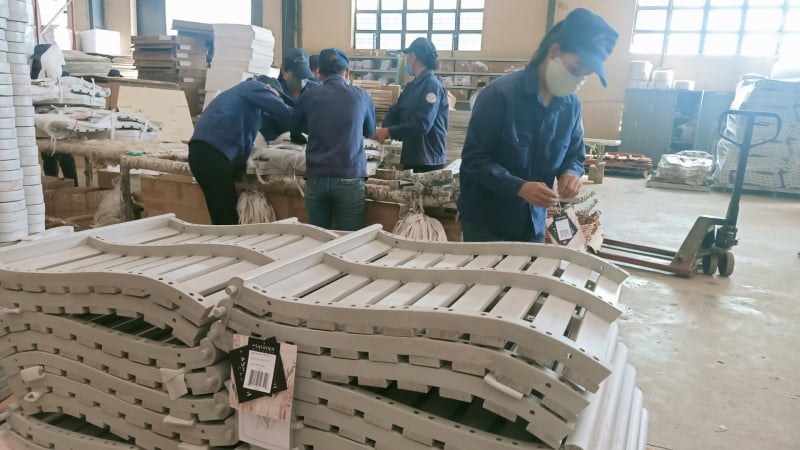
Vietnamese wood processors are treating the domestic market as a second growth pillar alongside exports worth about $17 billion-$17.3 billion. Industry representatives estimate local wood and furniture sales at roughly $5 billion, with some studies projecting more than $7.3 billion by 2030.
Domestic demand becomes a second growth pillar
Vietnam’s wood-processing industry is turning more attention to domestic housing and interior demand as global trade volatility exposes the risks of relying heavily on exports. At an August 6 webinar organized by the Vietnam Timber and Forest Products Association (VIFOREST), the Handicraft and Wood Industry Association of Ho Chi Minh City (HAWA), Forest Trends and the EUDR Forestry Network, industry representatives argued that the local market should operate as an independent growth pillar rather than an emergency outlet for lost export orders.
The shift comes from a strong international base. Dân Việt reported that Vietnam’s wood exports reached about $17.3 billion in 2025 and were sold in more than 160 countries and territories, including the United States, the European Union and Japan. The Government Electronic Newspaper described annual exports at about $17 billion. That success has built production, design, management and sustainability capabilities, but participants said domestic distribution, branding and market data have received less investment.
Vietnam has more than 100 million residents, rapid urbanization and rising demand for housing and better living spaces. Its expanding middle class is also paying more attention to design, functionality, product quality and sustainable materials. VIFOREST Secretary-General Ngô Sỹ Hoài estimated annual spending on wood and furniture at about $50 per person, putting the domestic market near $5 billion.
Market could exceed $7.3 billion by 2030
Dân Việt said some studies place the actual market closer to $7 billion and indicate that it could exceed $7.3 billion by 2030 if annual growth remains at 7%-9%. Those estimates exclude potential demand from green public procurement, social-housing programs and the biomass-energy market, according to Hoài.
The opportunity extends beyond manufacturing. Woodsland Chief Executive Vũ Hải Bằng identified design, distribution, installation and after-sales service as higher-value activities that can generate domestic employment. He warned that foreign companies could capture these segments if Vietnamese processors do not build the necessary capabilities. He cited Malaysia, where local companies face pressure as foreign suppliers move beyond materials into design, construction and project delivery.
However, domestic business presents different economics from standardized export production. Local orders are often small and customized, distribution is fragmented, brand-building costs are high and payments can take longer. Connections among manufacturers, property developers, architects, designers and consumers also remain weak. Industry representatives said these conditions require dedicated sales teams, service systems and long-term investment rather than simply redirecting export inventory.
Standards and traceability remain central obstacles
Both reports identified incomplete technical standards, inconsistent labeling and fragmented market data as major constraints. Companies and consumers lack a unified system for verifying quality and origin, while regulators have a limited basis for applying product requirements in public procurement. HAWA proposed developing company and product databases, business-matching platforms, showrooms and e-commerce infrastructure, alongside suitable preferences for Vietnamese wood products in government purchasing.
Traceability also affects export access. The Government Electronic Newspaper cited Forest Trends’ account of the United States’ Section 301 investigation in 2020-2021, which arose from Vietnam’s imports of certain higher-risk tropical timber for domestic consumption. Although exported products did not use that material, the case affected the reputation of the wider Vietnamese industry. Industry experts therefore see domestic controls as part of protecting access to overseas markets, not solely as consumer policy.
Some processors and traditional craft villages are already replacing higher-risk imported natural timber with laminated wood and panels made from domestic plantation timber. Producers are also combining plantation wood with composites, fabric and fiber to improve durability and broaden product ranges. The Government Electronic Newspaper reported that the use of higher-risk wood has declined significantly and that production costs have improved. An Cường Chairman Lê Đức Nghĩa added that digitizing the company’s full management process increased its profit margin by 2-3 percentage points without a corresponding rise in staffing. The industry’s domestic strategy will now depend on whether companies can convert such manufacturing gains into trusted brands, professional distribution and reliable service for Vietnamese buyers.