Vietnam wood exports slow to $10.2 billion as chips and pellets take over as growth driver
Vietnam's wood and wood product exports reached $10.2 billion in the first seven months of 2026, up 5.5% year on year, but high value-added furniture fell 6.2% under pressure from US tariff policy. Wood chips and pellets carried the growth, with chip shipments hitting nearly 7.8 million tonnes worth about $1.3 billion in the first half. Industry figures warn the two segments consume up to 80% of plantation wood while returning only $3-4 billion.
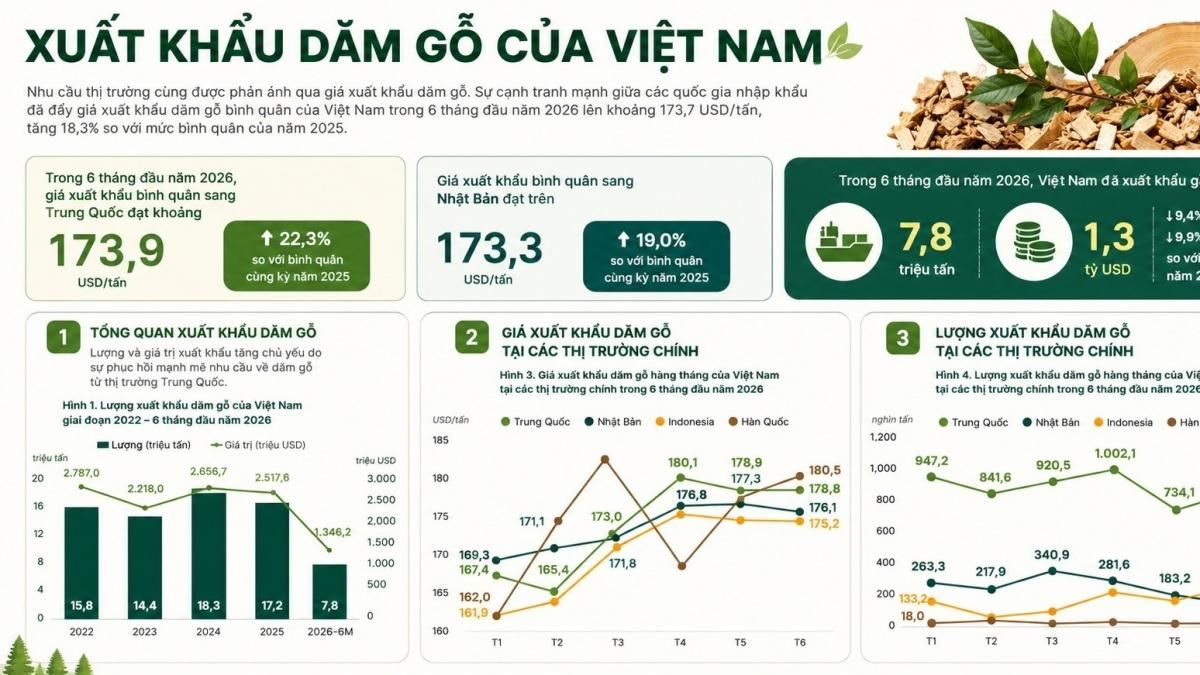
Vietnam exported $10.2 billion worth of wood and wood products in the first seven months of 2026, an increase of 5.5% on the same period of 2025, according to Cao Xuan Thanh, chief of office at the Vietnam Timber and Forest Product Association (Viforest), speaking to Mekong ASEAN. The growth rate is modest by the sector's standards, and the mix behind it has shifted: deeply processed furniture is contracting while wood chips and pellets supply the increase.
The United States remained the largest destination with 49.7% of the total, or roughly $4.2 billion. China followed with 14.9% and Japan with 12.5%.
Value-added furniture contracts under US tariff pressure
Exports of high value-added wooden furniture fell 6.2% in value year on year over the seven months, Viforest said. Cao Xuan Thanh attributed the decline mainly to tariff volatility and shifting trade policy in the United States, the market where deeply processed Vietnamese wood products account for the largest share of shipments.
Chips: 7.8 million tonnes and a price up 18.3%
A Forest Trends report citing customs data shows Vietnam shipped nearly 7.8 million tonnes of wood chips in the first half of 2026, worth about $1.3 billion, up 9.4% in volume and 9.9% in value against the first half of 2025.
Competition among importing countries pushed Vietnam's average chip export price to about $173.7 per tonne in the first half, 18.3% higher than a year earlier.
- China took 68.6% of total chip volume and remained the main source of growth, paying an average $173.9 per tonne, up 22.3% year on year.
- Indonesia bought about 809,600 tonnes, or 10.4% of the total, worth $139.5 million.
Forest Trends links the recovery in Chinese demand to intense competition in Asia's paper industry, with a number of new pulp projects announced or brought on stream. Indonesia is emerging as a further outlet as new paper mills prepare to start operations.
Pellets: Japan absorbs three quarters of volume
Pellet exports reached nearly 3.8 million tonnes worth $557.1 million in the first half of 2026, up 3.3% in volume and 1% in value. The average export price was about $147.8 per tonne, 2.3% above the 2025 average.
Japan accounted for 75% of volume, or 2.8 million tonnes worth $431 million. Forest Trends attributes that demand to the expansion of biomass co-firing plants under Japan's Feed-in Tariff (FIT) and Feed-in Premium (FIP) schemes. Shipments to the European Union also rose notably, reaching 249,600 tonnes and $38.1 million, about 6.6% of Vietnam's pellet export volume.
Raw material drain and the 2026 target
Both growth segments remain low-value users of fibre. Ha Cong Tuan, chairman of the Vietnam Association of Agricultural Economics and Rural Development Science and former permanent deputy minister of agriculture, said deep processing uses about 20% of raw material to generate $14-15 billion, while chips and pellets consume up to 80% of plantation wood yet return only about $3-4 billion.
Chip and pellet exports have absorbed most of the plantation harvest in recent years, Ha Cong Tuan said, forcing furniture manufacturers to rely more heavily on imported wood. Vietnam has roughly 4 million hectares of production plantation forest, more than 1 million forest-growing households and thousands of processing and exporting companies.
Viforest is targeting $18.5 billion in wood and wood product exports for 2026. Adding about $1.2 billion from non-timber forest products, total revenue could reach $19.5-19.7 billion, provided US tariff policy does not turn sharply unfavourable.