Vietnam's 7.7 million tonne rice export target meets weather, supply and price headwinds
Vietnam shipped about 5.5 million tonnes of rice worth $2.64 billion in the first seven months of 2026, with volume up 0.5% but value down 6.7% year on year. Reaching the 2026 target of roughly 7.7 million tonnes depends on Philippine demand, which is exposed to El Niño, while India's $360-a-tonne offers and importers' self-sufficiency drives narrow the room to manoeuvre.
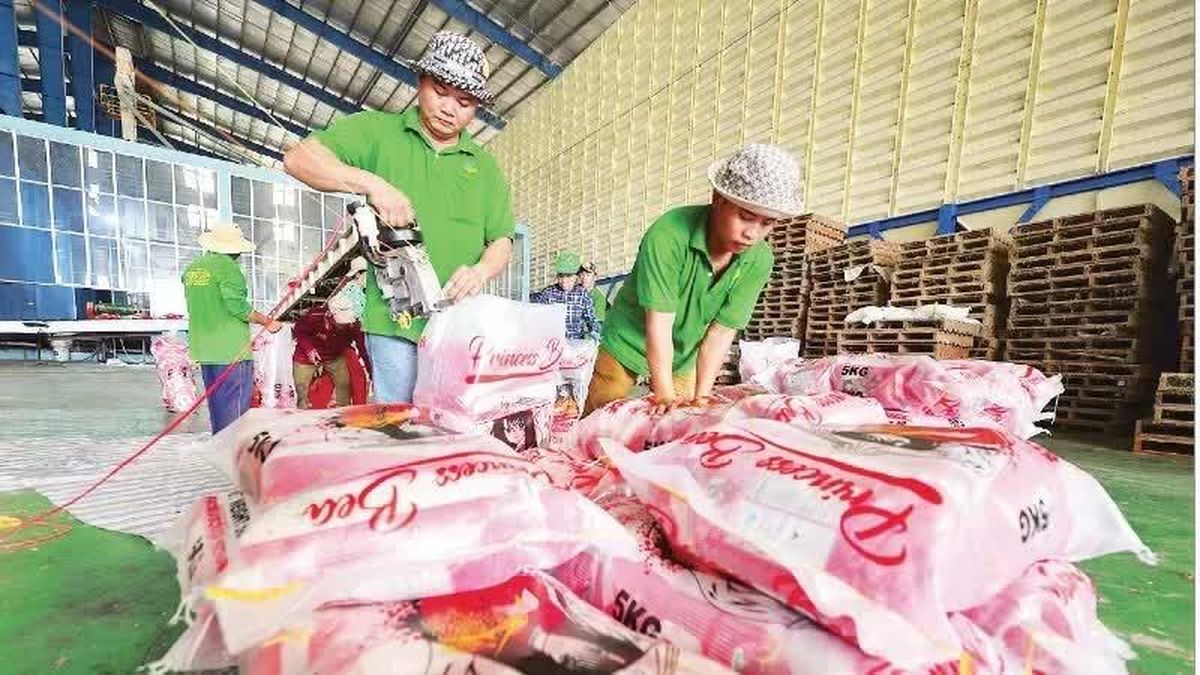
Vietnam exported about 5.5 million tonnes of rice in the first seven months of 2026, worth $2.64 billion, according to figures published by Nhân Dân. Volume rose 0.5% against the same period of 2025, but export value fell 6.7% — a divergence that points to weaker unit prices rather than weaker demand.
The country is targeting roughly 7.7 million tonnes of rice exports for 2026. That leaves about 2.2 million tonnes to be shipped in the final five months of the year, into a world market that Nhân Dân describes as exposed to weather, supply and geopolitical volatility through the end of 2026.
The Philippines remains the anchor market
The Philippines took around 2.5 million tonnes of Vietnamese rice in the first seven months, about 45% of total exports, confirming its position as Vietnam's largest buyer. Total Philippine rice imports from all origins reached roughly 3.3 million tonnes by early August.
Philippine demand looks set to hold. The country's Department of Agriculture has warned that third-quarter paddy output could fall by about 700,000 tonnes if El Niño strengthens, and has signalled it will keep importing to secure supply and stabilise domestic prices. Đỗ Hà Nam, chairman of the Vietnam Food Association (VFA), said exporters need to defend traditional markets while opening new ones, in order to reduce dependence on a small number of large partners.
Importers move toward self-sufficiency
Not every buyer is following the Philippine path. Several traditional importers are investing in their own output:
- Malaysia has set a target of 80% rice self-sufficiency by 2030;
- Indonesia is stepping up domestic procurement and building reserves;
- Bangladesh is concentrating on rice varieties tolerant of drought, flooding and salinity.
As production capacity in those markets improves, the room available to Vietnamese exporters narrows.
Price competition from India and Cambodia
Vietnamese rice is also competing against lower-cost origins. Indian 5% broken rice is quoted at about $360 a tonne, well below Thailand at $450, Vietnam at $438 and Pakistan at $401. Within Southeast Asia, Cambodia is expanding shipments to the Philippines on the strength of competitively priced long-grain white rice, while Thailand is negotiating with China and promoting its rice into the Philippine and Malaysian markets.
Against that backdrop, the VFA has asked the Ministry of Agriculture and Environment to engage directly with the Philippines and to promote a dialogue mechanism between the two countries' food associations, so that obstacles to rice trade can be cleared quickly.
The value gap
Over the longer term, raising the value of each tonne has become the strategic direction for the sector. Đỗ Hà Nam noted that Vietnam has high-quality varieties such as ST25 and Jasmine but has not built a national rice brand strong enough to command a price premium abroad. Thailand's Hom Mali sells at around $1,000 a tonne, while ST25 exported to China fetches about $700 a tonne, even though its domestic retail price converts to roughly $1,500 a tonne.
Differentiation is being pursued at the production stage. Lê Thanh Tùng, secretary general of the Vietnam Rice Industry Association (VIETRISA), said that over the past two years Vietnam has scaled up the programme for one million hectares of high-quality, low-emission rice in the Mekong Delta. VIETRISA has also created and certified the “Vietnamese green low-emission rice” label, which links product identification to quality, transparency and environmental requirements. From an initial 500 tonnes shipped to Japan in June 2025, about 70,000 tonnes had been certified and exported under the label by May 2026.