Vietnam’s rail project pipeline opens larger role for domestic contractors
Vietnam’s planned rail investments for 2025–2030 are creating a multibillion-dollar construction and engineering market. Ho Chi Minh City aims to develop domestic contractors capable of independently delivering urban rail works while using joint ventures, technology transfer and training to reduce reliance on foreign consultants.
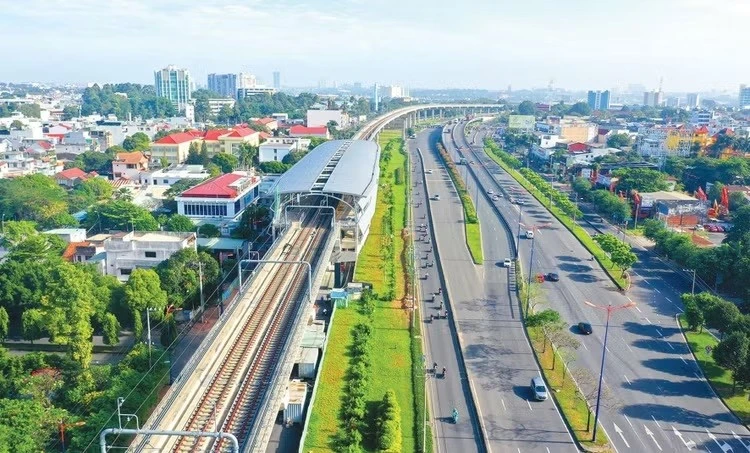
Major rail schemes move toward implementation
Vietnam’s pipeline of railway and metro projects for 2025–2030 is opening a larger market for domestic construction, engineering and mechanical contractors. Báo Đấu Thầu reports that the investment wave could help Vietnamese companies move beyond subcontracting and build the technical capacity to take leading roles in railway construction.
One of the largest proposed schemes is the Ho Chi Minh City–Can Tho railway. Tran Van Thi, director of the My Thuan Project Management Board, said the project’s pre-feasibility study had been submitted to the Ministry of Construction. The preliminary investment estimate is about VND171.3 trillion if the railway shares a road bridge when crossing the Hau River, or approximately VND175.11 trillion if a separate railway bridge is built.
The electrified line is designed to carry both passengers and freight. Its first phase would use a single 1,435 mm standard-gauge track, with maximum design speeds of 160 km/h for passenger trains and 120 km/h for freight services. Plans include 12 stations and three depots at An Binh, Tan Kien and Can Tho. The My Thuan board has recommended financing the project through public investment.
Construction timetable extends to 2035
The Ho Chi Minh City–Can Tho proposal is expected to go before the National Assembly for an investment-policy decision in August 2026. Overall technical design and project approval are scheduled for the first quarter of 2028, followed by construction starting in the third quarter of that year. The main works are expected to be substantially completed in 2035.
According to the pre-feasibility report cited by Báo Đấu Thầu, the railway would serve rising transport demand along the Ho Chi Minh City–Can Tho economic corridor, lower logistics costs and change the region’s transport mix. Its mixed passenger and freight role makes it relevant not only to civil contractors but also to railway specialists, mechanical companies and logistics operators serving the Mekong Delta.
Further projects are taking shape around Long Thanh International Airport. These include the North–South high-speed railway, the Thu Thiem–Long Thanh railway and an extension of Metro Line 1 from Ben Thanh–Suoi Tien to the administrative centre of Dong Nai and Long Thanh airport. The 48 km Thu Thiem–Long Thanh metro is being studied by Dai Quang Minh Real Estate Investment Corporation, with construction expected to start in September 2026. The Metro Line 1 extension has an estimated investment of about VND60.261 trillion and is planned for 2026–2029.
Localisation moves from policy to production
Ho Chi Minh City wants to establish a pool of domestic contractors capable of fully controlling urban railway construction during 2025–2030. Phan Cong Bang, head of the city’s Urban Railway Management Board, said the authorities also intend to reduce dependence on foreign consultants through consortium requirements, technology transfer and personnel training. Vietnamese subcontractors gained experience on Metro Line 1, and the city now wants them to assume larger and more important roles in forthcoming projects.
Domestic industrial participation is also moving into rolling stock and tunnel components. Dai Quang Minh, the investor in Metro Line 2, said it plans to begin producing railway carriages in April 2027 at a railway complex linked to its mechanical and aluminium plants. The company also plans to manufacture TBM tunnel-lining components.
Vietnamese contractors are already receiving packages on major railway infrastructure. A consortium comprising SGC Investment & Construction and Trung Chinh Trading & Construction, working with Waterway Concrete Corporation, recently completed the first two bored piles for piers P3 and P4 of the Can Gio railway bridge. The work provides an early test of whether accumulated subcontracting experience can be converted into domestic delivery capacity across Vietnam’s expanding rail programme.