Vietnam’s Processed Pistachio Exports Double to $323 Million Without Commercial Cultivation
Vietnam exported $323 million, equivalent to 8.3 trillion dong, of pistachio products in the first seven months, up 112% year on year. With no commercial pistachio cultivation, the business depends on imported inputs, domestic processing and re-export trade.
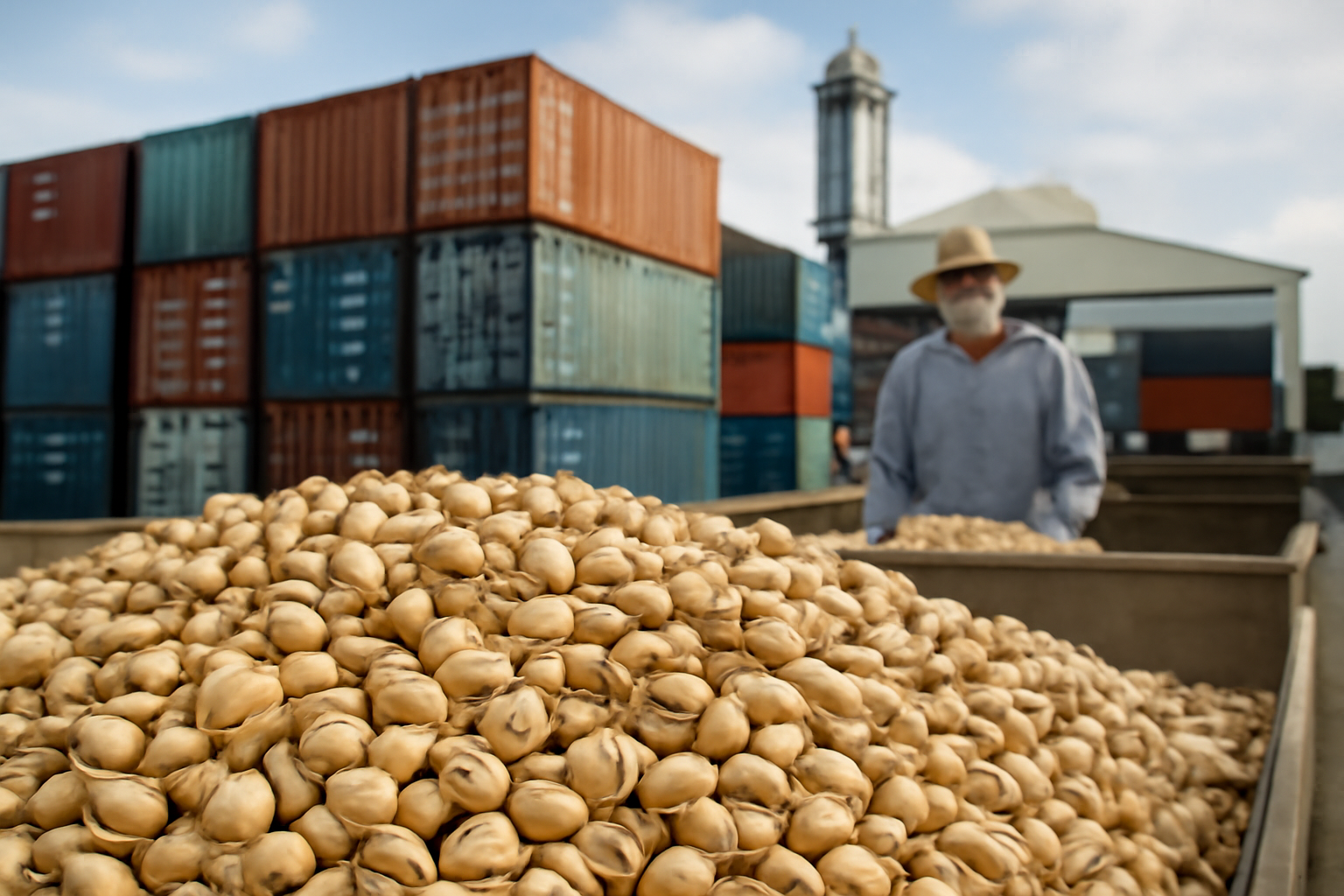
Exports rise 112% in seven months
Vietnam earned $323 million, equivalent to 8.3 trillion dong, from pistachio exports during the first seven months, according to the supplied report. The value increased 112% from the same period a year earlier, meaning exports more than doubled despite the country having no commercial pistachio cultivation.
The figures distinguish Vietnam’s position in pistachios from that of an agricultural producer. Its export earnings are tied to processed products rather than a domestically grown crop. The trade therefore reflects Vietnam’s role as a processor and re-export platform: raw or partly processed inputs enter the country, undergo value-adding operations and return to international markets as export products.
Imported inputs underpin the industry
Without commercial cultivation, processors cannot rely on a significant domestic harvest for their principal raw material. Their output consequently depends on imported pistachios and on the ability to source sufficient volumes at commercially viable prices. This makes procurement, shipping costs, product quality and continuity of supply central to the economics of the sector.
The model also changes how the headline export value should be interpreted. The full $323 million represents exported product value, not income generated entirely from Vietnamese agriculture. Part of that value covers the cost of imported nuts, while the domestic contribution comes from processing, packaging, quality control, logistics and commercial distribution. The available information does not provide import volumes, processing margins or destination-level sales, so the net value retained in Vietnam cannot be calculated from the export total alone.
Processing creates the export opportunity
The 112% year-on-year increase nevertheless shows that Vietnam has built substantial momentum in a product category for which it lacks a commercial farming base. Processing allows local companies to participate in the pistachio market without waiting for orchards to be established or for a domestic crop to reach industrial scale. It can also enable exporters to tailor formats, packaging and specifications to customer requirements, although the source material does not identify individual products, companies or destination markets.
For processors, rapid growth raises the importance of dependable raw-material contracts and sufficient factory capacity. For traders, the absence of domestic cultivation means that changes in overseas availability or input prices can pass directly into Vietnamese processing costs. Buyers must therefore distinguish between Vietnam as the recorded exporting country and the origin of the underlying agricultural commodity.
Trade data require a value-chain view
The result illustrates how processing and re-export activity can reshape country-level trade statistics. A country does not need to grow a commodity commercially to become a significant exporter of products made from it. Manufacturing capability, logistics and access to imported materials can be as important as farm output in determining where export value is recorded.
Vietnam’s $323 million performance should therefore be assessed alongside its dependence on foreign supply. Continued expansion will require processors to secure inputs while preserving enough margin after raw-material, production and logistics costs. The reported 112% rise confirms strong export growth, but the durability and profitability of that growth will depend on the operating conditions across the entire processing chain.