Vietnam’s MXV-Index rises for fifth session as oil prices jump nearly 5%
Vietnam’s MXV-Index rose for a fifth consecutive session and moved above 2,800 points on August 10 as gains dominated commodity markets. Brent and WTI advanced nearly 5% amid renewed concern over supply disruptions in the Strait of Hormuz and attacks on energy infrastructure.
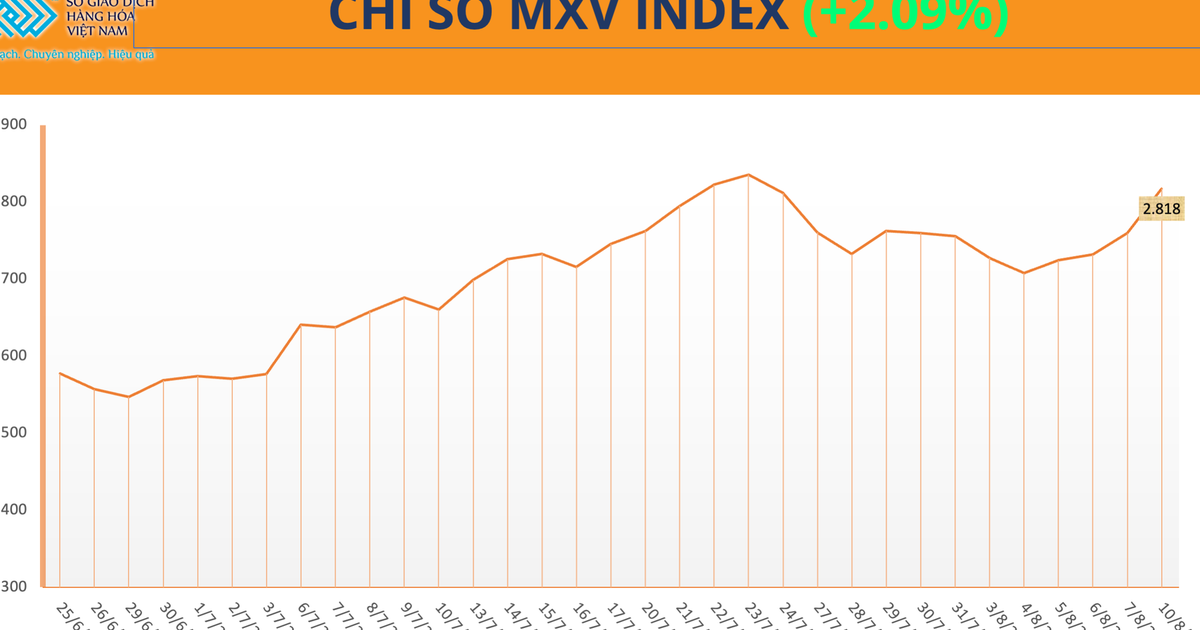
Energy gains lift Vietnam’s commodity benchmark
Vietnam’s MXV-Index extended its advance to a fifth consecutive session and moved above 2,800 points on August 10, with gains prevailing across raw-material markets. Energy led the rise as international crude prices rebounded sharply after falling more than 7% in the previous week.
According to data from the Mercantile Exchange of Vietnam, Brent gained $4.17, or 4.99%, to settle at $87.72 per barrel. WTI rose $3.95, or 5.05%, to $82.13 per barrel. The increases were the largest percentage gains for both benchmarks since July 29. On the morning of August 11, WTI was trading near $82.04 per barrel and Brent around $87.88.
Hormuz uncertainty restores supply premium
The rally followed fading expectations that normal shipping through the Strait of Hormuz would resume soon. Iran said discussions with Oman on a new maritime route had progressed, but technical issues remained unresolved. Tehran also demanded compensation from the United States, the lifting of sanctions and an end to military threats before reopening the strait. US President Donald Trump separately demanded that Iran compensate for damage and casualties he attributed to Tehran. Iranian Foreign Minister Abbas Araqchi said the countries were not holding direct negotiations.
Additional incidents reinforced concern about regional fuel supplies. Houthi forces said they had attacked Saudi Aramco’s Jazan refinery with drones. The facility has capacity of about 400,000 barrels per day. The fire was extinguished with no casualties reported, but the restart was postponed to August 30 after two attacks in recent weeks. The UAE’s ADNOC said 15 of its vessels had been attacked while passing through Hormuz since the conflict began. Ukrainian attacks on Russia’s Taneco refinery and ZapSibNeftekhim petrochemical complex added to energy-market risks.
Inventories and futures indicate a tight prompt market
US Strategic Petroleum Reserve stocks fell by about 6.1 million barrels during the previous week to 298.7 million barrels, their lowest level since January 1983. That decline reduced immediately available emergency supply if disruption persists. Higher OPEC output provided a partial counterweight: a Reuters survey showed production by 11 members increased by about 1.17 million barrels per day in July to 19.85 million barrels per day, mainly as Iraq and Kuwait restored extraction. Output nevertheless remained substantially below quotas.
Nearby Brent and WTI futures rose faster than later contracts, widening backwardation and indicating that buyers were willing to pay more for prompt supply. Commercial companies also increased options-market protection against continued disruption around Hormuz. Đỗ Xuân Quý, deputy chief executive and co-founder of 3D Commodity Trading, an MXV member, said crude retained an upward bias, although prices remained highly sensitive to geopolitical developments and could correct quickly if Middle East tensions eased.
Sugar advances as export availability draws scrutiny
Sugar prices rose alongside energy, extending their winning streak to seven sessions. Adverse weather in major growing regions and the increasing allocation of sugar cane to ethanol production in Brazil and India raised concern that exportable sugar supplies could narrow in the 2026-2027 season.
October No. 11 raw sugar increased 0.12% to $363.1 per tonne, its highest level in 10 months. White sugar gained 0.54% to $506.1 per tonne, a 15-month high. The simultaneous gains in oil and sugar highlight the influence of energy economics on agricultural processing decisions, particularly in countries where mills can shift cane between sweetener and ethanol output.