Vietnam's MXV-Index rises a third week as coffee and soybean prices surge
Vietnam's MXV-Index gained 3.25% to 2,660 points in the 6-10 July week, its third straight weekly rise. Arabica jumped nearly 11% to 7,369 USD/tonne in a fifth week of gains, while soybeans climbed nearly 5% to 434 USD/tonne on tighter USDA stock forecasts.
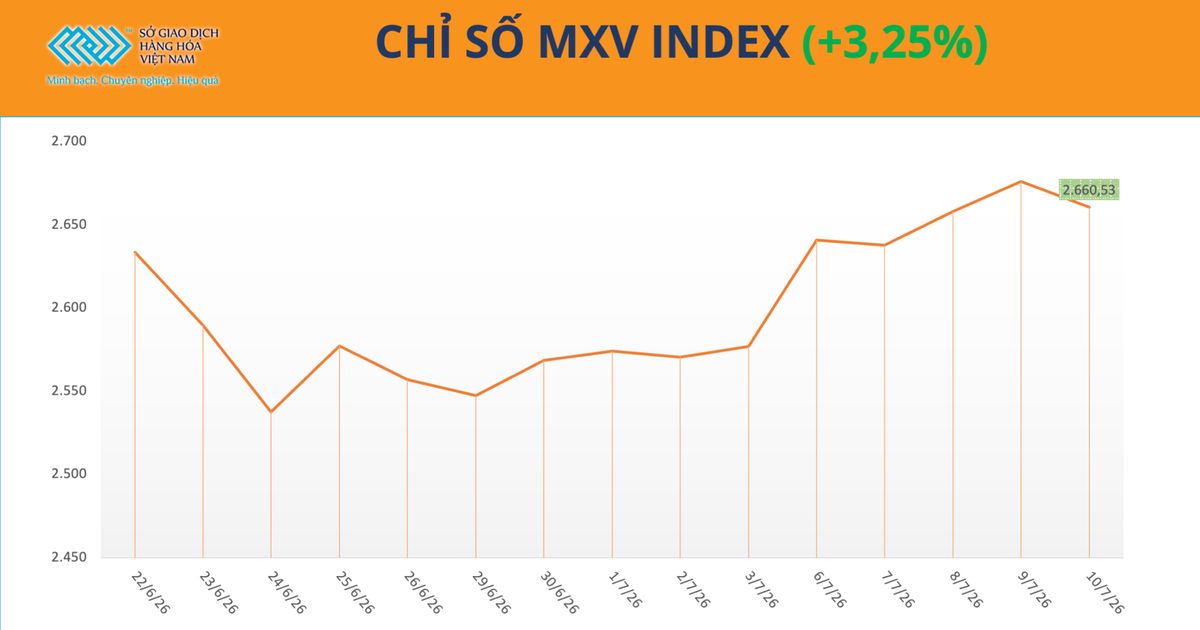
MXV-Index posts a third weekly gain
Vietnam's commodity market extended its rally in the trading week of 6-10 July, with buying dominant across all four commodity groups. According to the Mercantile Exchange of Vietnam (MXV), the MXV-Index rose 3.25% to 2,660 points, its third consecutive weekly advance. Industrial raw materials and agricultural products led the move.
The industrial group's sub-index climbed 8.15% to 2,529 points. Coffee remained the focal point with a fifth straight weekly gain. Arabica rose nearly 11% to 7,369 USD/tonne, while Robusta added 3.7% to 3,580 USD/tonne. The two coffee contracts accounted for 69% of the group's total trading value on MXV.
Coffee: supply fears and thinning stocks
MXV attributed the advance to persistent supply concerns as Brazil's harvest faltered and international inventories fell. Unseasonal rains during the June harvest peak slowed field work, triggered early flowering and knocked ripe cherries to the ground, part of which must be diverted to domestic use, trimming export availability. Bean size this crop is well below the multi-year average, cutting post-processing recovery by 15-20%.
Brazil's 2026-2027 crop had been forecast between 66.2 million bags (Conab) and 71.9 million bags (USDA). A 10-15% drop in Arabica recovery alone could erase 4.5-6.75 million bags, pulling output toward roughly 62 million bags if conditions do not improve. Certified Arabica stocks on ICE fell nearly 29,000 bags last week and now sit only about 302,000 bags above the historic low of 42,033 bags set nearly 30 years ago.
Weather risk added pressure. The US NOAA puts the probability of El Nino at 81% for October-December 2026 and 97% for it to persist into June 2027, a pattern that could hit key growing areas in Brazil, Vietnam and Indonesia. FGV Agro noted that coffee and oranges are the most weather-sensitive crops in Brazil's southeast. Speculative funds reinforced the trend, with net long positions up 25.8% to 34,454 contracts as of 7 July. In Vietnam's Central Highlands, bulk coffee averaged 95,200 VND/kg, up 2,300 VND/kg on the week, though trading stayed subdued.
Soybean complex rides USDA data
Agricultural markets had an active week. Soybeans rose nearly 5% to 434 USD/tonne, soybean meal nearly 5% to 349.6 USD/tonne and soybean oil 5.4% to 1,542 USD/tonne. The MXV-Index for agriculture gained nearly 5.5% to 1,464 points. MXV said the USDA's July WASDE report underpinned sentiment by cutting soybean stock forecasts.
For 2025-2026, USDA lowered US ending stocks by about 272,000 tonnes to nearly 9 million tonnes. For 2026-2027, ending stocks were held at 8.43 million tonnes, some 544,000-598,000 tonnes below the analyst average, while the export forecast was raised about 816,000 tonnes to 45.18 million tonnes. Globally, 2026-2027 ending stocks were cut to 124.2 million tonnes, roughly 1 million below market expectations. USDA also raised China's soybean import forecast by 1 million tonnes in each year, to 113 million tonnes in 2025-2026 and 115 million tonnes in 2026-2027.
US weather stayed in focus, with temperatures in the Dakotas seen exceeding 38 degrees C and the Northwest and Northern Plains short of rain, while heavy rain across the southern Midwest and Missouri raised local flooding risk.