US trade pressure renews debate over Canada’s dairy supply management
Concern over future US trade negotiations is reviving scrutiny of Canada’s protected dairy market. Supporters say supply management sustains regional farms, stabilizes producer prices and enforces common quality standards, while US producers see Canada as a nearby outlet.
A protected market returns to the trade agenda
The collapse of the latest trade negotiations with the United States has not ended concern that future talks could weaken Canada’s dairy supply-management system. The model repeatedly becomes a point of contention in commercial disputes with Washington, where producers are seeking greater access to the neighboring Canadian market.
Canada has about 9,400 dairy farms, including 4,134 in Quebec, according to Le Quotidien. The system is designed around three pillars: aligning production broadly with domestic demand, providing producers with a degree of price stability and controlling imports. Farms also pool resources for transport, logistics, marketing, traceability, research and development.
For Canadian producers, the debate therefore extends beyond border protection. Supply management determines where farms can operate, how milk is collected and how common standards are enforced. Any concession affecting production controls, pricing or imports could alter the economics of farms far from major processing plants.
Regional production depends on pooled costs
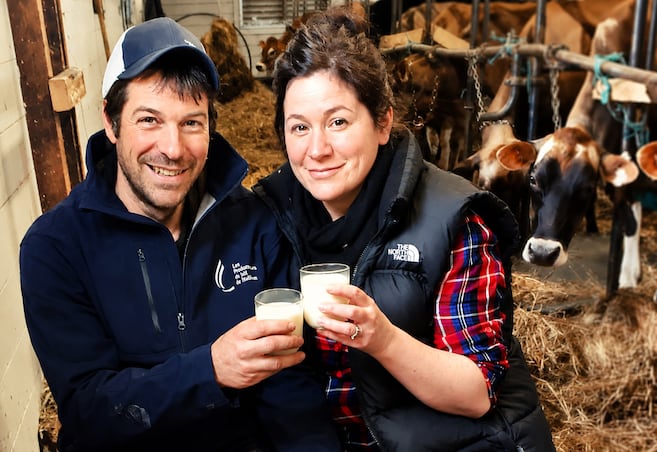
Le Quotidien illustrates the system through Évelyne Rancourt and Benoît Larochelle, who keep 72 lactating Jersey cows at Saint-Félix-de-Dalquier in Quebec’s Abitibi region. They opened a small cheese plant in February 2019, twelve kilometers north of Amos, and process part of their milk into cheese, yogurt and pasteurized, non-homogenized milk.
The farm is hundreds of leagues from Quebec’s main dairy-processing centers. Yet it pays the same transport cost as a producer located beside a plant in Saint-Hyacinthe because collection expenses are shared. That arrangement supports milk production outside the principal industrial corridors and gives processors and consumers access to a wider regional production base.
The farm shop now accounts for about one-third of the business’s revenue. Its customers include tourists, members of Cree communities and workers traveling toward mines and James Bay. The example shows how protected primary production can support local processing and retail activity in a remote market, rather than only supplying large centralized plants.
Scale, quality and the US competitive challenge
US pressure reflects substantial differences in farm structure. Northeastern US dairy production still includes many family farms that expanded over generations. In the Southwest, some operations have as many as 20,000 cows, creating major economies of scale even in areas with water deficits. A dairy cow can drink around 200 liters per day, while some water-intensive forage must be brought in from other states.
Annie Royer, professor of agri-food economics at Université Laval, argues that large southwestern farms also pressure northeastern US producers, encouraging them to seek an outlet in the nearby Canadian market. Direct comparisons between Canadian and US milk costs remain difficult because Canada’s system incorporates requirements related to environmental performance, animal welfare, food safety and quality.
Milk is tested at every collection in Canada. If antibiotic residues are detected, the entire tanker load is rejected at the responsible producer’s expense. Elsa Vasseur, associate professor of animal science at McGill University, also notes that animal-welfare rules are embedded in Canadian dairy production. New requirements taking effect in 2027 will compel some farms to change practices and facilities.
Greater import access could offer Canadian processors and buyers more supply options, but it would also expose smaller domestic farms to competition from operations operating at a radically different scale. For producers, traders and investors, the central issue in future negotiations will be whether market access can expand without weakening the pooled logistics, price stability and enforceable standards on which Canada’s regional dairy network depends.