US Natural Gas Output and LNG Exports Both Hit Record Highs in 2025
US natural gas production averaged a record 118.5 Bcf/d in 2025 while LNG exports jumped 26% to 14.6 Bcf/d, driven by new capacity from Venture Global and Cheniere. Fourth-quarter margin compression hit liquefaction stocks, but contracting activity and tightening global inventories have since revived the sector.
Record Output Led by Permian and Haynesville
US natural gas production and marketing reached a record high in 2025, rising 5.3 billion cubic feet per day (Bcf/d) to average 118.5 Bcf/d, according to data from the Energy Information Administration (EIA) cited by Texas Border Business. Roughly two-thirds of production comes from three regions: Appalachia, the Permian Basin and the Haynesville Shale, which together accounted for 81% of last year's growth. Appalachia supplied 31% of total production and the Permian Basin 23%, though the Permian posted the largest gain, up 11% and representing about half of the overall increase. Most of that growth came from associated gas produced alongside oil, supported by crude prices that remained high enough to sustain drilling activity through much of the year. Production also expanded in the Haynesville region of Louisiana and Texas, where higher well costs are offset by proximity to Gulf Coast LNG export terminals.
LNG Exports Surge to New Highs
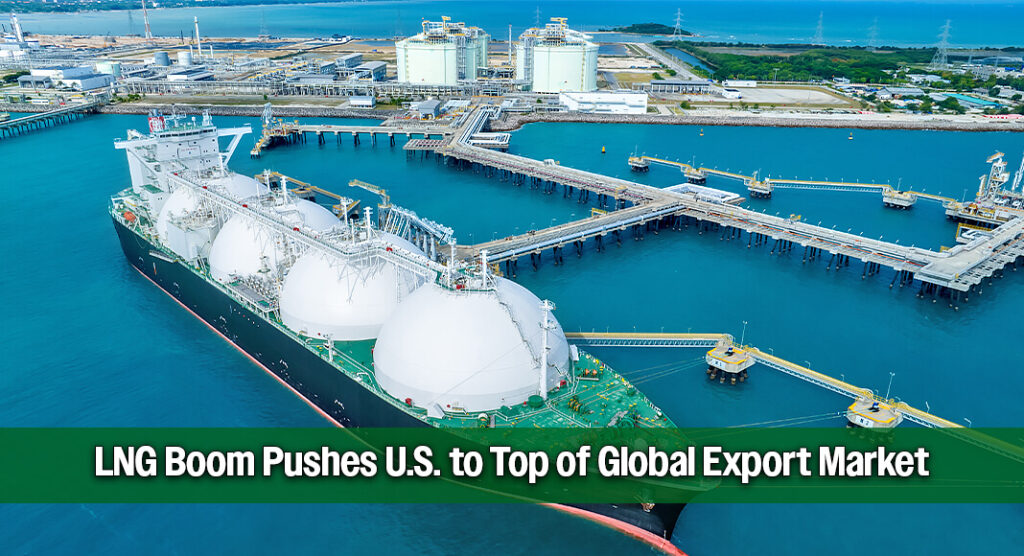
US LNG exports climbed sharply, reaching 569.3 billion cubic feet for the month of December 2025 alone, according to Texas Border Business, making the United States the largest source of LNG shipments globally. ETF Trends reported that full-year exports jumped 26% year-over-year to a record 14.6 Bcf/d, driven by the ramp-up of Venture Global's Plaquemines facility and the completion of Cheniere Energy's Corpus Christi Stage 3, both of which began production at the end of 2024. Roughly 9 Bcf/d of new export capacity reached Final Investment Decision (FID) in 2025, including projects from Venture Global, Woodside Energy and Sempra Infrastructure. Another 2.4 Bcf/d is expected online in 2026 from Venture Global's Plaquemines Phase 2 and Exxon's Golden Pass Train 1, and existing construction is set to double US export capacity by 2031, according to ETF Trends. Despite this expansion, Texas Border Business noted that natural gas prices have not risen substantially and even hit a decades-low in March 2024.
Margin Compression Hits Liquefaction Stocks
Fourth-quarter 2025 brought headwinds. ETF Trends reported that spreads between European (TTF) and Asian (JKM) LNG benchmarks and the US Henry Hub price compressed to $4-$6 per million British thermal units (MMBtu) by December, down from $8-$12/MMBtu in the first half of the year. With freight and regasification costs consuming another $1-$2/MMBtu, spot margins briefly fell below the standard fixed liquefaction fee of $2-$3/MMBtu in December. Liquefaction was the worst-performing subsector in the Alerian Midstream Energy Select Index for the year, with Cheniere down 17.1% and NextDecade down 22.4% in the fourth quarter; Venture Global was additionally weighed down by an arbitration loss to BP in October. Cheniere, the largest US LNG producer, remained comparatively insulated with over 90% of its portfolio under long-term contracts covering anticipated production through the mid-2030s. Energy Transfer suspended its 2.2 Bcf/d Lake Charles LNG project in December to prioritize pipeline investments instead.
Contracting Activity Points to Further Growth
Conditions have since shifted. Cold weather forecasts and falling gas inventories in Europe and Northeast Asia since the start of 2026 pushed global benchmarks higher again, according to ETF Trends, making liquefaction the best-performing AMEI subsector year-to-date through January 23. Three projects that had targeted 2025 FIDs pushed those decisions into the first half of 2026: Delfin FLNG said in mid-January it expects to reach FID within a month, Commonwealth LNG's parent Caturus Energy targets the first quarter, and Glenfarne signed a sales and purchase agreement for its Texas LNG project with a European energy company covering 0.1 Bcf/d, fully subscribing the project ahead of a targeted early-2026 FID. Separately, the EIA reported that US LNG developers signed the highest volume of sale and purchase contracts since 2022, underscoring continued buyer interest in US supply even as the sector navigates near-term margin pressure.