US imposes 12.5% Section 301 tariff on Thai goods as Bangkok accelerates ART talks
The US has imposed an additional 12.5% tariff on Thai goods under Section 301, while exempting 2,120 product lines representing more than half of Thailand’s export value to the US. Bangkok is accelerating reciprocal trade talks and preparing financing, tax and logistics support for affected exporters.
New levy replaces expiring Section 122 measure
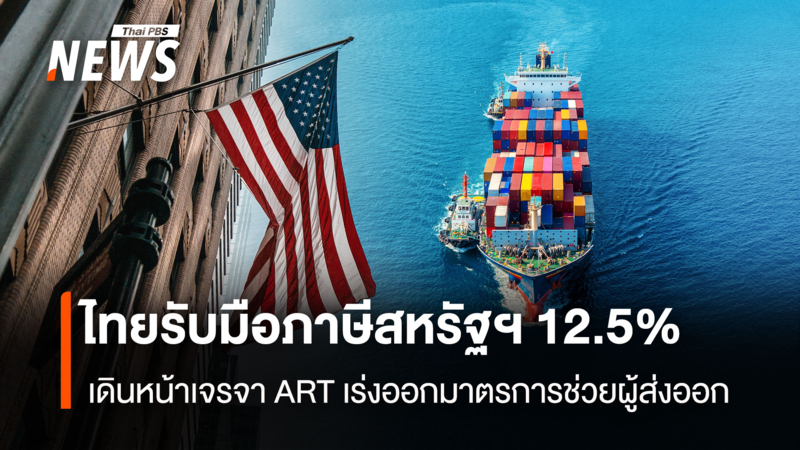
The United States has imposed an additional 12.5% tariff on imports from Thailand under Section 301 of the Trade Act of 1974, prompting Bangkok to accelerate negotiations on an Agreement on Reciprocal Trade, or ART. The measure applies on top of normal most-favoured-nation tariffs and took effect at 00:01 US time on July 24, 2026.
According to Thai PBS and The Bangkok Insight, the US announced its final determination on July 23, 2026, in an investigation concerning the absence of prohibitions on imports made with forced labour. Thailand and 37 other countries, including Vietnam, the Philippines and China, face an additional rate of 12.5%. A separate 10% rate applies to other countries covered by the decision.
The new levy replaces a 10% additional tariff collected under Section 122, which expired on July 24, 2026. The Bangkok Insight said this increases the additional burden on affected Thai goods by 2.5 percentage points compared with the expiring measure.
Exemptions cover more than half of Thai export value
The US decision exempts 2,120 Thai product lines from the additional 12.5% tariff. The exempted goods represent more than half of the value of Thailand’s exports to the US, according to both publications.
The list includes integrated circuits, hard disk drives, aircraft parts, natural rubber, rubber sheets and blocks, tapioca starch, fresh and processed pineapple, fresh and dried fruit, fresh coconuts, coconut water and cane sugar. The broad exemptions protect several of Thailand’s major industrial and agricultural supply chains from the immediate tariff increase.
Kirida Bhaopichitr, vice-minister for commerce, said the inclusion of Vietnam and China, two major Thai competitors in the US market, supported the ministry’s view that Thai products could remain competitive. Exposure will nevertheless vary sharply by product: exporters outside the exemption list must either absorb the additional cost, pass it to US buyers or renegotiate commercial terms.
Bangkok seeks an ART agreement
Deputy Prime Minister and Commerce Minister Suphajee Suthumpun, who leads the Thai delegation, said discussions with Washington were being accelerated to reach a mutually beneficial settlement and preserve the long-term trade relationship. She said Thailand wanted a timely agreement but would not compromise public health, national security, the public interest or the government’s ability to set domestic policy.
Thai PBS reported that sensitive issues and constraints under Thai law could make the negotiations take longer than those of some other regional countries. The Commerce Ministry is also monitoring a separate Section 301 investigation into structural excess capacity involving 16 countries, including Thailand. The US has not yet announced the outcome or any additional tariff rate in that case.
Support planned for exposed exporters
The ministry is preparing low-interest loans to support liquidity, tax assistance for exporters, measures to lower transport costs and improve logistics, and incentives to use more domestic raw materials and components. It also plans to help companies enter new markets while retaining customers in existing ones.
For Thai producers and traders, the immediate dividing line is whether their products are among the 2,120 exemptions. The longer-term risk is that the unresolved excess-capacity investigation could add another layer of tariffs. The ART negotiations will therefore shape not only market access in the US but also investment and sourcing decisions across Thailand’s export supply chains.