Turkish Cotton Opens New Season with Aegean Crop Down Nearly 50% and Mills Idle
The Aegean cotton harvest is expected to fall by close to 50% to 80,000-85,000 tonnes this season, against 140,000 tonnes last year, tekreferans.com reported. Şanlıurfa Commodity Exchange data for 11 September 2026 put domestic pressed cotton at 83-85 TL by colour grade, while imported pressed cotton traded at 97.97 TL. Around 60% of large spinning mills in four textile hubs have suspended production.
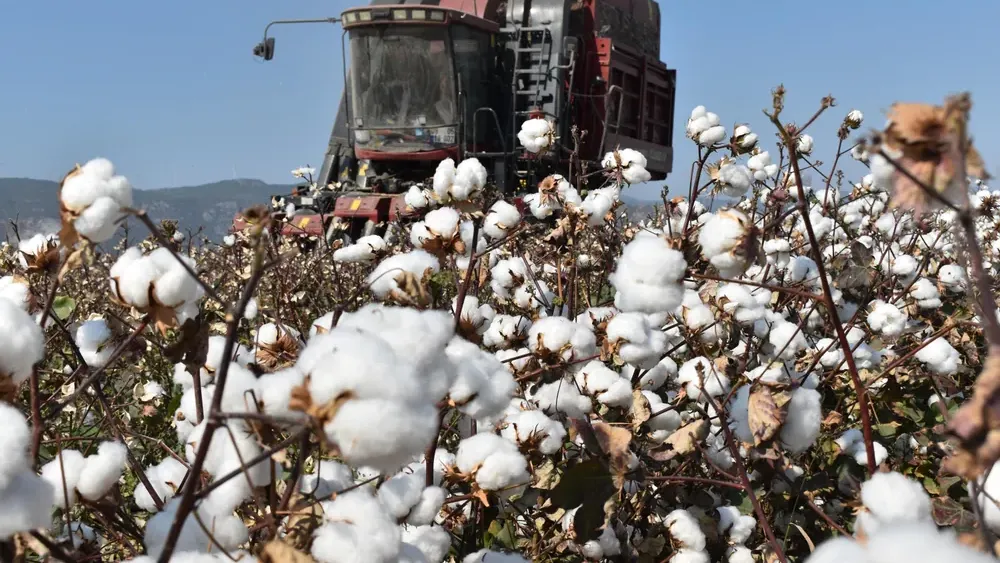
Turkey's cotton sector has opened the new season with a sharply smaller Aegean crop, idle spinning capacity and prices that vary widely by grade, according to tekreferans.com and data published by the Şanlıurfa Commodity Exchange.
Aegean crop set to fall by almost half
The Aegean cotton harvest was first announced at 160,000 tonnes last season and later revised to 140,000 tonnes. This season it is expected to fall by close to 50% to 80,000-85,000 tonnes, tekreferans.com reported — below the 100,000-tonne mark the region had been holding.
Aegean cotton was once considered a rival to Egyptian cotton on fibre length and is rated as equivalent to cotton grown in the Memphis region of the United States. According to tekreferans.com, quality began to slip after 2008, when the planting of different seed varieties was permitted under the then Minister of Agriculture and Rural Affairs, Mehdi Eker; region-specific varieties such as Nazilli 84 and Nazilli 87 degenerated over time, bringing quality problems with them. The contraction has accelerated over the past four to five years, driven by higher production costs, swings in the Turkish and global economies and capacity losses in textiles.
Şanlıurfa sets the opening prices
In Şanlıurfa, turned into a centre of “white gold” production by the irrigated area created under the Southeastern Anatolia Project (GAP), growers have turned their attention to the commodity exchange as harvest begins. Exchange data for 11 September 2026 put pressed cotton between 83 TL and 97 TL depending on quality and colour class: colour 51 pressed cotton traded at 83 TL, colour 41 at 84 TL and colour 31 at 85 TL. Standard 1 white pressed cotton was recorded in a range of 54.75 TL to 95.50 TL.
The highest figure on the list belonged to imported pressed cotton at 97.97 TL — above every domestic grade quoted that day. tekreferans.com reported domestic cotton trading at 90-94 TL, while the price of cotton in US markets rose as high as $2.15 per pound.
Spinning mills on pause, buyers turning away
Relatively competitive domestic prices have not generated the activity the trade expected. Falling capacity utilisation in textiles, ready-made garments and apparel is feeding straight through to cotton demand: around 60% of the large spinning mills in Gaziantep, Kayseri, Kahramanmaraş and Denizli have suspended production, tekreferans.com reported. Contamination — foreign matter in the lint — is compounding the problem, lifting waste rates and costs to the point where textile manufacturers have started to move away from domestic fibre.
Bülent Uçak, Vice Chairman of the Board of the İzmir Commodity Exchange, said this season's price curve will be set by demand, with cotton prices in the United States and Brazil serving as an important indicator for Turkey and the buying of garment and textile manufacturers that prefer Turkish cotton proving decisive. Growers are not satisfied with cotton and the trend of abandoning the crop is accelerating, he said, with contamination adding to costs. Cotton, Uçak noted, was historically a “balance crop” for farmers — a role that has now largely changed.
Rotations shift as imports loom
The retreat of cotton area is reshaping the region's crop pattern. Maize has spread in place of cotton on the Söke Plain, while sunflower has begun to replace wheat in some areas. In Thrace, the traditional centre of sunflower production, planted area is shrinking as growers turn to canola, and the Aegean is moving towards becoming a new sunflower production hub.
Faruk Aydın, head of the Tariş Cotton Union, said rising input costs have put cotton farming under serious pressure and that a sustainable production structure is needed. Quality problems in Aegean cotton have shifted textile manufacturers' preferences, he said, pointing to the need to grow cotton with the characteristics mills actually require and to state-organised work on new seed trials and seed breeding. “Cotton must be accepted as a strategic product,” Aydın said. He put Turkey's annual cotton demand at around 1.5 million tonnes and said that, with domestic output falling, imports of about 1 million tonnes could come onto the agenda.