Thailand targets sustainable certification for 350,000 rai of rubber by 2027
Thailand’s rubber authority aims to bring 350,000 rai of plantations under FSC or PEFC certification by 2027. The program is intended to support premium sales and improve readiness for the EU Deforestation Regulation.
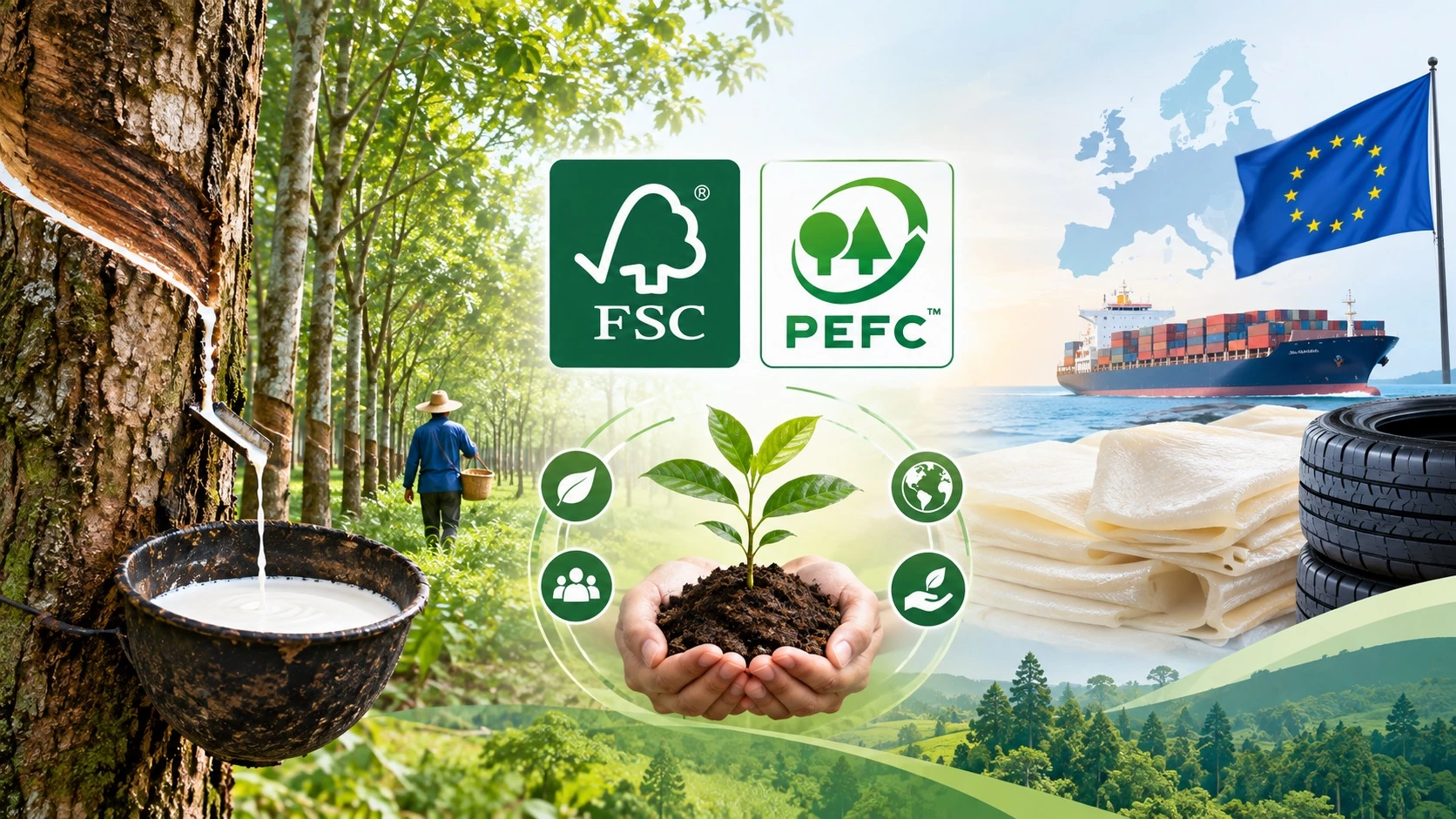
Certification target set at 350,000 rai
The Rubber Authority of Thailand plans to promote Forest Stewardship Council or Programme for the Endorsement of Forest Certification standards across 350,000 rai of rubber plantations by 2027, Bangkok Biz News reported. The initiative is designed to move Thai rubber into premium markets while aligning plantation management with international environmental requirements.
Ditsadet Wattanaporn, the authority’s deputy governor for operations, said certification could give growers more opportunities to sell rubber at prices above the general market. Demand is particularly strong among major tire manufacturers seeking FSC-certified raw material. Certification should also improve the position of Thai rubber and rubber products seeking entry into the European Union under the EU Deforestation Regulation.
Existing groups receive five years of support
Fourteen farmer groups currently participate in the authority’s program, covering more than 80,000 rai. The Rubber Authority of Thailand is funding assessment and certification costs for these groups during their first certification cycle.
Each certificate is valid for five years. Audits, certification and status monitoring cost around 500,000 baht annually, or approximately 2.5 million baht over the full five-year period. The authority will cover these expenses for all 14 groups during the initial cycle. From the second cycle onward, the groups will have to finance the cost of maintaining certification themselves.
The program assumes that a premium on certified rubber will increase farmer revenue and provide funds for future certification expenses. However, no specific premium level was disclosed. The authority also acknowledged that budget constraints prevent it from financing certification for all new applicant groups.
Private companies add 90,000 rai
To broaden participation without placing the entire cost on the public budget, the authority has coordinated with private companies. Agriac Global and CMO Thai have agreed to support farmer groups seeking FSC certification, on condition that their rubber is sold through the authority’s central market system.
Farmer groups covering approximately 90,000 rai have joined arrangements with the two companies. About 60,000 rai are associated with Agriac Global and 30,000 rai with CMO Thai. This private-sector route is expected to reduce the authority’s financial burden and allow it to concentrate more resources on market development.
FSC supports traceability but does not replace EUDR checks
FSC is a voluntary standard, but its requirements overlap with several elements of the EUDR. The forestry standard covers legal compliance, payment of fees and taxes, documented land rights, responsible land use and the exclusion of deforestation. It also requires plantation operators to consider environmental, community and labor impacts.
Certified operators must address worker safety, welfare, training and labor rights. Plantation plans must include biodiversity protection, ecosystem balance, monitoring, reduced chemical use and measures against child labor. They must also support the conservation and restoration of natural forests and limit pressure on natural resources.
The EUDR places particular emphasis on plot geolocation and supply-chain traceability. FSC certification can therefore make plantations better prepared for European due-diligence requirements, but exporters and processors will still need the location data and traceability systems required by EU rules. For growers, traders and tire-sector suppliers, the commercial result will depend on whether certified volumes attract enough of a premium to fund certification after the authority’s initial support ends.