Thailand Builds Traceability Database for 1.4 Million Rubber Growers to Meet EUDR Rules
Thailand is accelerating the registration of 1.4 million rubber growers to establish traceability under the EU Deforestation Regulation. The initiative is intended to protect access to the EU market while encouraging more diversified production in rubber-growing areas.
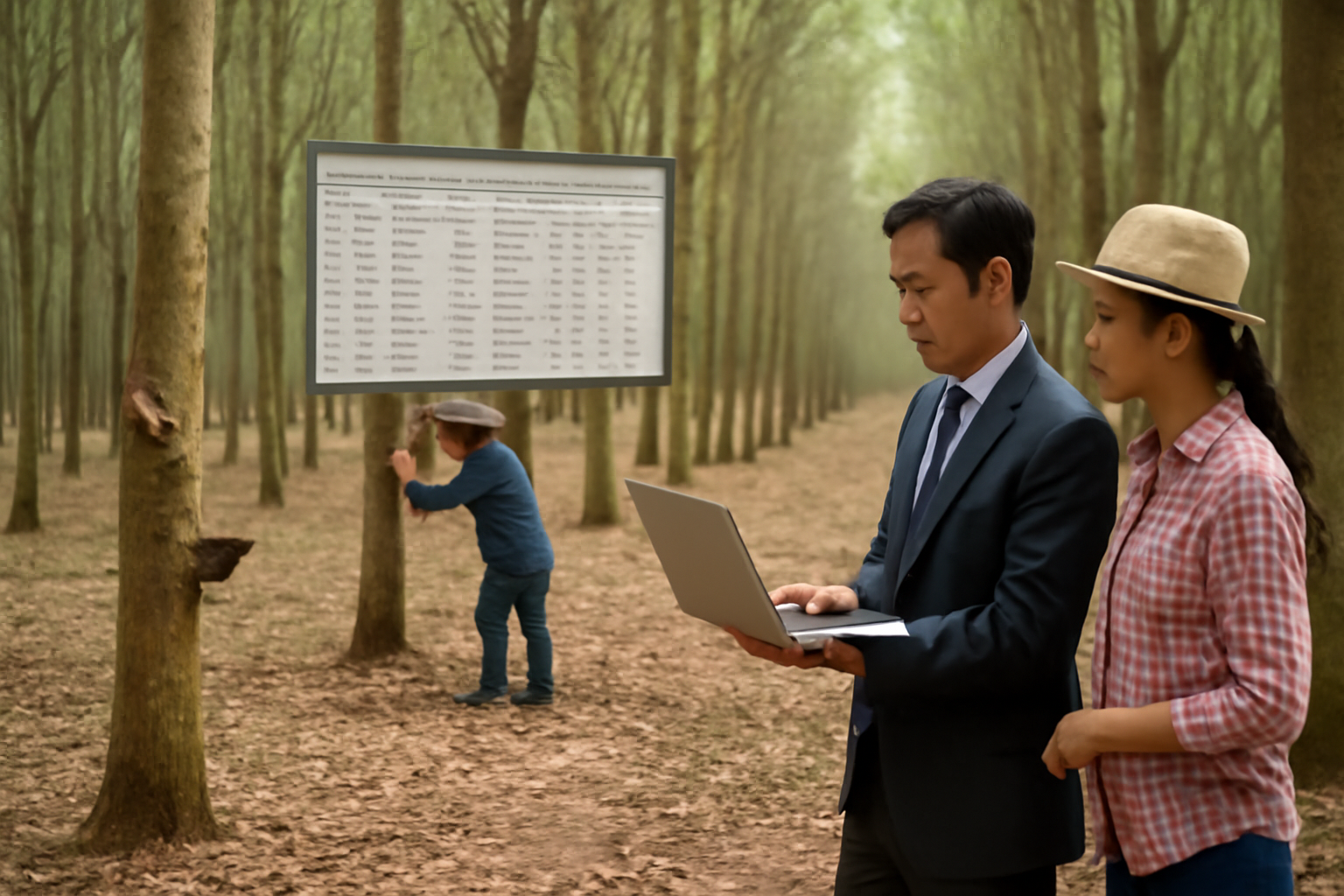
Thailand accelerates grower registration
Thailand is accelerating work on a national database covering 1.4 million rubber growers as the country prepares its supply chain for the European Union’s deforestation regulation. According to Prachachat, the initiative is being led by the Rubber Authority of Thailand and is intended to establish the traceability needed to preserve access to the EU market.
The scale of the registration effort reflects the structure of Thailand’s rubber sector. A system covering 1.4 million producers must connect farm-level information with the rubber that subsequently moves through processors and traders. For companies selling into Europe, the practical value of the database will depend on whether individual consignments can be linked reliably to registered production areas.
Traceability becomes a market-access requirement
The EU Deforestation Regulation has made supply-chain documentation a commercial issue for rubber producers and exporters. Thailand’s database project is therefore not only an administrative exercise. It is designed to give buyers and sellers a common information base for demonstrating where rubber was produced and whether the relevant holdings meet the conditions required by the European market.
For growers, registration could determine whether their output remains attractive to processors and exporters serving EU customers. For processors, the challenge is to preserve traceability when rubber from many farms is collected, aggregated and handled through successive stages. Traders will also need data that can be transferred through the supply chain without losing the connection to the original producer.
Prachachat’s report frames the programme as an effort to maintain Thailand’s position in the EU market. A complete and usable database could reduce uncertainty for European buyers sourcing Thai rubber. Gaps in registration or weak links between farm records and physical shipments, however, could leave some supply outside procurement channels that require EUDR documentation.
Songkhla visit highlights farm diversification
The initiative was highlighted during Suriya’s visit to Songkhla, a major rubber-growing area. Prachachat reported that the visit also promoted the concept of “Araya Kaset,” which would shift farms away from exclusive dependence on monoculture rubber and towards integrated agriculture involving crop cultivation, livestock, fisheries and water management.
The diversification proposal addresses income at farm level rather than traceability alone. Combining rubber with other agricultural activities is intended to create recurring sources of revenue for growers. The two policies are closely connected: the database seeks to protect market access for rubber, while mixed farming is presented as a way to reduce producers’ dependence on a single commodity.
Implementation will now be the decisive issue. Registering 1.4 million growers is a substantial data-management task, and market participants will need records that remain accurate as rubber changes hands. Thailand’s ability to translate grower registration into verifiable supply-chain information will determine how useful the system is to producers, processors, exporters and EU importers.