Thai agencies sign MOU linking farm data, FTA rules and trade finance
Thailand's Office of Agricultural Economics, the Department of Trade Negotiations and EXIM Bank have signed a memorandum of understanding to combine production statistics, tariff-preference expertise and export financing. The aim is to help farmers and agri-food exporters claim benefits under existing free trade agreements and prepare for the effects of further liberalisation. The agreement was signed at the closing of the fourth FTA Club cohort, according to Bangkok Biznews.
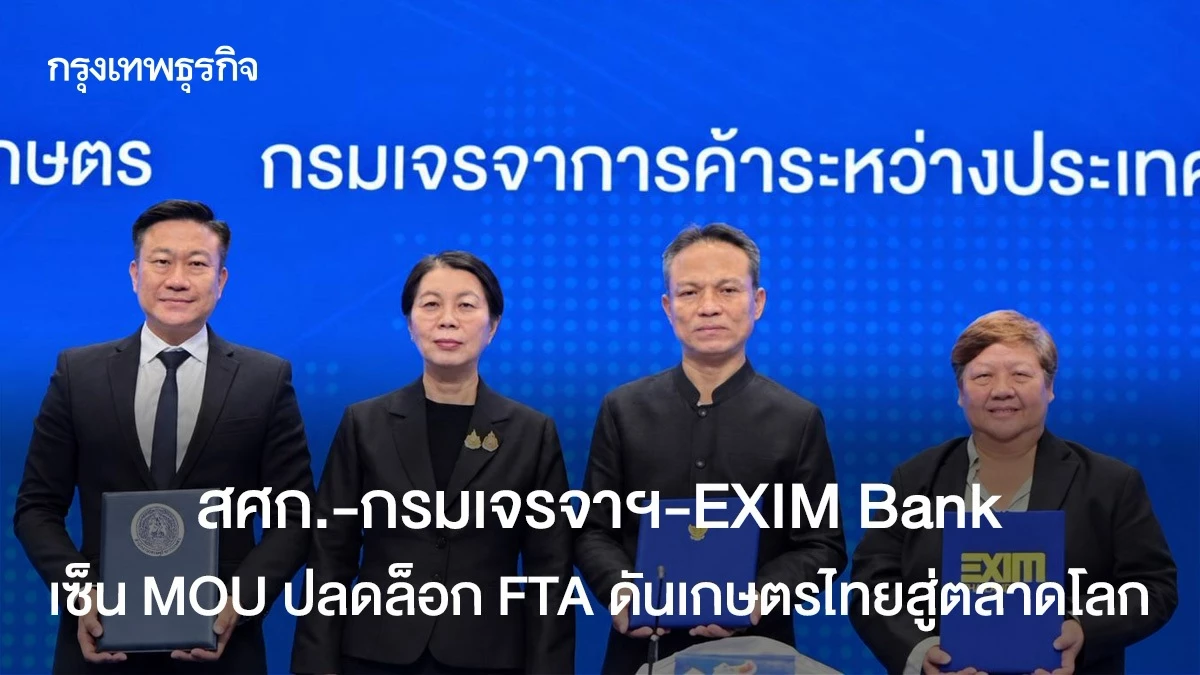
Three Thai state bodies — the Office of Agricultural Economics (OAE), the Department of Trade Negotiations (DTN) and the Export-Import Bank of Thailand (EXIM Bank) — have signed a memorandum of understanding to pool agricultural production data, free trade agreement expertise and export financing into a single support channel for farmers and exporters, Bangkok Biznews reported.
The memorandum covers cooperation on raising Thailand's international trade and investment capability for global markets. It was signed at the closing event of the fourth cohort of the programme “Building Understanding of FTA Benefits and Creating the FTA Club Network”.
Three mandates, one channel
OAE Secretary-General Peeraphan Khorthong said that encouraging the Thai farm sector to use FTA benefits requires readiness on several fronts at once: production and market data, an understanding of trade rules, and access to financial services. The three agencies concluded that linking their respective areas of expertise was the way to support market expansion while also preparing the sector for the consequences of trade liberalisation.
- The Department of Trade Negotiations contributes FTA content, tariff preferences and trade regulations.
- EXIM Bank contributes credit services, export insurance and foreign exchange risk management, with access to those services remaining subject to the bank's own criteria.
- The OAE contributes agricultural economic data and analysis, including planted area, output volumes, farm commodity prices, and agricultural import and export figures.
Closing a gap in FTA use
Bangkok Biznews frames the signing as an attempt to close a strategic weakness rather than a routine administrative exercise, arguing that Thai farmers have historically been left on the margins of FTA utilisation because they lacked precise production data and were wary of financial risk.
Under the arrangement, OAE data on production capacity is intended to be read alongside market information and trade conditions, so that exporters can judge where Thai agricultural goods have room to expand and where producers will need to adapt. The same analysis is meant to feed into policy proposals for developing the farm sector under liberalised trade.
Adjustment as well as expansion
Peeraphan said the cooperation should give exporters and farmers a basis for planning production and sales in line with market opportunities, while state agencies can use the joint analysis when designing support measures for parts of the farm sector exposed to liberalisation.
The OAE will transfer data and knowledge through activities carried out under the framework, including training courses, seminars and advisory services, so that farmers and businesses can apply the information to their own decisions. “Linking OAE data with FTA knowledge and financial services will help operators see business opportunities and prepare on all fronts,” Peeraphan said, adding that the agency's goal is for agricultural economic data to improve farmers' production and marketing planning.
What the agreement does not specify
The report does not disclose a budget, a duration or numerical targets for the cooperation, and it does not identify priority commodities or destination markets. Nor does it indicate how many farmers or firms the FTA Club network has reached across its four cohorts.
Bangkok Biznews describes the combined effort as an end-to-end export ecosystem, and argues that the result to watch is not only higher export values but the ability of farmers to adjust to free trade competition and to move from supplying raw materials to trading actively within the FTA network.