Thailand’s FTA preference use reaches 81.32% on $40.44 billion of exports
Thai exporters claimed FTA preferences on $40.44 billion of eligible exports in May 2026, up 8.38% year on year. Industrial goods generated 73.27% of the value, while ASEAN and China were the two largest destinations under the agreements.
Preferential trade reaches $40.44 billion
Thai exporters used benefits available under free-trade agreements for $40.44 billion of exports in May 2026, according to Naewna, citing Arada Fuangtong, director-general of Thailand’s Department of Foreign Trade. The value increased 8.38% from the same period a year earlier and represented 81.32% of exports eligible for preferential treatment.
The figures indicate that tariff preferences are being applied across a large majority of qualifying shipments. For Thai producers and exporters, effective use of an FTA can lower the landed cost of goods in partner markets, although companies still need to meet rules of origin, documentation requirements and product standards.
ASEAN and China lead agreement use
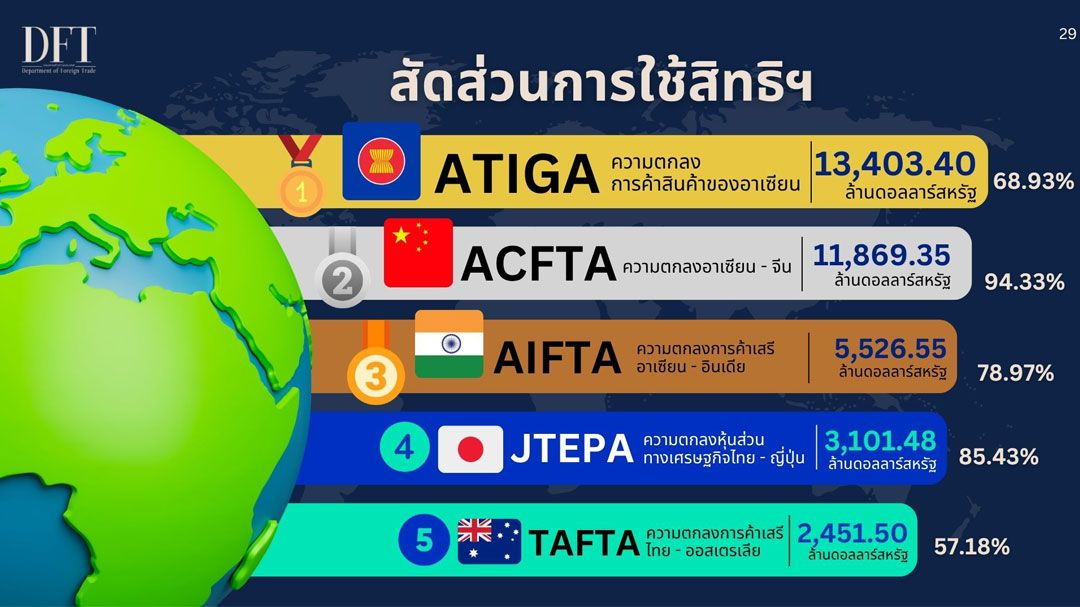
Exports using preferences under the ASEAN Trade in Goods Agreement ranked first at $13.40 billion, with a utilization rate of 68.93%. The ASEAN-China Free Trade Area followed at $11.87 billion and recorded a substantially higher utilization rate of 94.33%. Preferences under the ASEAN-India agreement covered $5.53 billion of exports, equivalent to 78.97% of eligible trade.
The Thailand-Japan Economic Partnership Agreement accounted for another $3.10 billion, with utilization at 85.43%. The Thailand-Australia FTA ranked fifth by value at $2.45 billion, but its utilization rate was the lowest among the five leading agreements at 57.18%. The spread between China’s 94.33% and Australia’s 57.18% suggests that the practical value of an agreement depends not only on tariff schedules but also on the product mix and exporters’ ability to satisfy its conditions.
Industrial goods account for nearly three quarters
Industrial products generated $29.63 billion, or 73.27% of all FTA preference use. The leading categories were vehicles for transporting goods, jewelry made from other precious metals, synthetic rubber mixed with natural rubber, gold and silver articles and components made from other precious metals, and copper waste and scrap. Fresh durian was the highest-ranked individual product overall.
Agricultural and processed food products contributed $10.81 billion, equal to 26.73% of the total. The principal products were fresh durian, other cane sugar, prepared chicken meat, frozen chicken cuts and offal, and fresh rambutan, longan and pomegranate. This mix shows that preferential access supports both Thailand’s industrial supply chains and its established food and agricultural export sectors.
SMEs prepare for EFTA markets
The Commerce Ministry sees the changing geography of global supply chains as an opportunity for Thailand, pointing to the country’s location, infrastructure, foreign-policy position and network of trade agreements. It wants businesses to use FTAs alongside innovation, higher standards and cost reduction to reach higher-value markets, including Latin America and South Asia.
In August 2026, the department’s Boost Up SMEs to FTA Markets project is scheduled to take Thai small and medium-sized enterprises to Switzerland and Norway. The mission is intended to connect them with buyers and importers before the Thailand-European Free Trade Association agreement is expected to take effect in early 2027. The department also identified India as a large market with growing purchasing power. For participating SMEs, the immediate task will be to turn market access into orders while ensuring that their products comply with origin and premium-market requirements.