Thailand Cuts 2026 Manufacturing Forecast to 0-0.5% as Fertilizer Output Falls 41%
Thailand's Office of Industrial Economics has lowered its 2026 manufacturing production index forecast to 0.0-0.5% from 1.0-2.0%, and industrial GDP to 0.75-1.75%. July MPI rose 0.46% to 94.80, supported by electronics and hard disk drives, while chemical fertilizer output fell 41.31%.
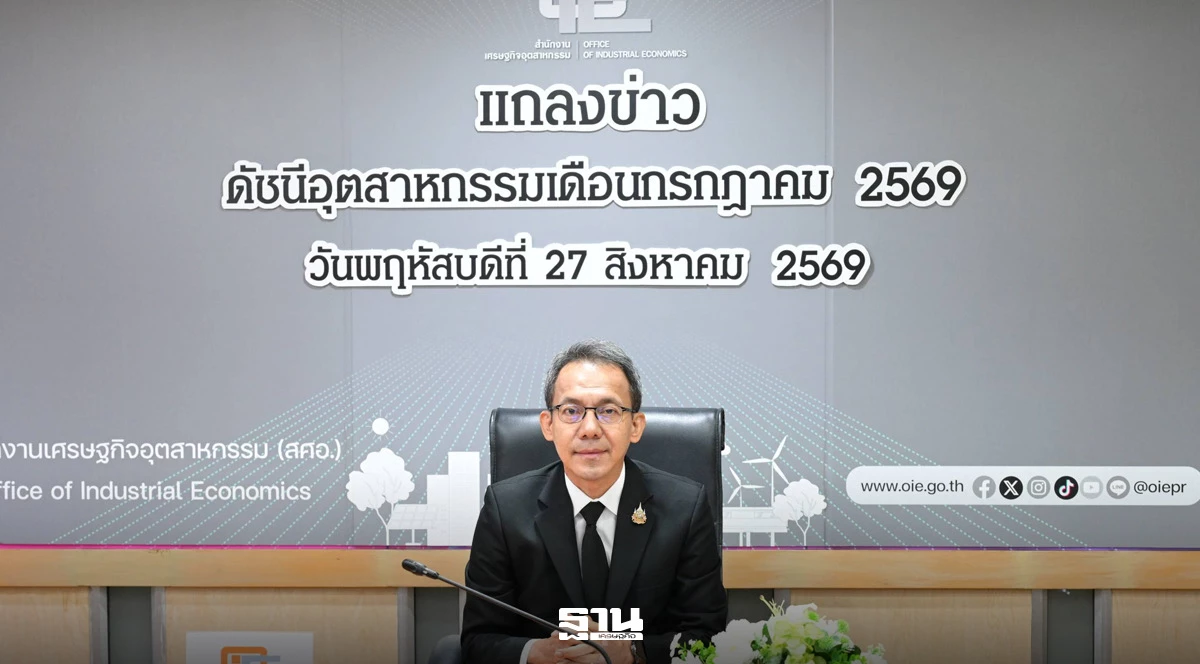
Thailand's Office of Industrial Economics (OIE) has lowered its 2026 forecast for the manufacturing production index (MPI) to growth of 0.0-0.5%, down from the 1.0-2.0% range it projected earlier. The agency also cut its estimate for industrial GDP to 0.75-1.75% from 1.0-2.0%, according to Thai business daily Thansettakij. The revision removes the upper half of the previous MPI range and lowers both ends of the industrial GDP forecast.
July output barely positive
The MPI stood at 94.80 in July 2026, up 0.46% from the same month a year earlier, OIE director Supakit Boonsiri said. He linked the increase to industries aligned with technology trends and shifting consumer behaviour rather than to a broad recovery across manufacturing.
Electronics was the clearest source of growth, expanding on demand tied to artificial intelligence and digital infrastructure. That demand fed through to hard disk drive production and electronic components. Two food segments also supported the index: prepared pet food, which the agency linked to the pet humanisation trend, and ready-to-eat food, which benefited from urban consumption patterns.
Government measures to support purchasing power and cushion energy costs added to the result, as did a weaker baht, which the OIE said helps the price competitiveness of Thai export goods.
The picture was far less favourable elsewhere. Chemical fertilizer production fell 41.31% year on year in July, according to Thansettakij, offsetting much of the contribution from the technology-linked sectors.
Four pressures on the outlook
The OIE identified four main pressures it is monitoring closely for the rest of 2026:
- geopolitical conflict, including the situation in the Middle East, which drives energy price volatility and raises production and logistics costs;
- uncertainty over US economic policy and import tariff measures, which could affect export sentiment and competition in overseas markets;
- household debt and consumption that has yet to recover;
- competition from low-priced imported goods.
The agency also flagged risks to raw material sourcing and to supply chain continuity, alongside the adjustment of supply chains and trade patterns. A slowdown in foreign tourist arrivals could affect related industries such as food and beverages. Even so, the OIE said Thai manufacturers have been able to adapt, manage costs and hold production at appropriate levels.
Early warning system reads normal, with caveats
The OIE's industrial economy early warning system gave a preliminary normal signal for Thailand overall in August 2026, helped by expanding private investment. Weak domestic purchasing power and US import tariff measures remain pressures on domestic production. For external factors the system issued a watch signal, reflecting concern that US import tariffs could affect manufacturing in some countries. Continued growth in demand for electronics was the offsetting positive.
What could support industry
The agency listed several factors expected to support Thai industry in the period ahead: trade with major partners still trending upward, government economic stimulus measures, expanding private investment, and demand for electronics tied to AI and data centres. Those are the same drivers behind the July result, leaving the 2026 outcome dependent on a narrow set of technology-linked segments while domestic demand and fertilizer-intensive activity remain weak.