Thai Rice Exports Fall 18.81% to 3.28 Million Tonnes in First Half of 2026
Thailand shipped 3.28 million tonnes of rice in January–June 2026, down 18.81% year on year, with value falling 20.51% to more than $1.911 billion. The Department of Foreign Trade blamed abundant global supply, uncompetitive Thai prices and the suspension of shipments to Iraq since March. It still expects the full-year target of 7 million tonnes to be met, 15% below 2025 volumes.
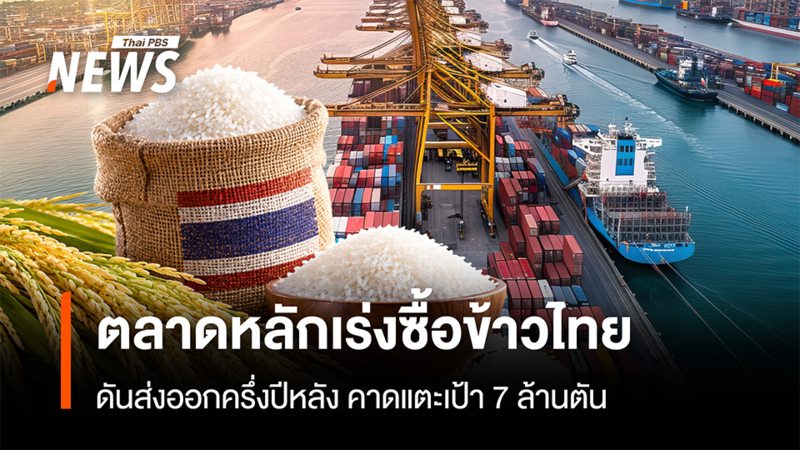
Thailand exported 3.28 million tonnes of rice in the first six months of 2026, an 18.81% decline from the same period a year earlier, the Department of Foreign Trade said on 5 August. Export value fell 20.51% to more than $1.911 billion, equivalent to about 60.387 billion baht. The figures were released by department director-general Arada Fuangthong and reported by Thai PBS and Bangkok Business News.
The department attributed the contraction to the large volume of rice available on the world market, which sharpened price competition among exporters, and to the conflict in the Middle East. Shipments to Iraq, one of Thailand's main destinations, have been suspended since March 2026. Bangkok Business News also cited production costs, freight and rising energy and fuel prices as reasons Thai export quotations sit above those of competing origins.
Price gap against Asian rivals
Thai white rice was quoted at $447 per tonne, against $435 for Vietnam, $405 for Pakistan and $367 for India, according to the comparison published by Bangkok Business News. The difference of $80 per tonne with Indian rice is the widest among the four origins, and it applies to the standard white grades that make up the largest share of Thai shipments. For buyers purchasing on price rather than on aroma or grade specification, that spread is decisive.
White rice and hom mali lead the shipment mix
White rice remained the single largest category in the first-half mix, followed by Thai hom mali. The breakdown reported by Bangkok Business News was as follows.
- White rice: 1.51 million tonnes, or 46.03% of the total
- Thai hom mali rice: 0.81 million tonnes, 24.67%
- Parboiled rice: 0.61 million tonnes, 18.69%
- Thai fragrant rice: 0.23 million tonnes, 6.97%
- Glutinous rice: 0.11 million tonnes, 3.31%
- Brown rice: 0.01 million tonnes, 0.33%
That places 64.72% of volume in the two categories most exposed to price competition, white rice and parboiled rice, while the aromatic grades, hom mali and Thai fragrant rice, together account for 31.64%.
New markets and the 7-million-tonne target
The department said it sees potential in markets that can replace Iraqi demand, naming Malaysia and the Philippines in Asia and South Africa, the Democratic Republic of the Congo and Mozambique in Africa. All of them increased purchases of Thai rice compared with the same period last year, which the department linked to confidence in Thailand as a supplier, on-time delivery under contract and a stable government export policy.
The Department of Foreign Trade said it would accelerate government-to-government (G2G) negotiations with COFCO and the Chinese government, and that a delegation of public and private sector representatives was scheduled to meet major importers in the Philippines and Malaysia between 2 and 6 August. The stated aim is to reduce dependence on any single market and to generate orders that absorb Thai output.
Arada said the prospect of drought linked to El Nino had prompted several importing countries to consider raising purchases to build stocks and strengthen domestic food security, which she described as a positive signal for Thai exports over the remaining five months of the year. On that basis the department expects the annual target of 7 million tonnes to be met, a level that would still be 15% below the 8.3 million tonnes Thailand exported in 2025.