Thai modified starch exports forecast to reach four-year high in 2026
Thailand’s modified starch exports are forecast to rise 2.4% to 1.10 million tonnes in 2026, from about 1.07 million tonnes in 2025. ThaiPR reports that the projected volume would be the highest in four years since the pandemic.
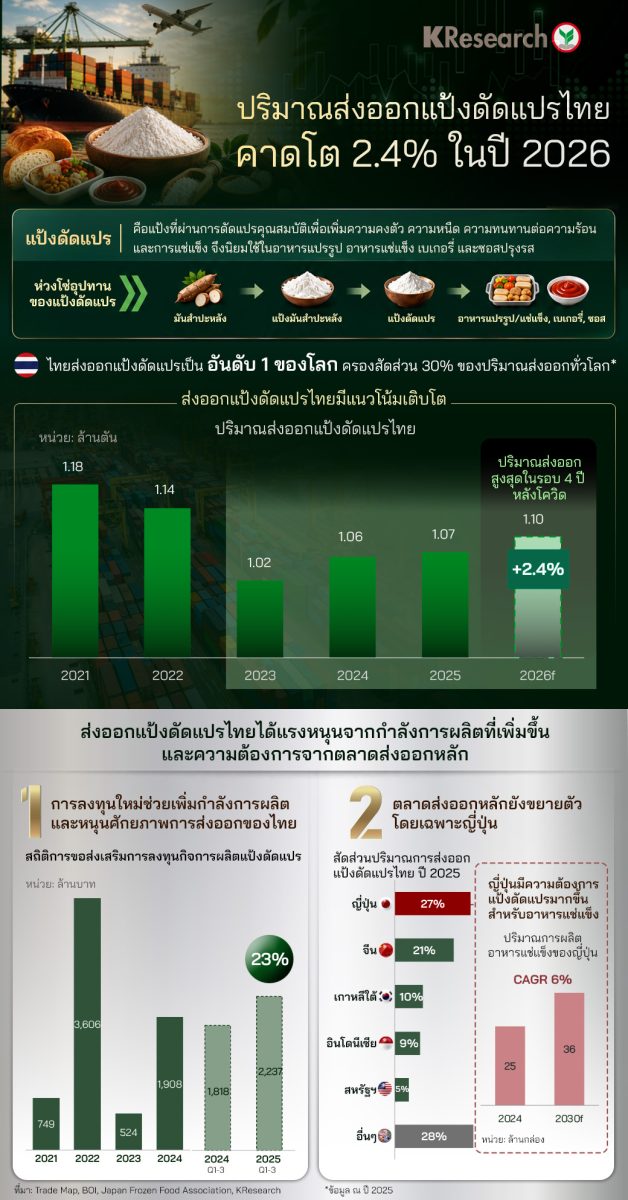
Export volume forecast at 1.10 million tonnes
Thailand’s modified starch exports are forecast to increase by 2.4% in 2026, extending the recovery of an industry supplying processed ingredients to customers outside the country. Export volume is expected to rise from about 1.07 million tonnes in 2025 to 1.10 million tonnes in 2026, according to ThaiPR.
The additional volume is modest relative to the size of the market, but the forecast carries a stronger historical signal. At 1.10 million tonnes, exports would reach their highest level in four years following the pandemic. The projection therefore points to a continued improvement in overseas shipments rather than a sudden expansion in Thailand’s production or processing base.
Recovery depends on demand from overseas processors
Modified starch is an industrial ingredient rather than a finished consumer product. Export performance consequently depends on purchasing decisions by processors and manufacturers in destination markets. A 2.4% rise would indicate that overseas customers can absorb more Thai material in 2026, although the available forecast does not identify individual destination countries or provide a breakdown by application.
The projected increase from approximately 1.07 million tonnes to 1.10 million tonnes also suggests incremental market growth. For Thai producers and exporters, that creates an opportunity to raise plant utilisation and shipment volumes without assuming a sharp change in demand. For international buyers, higher availability could broaden procurement options, but the forecast provides no price data and does not establish whether the added volume will affect contract terms or spot-market quotations.
Four-year high strengthens the post-pandemic benchmark
The four-year comparison is important for companies assessing whether the export recovery is durable. Reaching the strongest post-pandemic volume would give producers, traders and investors a clearer benchmark for evaluating order books, capacity use and logistics requirements. It would also move the discussion beyond a comparison with 2025, when exports are estimated at around 1.07 million tonnes.
However, the forecast is a volume projection, not a revenue forecast. Export earnings can move differently from tonnage because sales values depend on product specifications, customer mix, contractual arrangements and market prices. None of those variables is quantified in the available source material. The 2.4% growth estimate should therefore be read as evidence of improving physical demand, not as a direct indication of stronger margins or export income.
Industry focus turns to execution in 2026
The central test will be whether exporters convert the forecast into actual shipments during 2026. Producers will need to align processing schedules and logistics with the expected rise to 1.10 million tonnes, while traders will monitor whether orders remain strong enough to sustain the four-year high. The outlook is positive in volume terms, but its commercial impact will depend on how consistently overseas demand develops through the year.