Syrian food and textile producers seek to rebuild sales in Gulf markets
Syrian manufacturers are renewing commercial ties with Gulf importers after more than a decade of falling exports and industrial capacity. Food and agricultural products have the strongest immediate prospects, while textile producers face deeper constraints in productivity, skills, equipment and price competition.
Existing food trade provides a starting point
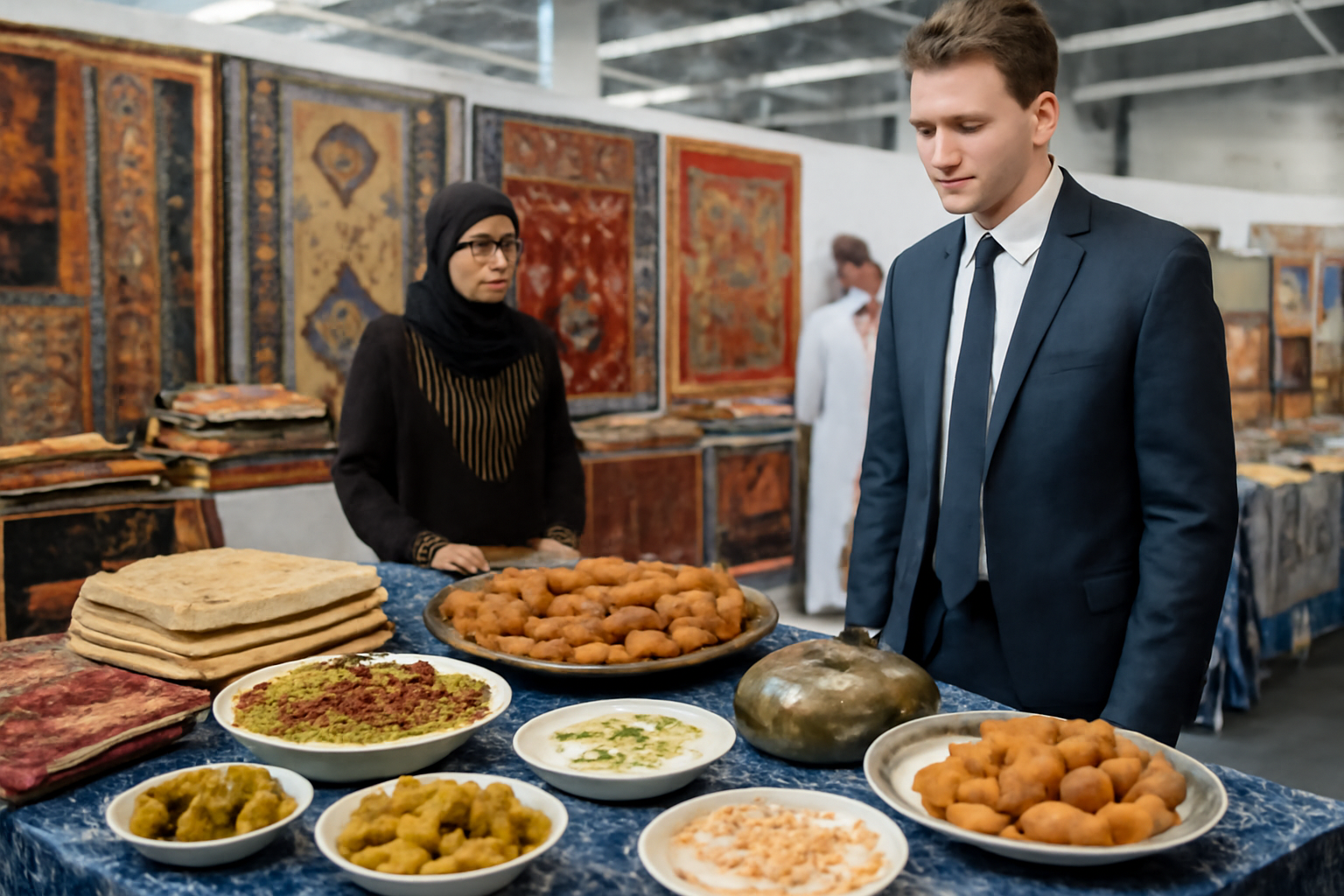
Syrian manufacturers are trying to rebuild their position in Gulf markets after more than a decade of contracting exports and declining production capacity. Erem Business reports that direct contact between Syrian producers and Gulf importers has resumed, with the Syrix exhibition in Jeddah providing a recent channel for commercial discussions. The central test is whether those contacts produce recurring supply contracts rather than isolated transactions.
Food processing and agriculture appear best placed for an early expansion because Syrian goods already reach several Gulf markets. According to DataSaudi figures cited by Erem Business, Saudi imports from Syria increased 19.9% in 2025 to 820.8 million Saudi riyals. Animal and vegetable fats and oils, preparations of vegetables, fruit and nuts, and fresh fruit, nuts and citrus peel represented about half of that value, exceeding 411 million Saudi riyals.
The United Arab Emirates also recorded rapid growth. Official Emirati data announced in May put non-oil trade with Syria at about $1.4 billion in 2025, an increase of 132.4%. Kuwait imported $57.8 million of Syrian goods during the year, with oils and fats, live animals, vegetables and fruit prominent in the product mix. These established flows give food suppliers functioning importer and distribution networks from which to increase volumes or add products.
Past exports show a broader product base
Syria’s Gulf trade was geographically and commercially broader before the civil war. UN Comtrade figures cited by Erem Business show that in 2010 Syrian exports reached $542.6 million to Saudi Arabia, $161.2 million to Kuwait, $90.2 million to the United Arab Emirates and about $66 million to Qatar. Shipments included vegetables, fruit, live animals and processed food, as well as clothing, textiles and other manufactured goods.
Nominal values from 2010 cannot be compared directly with current figures because prices, demand and competitive conditions have changed over 15 years. They nevertheless demonstrate that Syrian exporters once sold a more diverse range of products across the Gulf. Geographic proximity and tariff exemptions available under the Greater Arab Free Trade Area for goods meeting rules of origin could again support shorter delivery times and lower landed costs.
Textiles face entrenched Asian competition
The textile industry has a more difficult route back. Saudi imports of Syrian non-knitted clothing were about $9 million in 2025, compared with Syrian exports in the same category worth $32.9 million in 2010, according to UN Comtrade data reported by Erem Business. Meanwhile, Saudi Arabia imported about $358 million of knitted clothing from India, $192 million from Bangladesh and $72.5 million from Turkey in 2025. These figures cover a different apparel category but illustrate the scale and depth of competing regional and Asian supply networks.
Syrian textile producers must therefore improve factory productivity and unit costs while delivering consistent quality, large orders and reliable schedules. Their constraints include shortages of skilled labor, cotton availability, aging machinery and energy supply. An International Labour Organization assessment of 140 factories in Damascus, Aleppo, Homs and Hama identified skills gaps across food, textile, chemical and engineering industries.
Factory growth must translate into reliable capacity
The wider production base remains below its prewar level. A United Nations Development Programme study valued private manufacturing output at constant prices at 428.4 billion Syrian pounds in 2010, falling to 261 billion Syrian pounds in 2024. Syria’s Ministry of Economy and Industry says more than 2,000 factories have been established since March 2025 across food, chemical, textile and engineering industries, creating about 30,000 jobs.
New registrations and jobs indicate renewed industrial activity, but they do not establish how much export-ready capacity is operating. Gulf buyers will evaluate actual output, cost, quality and delivery performance. Food and agricultural suppliers can build on active trade channels and existing demand; textile companies must first close larger productivity and supply gaps. For both sectors, the practical measure of recovery will be sustained contract volumes rather than exhibition attendance or the number of newly established plants.