Suntory to reclassify Kinmugi as beer under Japan’s alcohol tax reform
Suntory will convert its Kinmugi and Kinmugi 75% Less Carbohydrate products from low-tax quasi-beer to beer on October 6. The company plans to reflect only the additional tax in prices, including ¥880 for a six-pack of 350 ml cans, while retaining the brand’s economy positioning.
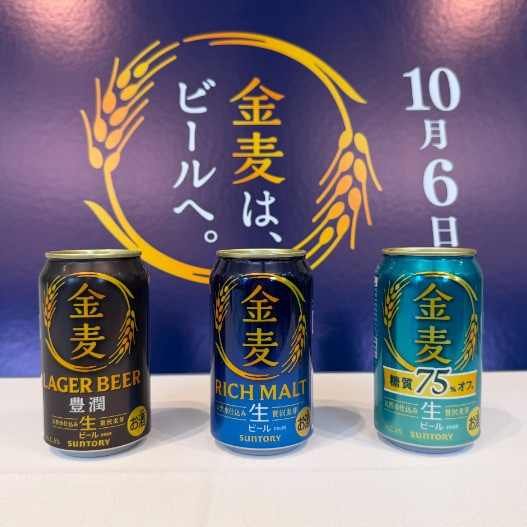
Kinmugi moves into Japan’s beer category
Suntory will turn Kinmugi and Kinmugi 75% Less Carbohydrate into beer on October 6, changing both products from the low-tax quasi-beer category known as happoshu ② to a beer production method. The company announced the decision on the 16th, according to 373news.com.
The change is linked to Japan’s alcohol tax reform, which will unify the tax rates applied to beer and happoshu. Tax differences have long influenced how Japanese brewers formulate, classify and price malt-based alcoholic drinks. Suntory is responding by upgrading the contents of one of its economy-positioned brands rather than preserving its existing quasi-beer classification.
Price strategy keeps the economy positioning
Suntory intends to pass through only the increase in alcohol tax, according to the report. A six-pack of 350 ml cans is expected to be priced at ¥880. The company’s stated approach is to move the liquid into the beer category while maintaining Kinmugi’s position in the economy price range.
This distinction will be important for consumers deciding whether the move represents sufficient additional value. Kinmugi will carry the legal and production classification of beer, but Suntory is seeking to avoid a broader price repositioning beyond the tax increase. The strategy therefore connects the product upgrade directly to the new tax environment rather than using the reclassification to move the brand into a substantially more expensive segment.
A broader Kinmugi beer range
Suntory will also introduce Kinmugi Hojun on October 13. The new product will follow the reclassification of the two existing Kinmugi variants and broaden the brand’s offer after its move into beer. The staggered dates give Suntory a converted core range on October 6 and an additional product one week later.
For Japan’s brewers, the reform reduces the tax advantage that supported quasi-beer products and changes the commercial logic behind their recipes. Suntory’s decision shows one possible response: improve the product’s classification and formulation while limiting the shelf-price adjustment to the additional tax burden. That approach may protect volume among price-sensitive buyers, although their response to the ¥880 six-pack will determine whether Kinmugi can retain its economy credentials as a beer.
Implications for producers and retailers
The conversion affects production, packaging, price communication and shelf positioning. Retailers will have to present Kinmugi as beer while explaining why a familiar economy brand has changed category and price. Suntory, meanwhile, must persuade existing customers that the beer formulation offers value without weakening the affordability on which the brand has competed.
The reform also narrows the role of tax classification as a tool for product development. As beer and happoshu tax rates converge, brewers have less reason to maintain recipes designed primarily for a lower-tax category. Product quality, brand strength and retail pricing are likely to carry more weight in competition. Kinmugi’s conversion provides an early test of whether a major economy brand can make that shift without losing price-conscious consumers.