Sri Lanka's poultry industry blames maize import policy for chronic crisis
Sri Lanka's poultry and livestock producers say more than a decade of unpredictable maize import policy has left the sector in chronic crisis, the Daily Mirror reports. Since 2012 the industry has repeatedly asked successive governments for a rational, predictable framework, warning that the instability feeds through to chicken and egg prices for consumers.
A decade of appeals for a stable maize policy
Sri Lanka's poultry and livestock industry says more than a decade of unpredictable maize import policy has kept the sector in a state of chronic crisis, according to the Daily Mirror. In a report headlined "Held to Ransom: How policy failure is poisoning Sri Lanka's poultry industry, consumers," the newspaper wrote that since 2012 producers have repeatedly sat across the table from successive governments to plead for a rational, predictable framework for importing maize — and have yet to secure one.
The complaint is structural rather than tied to a single season. The Daily Mirror describes an industry that has spent years asking for clear, consistent rules, only to face policy that changes with each administration. That unpredictability, producers argue, is the root cause of the difficulties running through feed supply, farm economics and, ultimately, retail prices.
Why maize sits at the centre
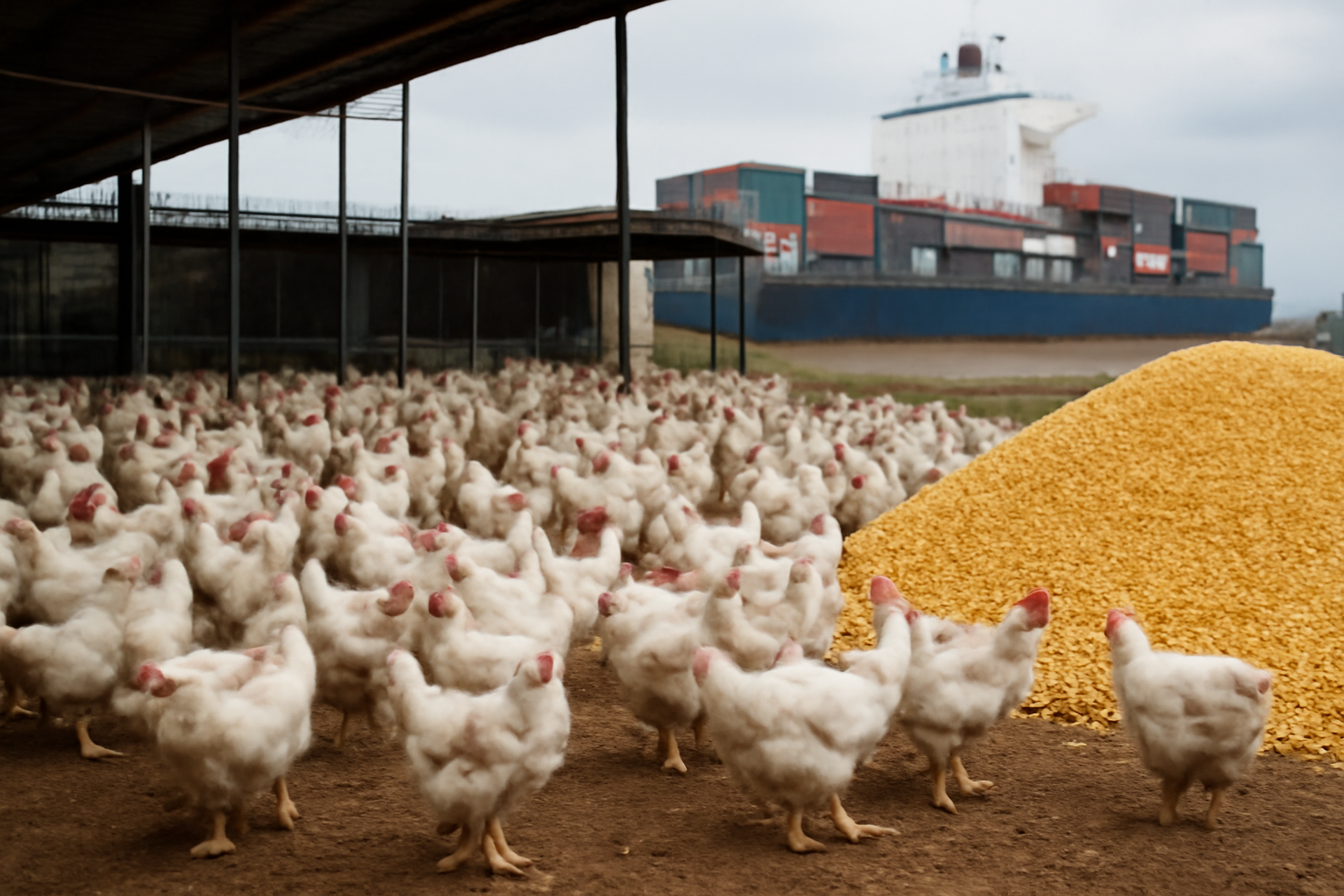
Maize is the main energy component of poultry feed, so its price and availability largely set the cost of producing chicken meat and eggs. When the terms governing maize imports change without warning, feed millers and farmers cannot plan purchases, lock in supply or hold prices steady. The Daily Mirror frames this as the mechanism by which policy failure feeds through to the wider industry: uncertain grain supply becomes uncertain feed, and uncertain feed becomes an unstable poultry business.
For importers and feed producers, the practical problem is timing and certainty. Maize is a bulk commodity bought on forward terms; buyers need to know whether, when and on what conditions they can bring it into the country. Rules that shift between openness and restriction make that planning difficult and raise the risk attached to every purchasing decision.
The pass-through to consumers
The Daily Mirror's headline explicitly links the policy problem to consumers. Because feed is the largest single cost in poultry production, instability in maize supply does not stay inside the industry; it reaches households through the price of chicken and eggs, two of the more affordable animal-protein sources in Sri Lankan diets. The newspaper's argument is that a failure to fix maize import policy is not only an industry issue but a food-price and food-security issue.
What the industry is asking for
According to the Daily Mirror, the central demand has not changed in more than ten years: a rational and predictable maize import policy that producers can plan around. The industry is not, on the newspaper's account, seeking a one-off concession but a durable framework that survives changes of government and gives feed millers, farmers and importers a stable basis for their decisions.
The report does not describe a resolution. It presents a long-running standoff between an industry that says it has been clear about what it needs and a policy process that, in its telling, has repeatedly failed to deliver it. For traders watching South Asian feed-grain flows, the takeaway is that Sri Lanka's maize demand — and its appetite for imports — remains hostage to a domestic policy debate that has run, unresolved, since 2012.