Spanish pork overtakes US supply in South Korea as belly prices reshape demand
Spanish pork imports into South Korea were worth $297.49 million from March to July, exceeding the $286.80 million recorded for US pork. A wide price gap between domestic and Spanish pork belly is shifting consumer demand and encouraging the livestock industry to build larger inventories.
Spanish pork moves ahead of US supply
Spain has overtaken the United States by value in South Korea’s imported pork market since March, putting it on course to become the country’s leading supplier for the first time in four years. Citing Ministry of Food and Drug Safety data, Financial News reported that imports of Spanish pork were worth $297.49 million between March and July, compared with $286.80 million for US pork.
The change follows several years of rapid gains for Spain. US pork accounted for 29.5% of South Korean import value in 2023, 32.7% in 2024 and 30.1% last year. Spain’s share climbed from 16.4% to 20.8% and then 25.8% over the same period. Spanish supply moved ahead of US pork in March this year, according to the publication.
Pork belly price gap redirects demand
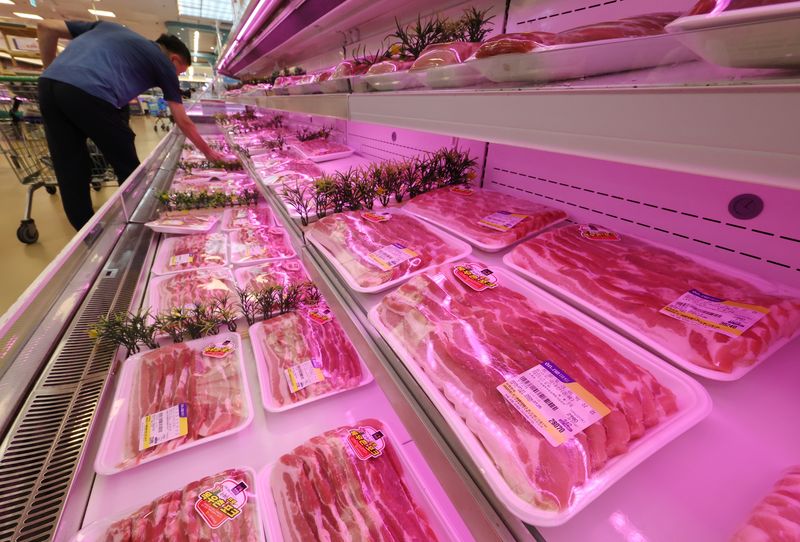
Product mix is central to the shift. Domestic pork is widely consumed as grilled pork belly, while imports from the United States consist mainly of shoulder and Boston butt cuts. These US products are commonly used by institutional catering operations, in stews and by processors producing ham and sausages. Strong US demand for pork belly for bacon allows suppliers to sell surplus shoulder and foreleg cuts to South Korea at lower prices.
Spanish shipments compete more directly with domestic meat because they are dominated by pork belly intended for grilling. Demand had remained limited when local pork belly was relatively inexpensive. Financial News said domestic pork belly has recently risen to 2,881 won per 100 grams, while Spanish pork belly sells for about 1,550 won per 100 grams. The imported product therefore costs only slightly more than half as much, creating a strong incentive for households and food-service buyers to switch.
Iberico positioning supports Spanish growth
Price is not the only factor behind Spain’s expansion. Spanish pork is marketed around Iberico breeds and quality controls applied by the Spanish government, helping the product retain a premium image despite its lower price relative to domestic pork. This combination gives Spanish suppliers access to the grilling segment traditionally served by South Korean producers, rather than limiting them to processing and catering channels.
Importers and livestock companies are responding by increasing stocks. An industry representative told Financial News that businesses were strategically expanding inventories of Spanish pork to manage the sharp rise in domestic prices. While inventories normally cover two to three months, stocks have been extended to six or seven months to help ease pressure on household food costs. The larger buffer could keep Spanish pork readily available even if domestic prices remain elevated, intensifying competition in South Korea’s high-value pork belly market. US suppliers remain important to catering and processing, but Spain’s growth shows that the contest for import leadership is increasingly being decided by retail and grilling demand.