Spain's power pool settles at 158.92 €/MWh as renewables cover 59.2% of daily demand
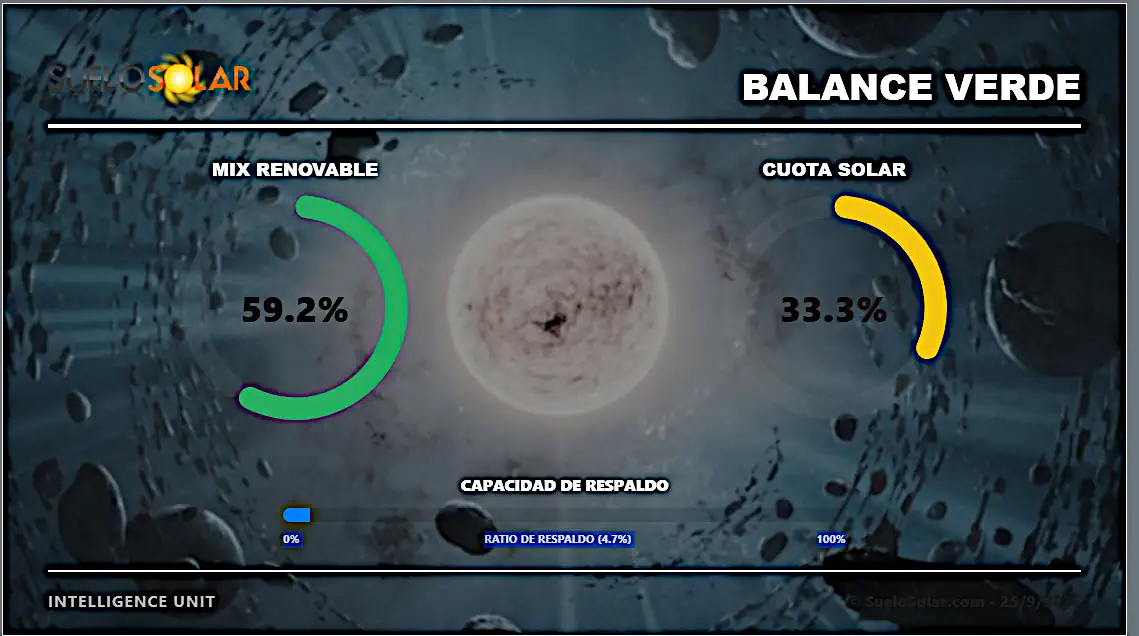
Spain's peninsular wholesale electricity price settled at 158.92 €/MWh even as renewable sources covered 59.2% of daily demand and solar reached a 33.3% share during central hours. The regulated PVPC tariff was set at 0.20056 €/kWh, while Portugal averaged 161.379 €/MWh and France 161.52 €/MWh.
Pool settles at 158.92 €/MWh
The wholesale electricity price on Spain's peninsular market settled at 158.92 €/MWh in the session covered by the daily market report of suelosolar.com. The outlet attributes the level to the continued weight of dispatchable backup generation during peak-demand hours, a cost that passes directly into industrial and household energy bills.
The regulated retail tariff moved in step. The PVPC, Spain's regulated price for small consumers, was set at 0.20056 €/kWh, transferring hourly volatility straight to the end user. Retailers and large industrial buyers are reinforcing long-term contracting strategies to keep these daily swings out of their operating accounts, according to the same report.
Renewables cover 59.2% of demand
The generation mix told a different story from the price. Renewable sources covered 59.2% of total daily demand on the national system. Solar alone held a 33.3% share during the central hours of the day, leading daytime output and displacing more expensive conventional technologies.
The coexistence of a 59.2% renewable share with a pool near 159 €/MWh reflects the marginal design of the European market, which continues to expose users to natural gas price movements even when clean technologies inject large volumes of power. During hours without solar radiation, combined-cycle gas plants and hydropower took on the task of covering demand and preventing supply imbalances on the peninsular transmission grid.
suelosolar.com reports that analysts are pressing for faster deployment of storage, including large-scale batteries and pumped hydro, to capture daytime surpluses and release them when the grid is most stretched, alongside modernisation of distribution networks and new incentives for demand-side flexibility. The same report references a proposal for a fast-track procedure covering 15 grid nodes and a tender in Palencia, drawing on the results of an expression-of-interest process held in spring, with socio-economic commitments attached in each case.
Iberian and European price comparison
Prices across Europe were broadly elevated, with marked interdependence through cross-border interconnections. Portugal recorded an average of 161.379 €/MWh and France 161.52 €/MWh, placing the two almost level and underlining the commercial and physical coupling between neighbours constrained by limited Pyrenean interconnection capacity. The readings also show that the elevated level is a regional rather than purely Spanish phenomenon.
In central Europe, where tax and cost structures differ substantially, consumer-facing quotations put Germany at 0.17663 €/kWh, Belgium at 0.17169 €/kWh and the Netherlands at 0.16794 €/kWh. The report attributes the spread to differing energy levies, emission allowance costs and the reach of compensation mechanisms in each member state, and cites European energy policy specialists who argue that continued development of cross-border electricity corridors is indispensable for genuine price convergence.
Commodities, currencies and sector equities
Commodity markets added to the pressure. Brent crude traded at 107.03 dollars per barrel, up 8.8%, raising logistics and industrial supply chain costs worldwide. Natural gas at the European TTF hub stood at 75.27 euros per megawatt-hour, up 1.8%, keeping gas-intensive industry on alert. On currency markets, the euro-dollar cross slipped 0.1% to 1.1380, a move that raises the euro cost of dollar-denominated fuel and technology imports.
Equities tied to the energy transition diverged: Sunpower gained 3.3% while Solaredge Technologies Ltd. fell 7.6% on valuation adjustments across the global photovoltaic sector. In crypto assets, Filecoin rose 6.9%. In the month-to-date ranking of the SolRank sector barometer, which tracks Spanish photovoltaic companies, SUNLAB POWER led with 461 points, ahead of IGNASI JAÉN with 330 and KRANNICH SOLAR with 298.