Spain changes supermarket nutrition labels in October: sweetened oat and rice drinks lose the top “A” rating
Spain's Ministry of Consumer Affairs, Consumo, is revising the nutrition labelling carried by supermarket products, and from October five products will lose the rating that marks them as the healthiest option in their category. Sweetened plant-based drinks made from oats and rice are among them, dropping the front-of-pack “A”. The revision is not confined to Spain, which pushes the decision from packaging artwork into product recipes.
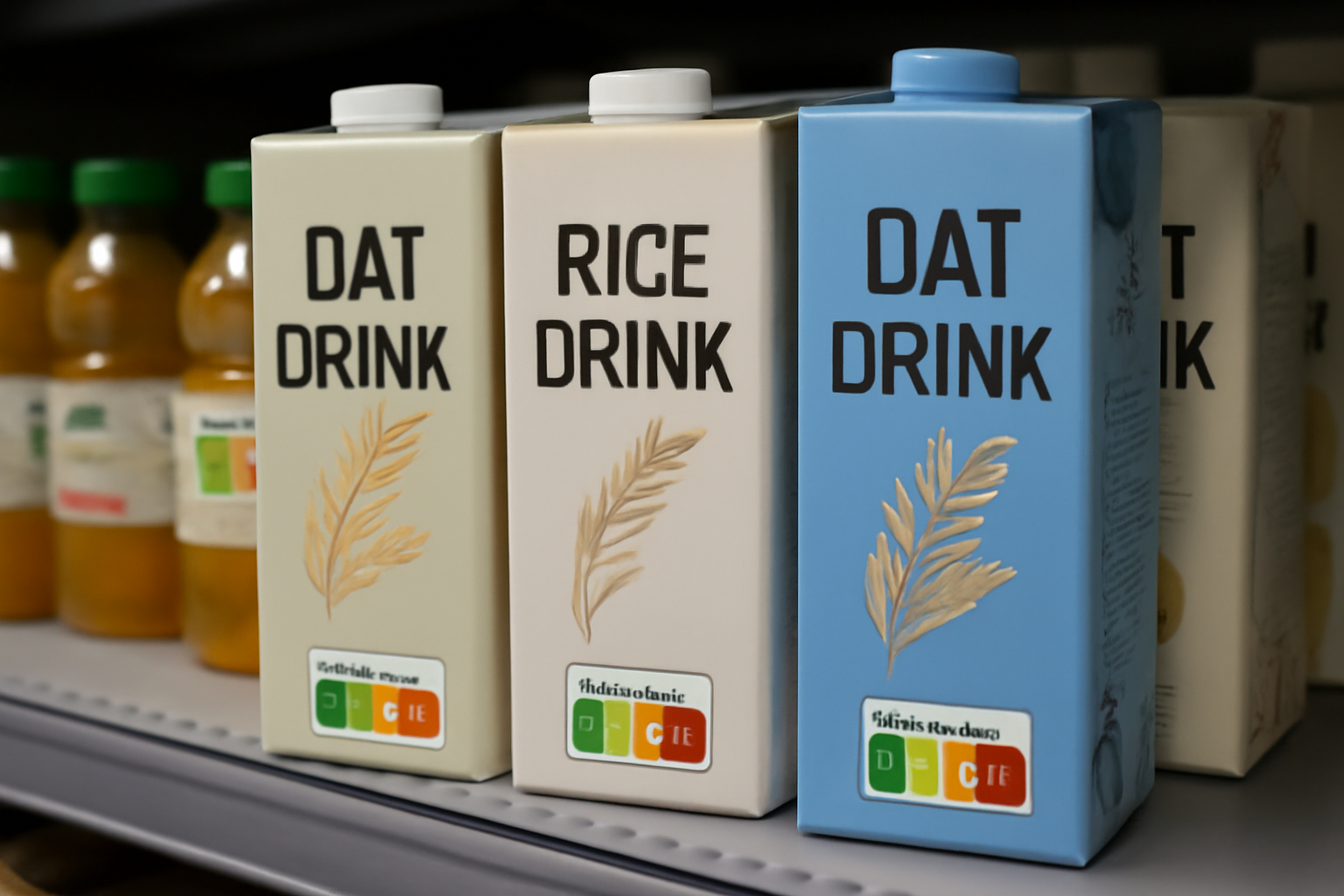
Consumo revises front-of-pack ratings from October
Spain's Ministry of Consumer Affairs, Consumo, is changing the nutrition labels carried by products on supermarket shelves. From October, five products will lose the top rating that identifies them as the healthiest choice in their category. Among them are sweetened plant-based drinks made from oats and rice, which will no longer hold the “A” grade on front-of-pack labelling.
The rating in question is the letter scale printed on the front of packaged food and drink, where “A” signals the most favourable nutritional profile and the lower letters progressively less favourable ones. It is not a safety marker. It is a comparative signal aimed at a shopper who decides in a few seconds at the shelf, and that is exactly what makes it commercially sensitive: the letter sits in the same visual field as the brand, and retailers use it in category management and in selecting which lines go into promotions.
Only the plant-drink case is specified in the material published so far. The remaining products affected by the October reclassification have not been itemised.
Why sweetened oat and rice drinks are the clearest case
Oat and rice drinks built their positioning on a health image, and the “A” was the shortest possible proof of that promise at the point of sale. For the sweetened versions, added sugar is the variable that moves the grade. The new dividing line does not run between plant drinks and dairy, as the category's marketing has long implied, but inside the category itself — between formulations with sugar and formulations without it. Shoppers who treated sweetened and unsweetened cartons as one product will now see two different letters on the same fixture.
A revision that extends beyond Spain
The decision to strip the “A” from sweetened oat and rice drinks is not an isolated Spanish measure. It forms part of a broader revision of the rating criteria that is being applied outside Spain as well. That distinction matters for suppliers shipping plant-based drinks into the Spanish market. A label rule confined to one country can be absorbed with a market-specific SKU and a local print run. Common criteria across several markets move the problem upstream, into the recipe and the production schedule, where the cost is no longer cosmetic.
What producers and retailers have to decide
- Reformulate to cut added sugar and defend the grade, accepting a changed taste profile and the risk of losing part of the existing buyer base.
- Keep the recipe and accept the lower letter, betting that taste and brand loyalty outweigh a symbol on the pack.
- Split the range, promoting unsweetened variants as the flagship while keeping sweetened lines as a flavour proposition.
Packaging is the immediate bill. Artwork, printing plates, print runs and stock already in the distribution channel all have to be handled before the October switch, and in practice across every SKU in the range rather than only the lines losing the “A”, because a mixed shelf with inconsistent labelling is the worst outcome for a brand.
Private label is the segment to watch first. Retailers control both the shelf and the listing decision, and they carry no brand equity tied to a sweetened recipe, which makes reformulation cheaper for them than for national brands. If the chains move their own lines to unsweetened formulations ahead of October, the room for branded suppliers to wait and see narrows quickly. For upstream suppliers of oats, rice and sugar into this category, the volume question and the specification question separate: demand for the base grains is unaffected by a letter grade, while the sweetener component is the line being rewritten.