Spain’s biochar industry seeks scale as output remains below 10,000 tonnes
Spain produces less than 10,000 tonnes of biochar annually, compared with more than 200,000 tonnes across Europe. New plants, agricultural applications, construction projects and carbon-removal markets could support a significant expansion.
Production remains at an early stage
Spain produces less than 10,000 tonnes of biochar a year, leaving its industry well behind the European market, where annual production exceeds 200,000 tonnes and Germany is the leading producer. According to El Español’s Invertia, only a small group of Spanish companies currently operates at commercial scale, although projects are advancing in several regions.
Biochar is made by heating organic material through pyrolysis. Spain has substantial potential feedstock in agricultural, forestry and food-industry residues. The resulting material can be used in agriculture, livestock operations, energy, construction, industrial processes and environmental management. It can also generate carbon-removal credits because each tonne of biochar can sequester between 2.5 and 3 tonnes of CO2, depending on the raw material.
Existing producers and new capacity
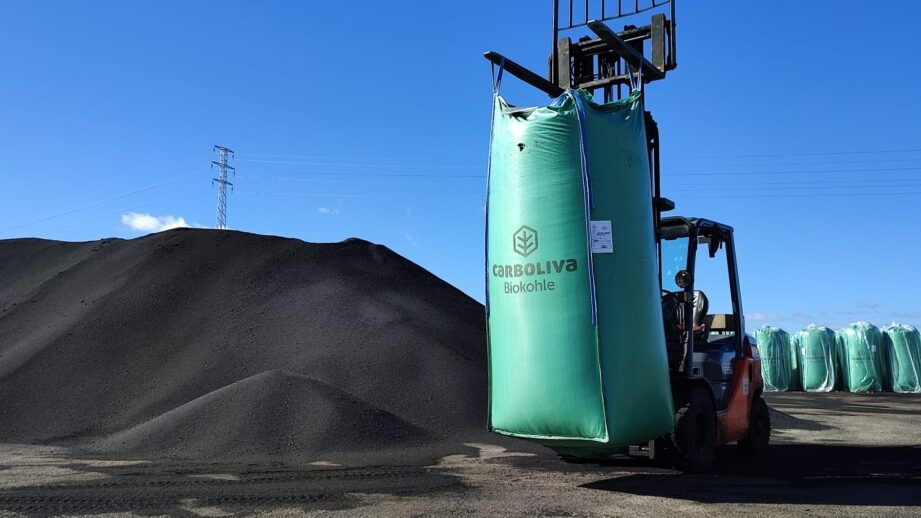
Carboliva, founded in 2017 by the Espuny family, supplies biochar for a Barcelona paving pilot that incorporates carbonised olive stones. Its plant at the Coosur–Acesur facilities in Puente del Obispo, Jaén, processes between 12,000 and 15,000 tonnes of clean, dry olive stones or extracted olive pomace each season. The operation produces 6,000-8,000 kilograms of steam per hour for oil extraction, alongside 4,000-5,000 tonnes of biochar annually, and sequesters more than 10,000 tonnes of CO2 a year. The company has reached revenue of €2 million.
Maclean Biocarbon produces biochar from almond shells at Hellín in Albacete, using residues from an almond-processing plant in the same industrial complex. Its unit can produce up to 6.4 tonnes per day, although it does not operate at full capacity throughout the year. Euthenia Energy has also announced the first of three large biochar facilities in Puente Genil, Córdoba, while other initiatives are progressing in Cantabria, Soria, Ciudad Real and Menorca.
The largest prospective step-change is Biochar Norte’s project in Tineo, Asturias. The planned facility targets annual capacity of about 15,000 tonnes, which alone would exceed Spain’s current real production. Biochar del Sur, a joint venture between Bioliza and Pretium Renovables, is separately developing an industrial project portfolio in Andalusia using agricultural, forestry and agro-industrial biomass to produce soil improvers.
Agriculture and biomethane open new markets
The Biochargae operating group brings together Fundación Ayesa, Volterra Ecosystems, G2G Algae Solutions, AICIA, agricultural cooperatives and other partners. It plans to convert pruning waste, shells and other plant residues into biochar for use as a soil amendment. The partners say the material can improve soil structure and fertility, raise water retention and store carbon in a stable form.
Government policy may provide another demand channel. Spain is preparing a fertiliser plan that will include organic alternatives to synthetic agricultural products. Recognition of pyrolysis as a carbon-removal technology could also make biochar projects more attractive to companies seeking or required to reduce their emissions.
Biomethane plants offer an additional route to scale. Spain has more than 200 biomethane initiatives, including 71 projects under development in Andalusia. These facilities produce digestate, which faces restrictions when applied directly to farmland and is not classified as fertiliser. El Español reports that controlled heating at 500 degrees can convert digestate into biochar that may be certified as fertiliser. Adding pyrolysis units to biomethane plants could therefore address residue management while creating a saleable product and a potential source of carbon credits.