South Korea Applies Agricultural Price Guarantees to Garlic and Onions
South Korea will apply its agricultural price-stabilization system to garlic and onions for the first time. Eligible growers may receive compensation when average harvest prices fall below a benchmark set at around 80% of normal wholesale prices.
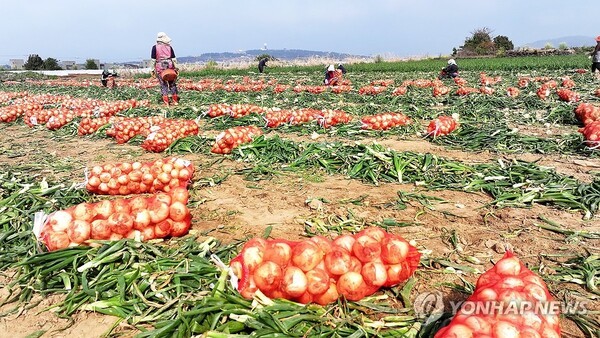
Garlic and onions selected for first application
South Korea will apply its agricultural price-stabilization system to garlic and onions for the first time, providing payments when average harvest prices fall below an official benchmark. The benchmark will be set at around 80% of the normal wholesale price, according to Market Economy News.
The Ministry of Agriculture, Food and Rural Affairs discussed the detailed operating rules at the first meeting of the Agricultural Product Price Stabilization Deliberation Committee, held on the 10th at the aT Center in Yangjae-dong, Seoul. The meeting was chaired by Vice Minister Kim Jong-gu. Under the system, the government compensates farmers for all or part of the gap when the market price of a covered crop falls below the reference price.
Benchmark includes costs and multiple quality grades
The government selected garlic and onions because their production volumes and prices can change sharply with growing conditions. By limiting the financial effect of a harvest-time price decline, the program is intended to reduce uncertainty for farms producing two crops that are important to South Korean food consumption.
The reference price used to determine whether support is payable will correspond to approximately 80% of the normal wholesale price. Direct operating expenses incurred in cultivation will be fully reflected in the calculation. The government will also include all or part of the value of labor supplied by farmers and their family members.
Actual compensation will be calculated against the crop's average price during the harvest period. Prices for high, medium and lower grades will all be included, avoiding a calculation dominated by a single quality category. The final covered products and the proportion of the price gap to be compensated will be confirmed through a ministry notice.
Eligibility tied to planting data and supply management
Support will be available to individual farmers and agricultural corporations cultivating at least 1,000 square meters of the same crop. Applicants must be registered as agricultural businesses or report that they are farming the land. They must also declare the actual planted area when sowing seed or transplanting seedlings, giving the government data to forecast production and respond to possible oversupply.
Farmers who have already received a payment through revenue-stability insurance will receive only the remaining amount under the new system. This provision prevents compensation for the same loss through both insurance and the price-stabilization program. Payments will also be linked to producer contributions to self-help funds used for voluntary supply management. A producer who does not contribute will lose 20% of the payment in the first year, and the government plans to raise that deduction gradually.
The program will combine price support with measures affecting planted area and production. Local governments will be assessed on their implementation of acreage adjustments under statutory supply plans; those that do not comply may receive different allocations of related project funding and price-stabilization budgets. Additional crops are expected to enter the system in stages, based on their importance to diets, the availability of production-cost statistics and the maturity of advance supply-management arrangements. The committee plans another meeting after the National Assembly completes its budget review to consider expanding coverage for 2027.