South Korea’s hygiene products market exceeds 3 trillion won as adult diaper supply rises
South Korea’s hygiene products market reached 3.1492 trillion won in 2025, up 9.7% from the previous year. Adult diaper supply exceeded children’s diaper supply for a second consecutive year, while toilet paper remained the largest domestic production category.
Market reaches a record 3.1492 trillion won
South Korea’s hygiene products market exceeded 3 trillion won for the first time in 2025 as population aging increased demand for adult diapers and newly regulated product categories expanded the official market total. Citing Ministry of Food and Drug Safety data, Safe Times reported that the market reached 3.1492 trillion won, up 9.7% from 2.8716 trillion won in the previous year.
The total comprised 2.5320 trillion won of domestic production and 617.2 billion won of imports. Domestic output therefore accounted for 80.4% of the market, while imports represented 19.6%. The figures cover hygiene products under the ministry’s supervision, including disposable diapers, toilet paper, disposable cups, cleaning agents and other goods used by households and food-service businesses.
Adult diaper supply moves further ahead
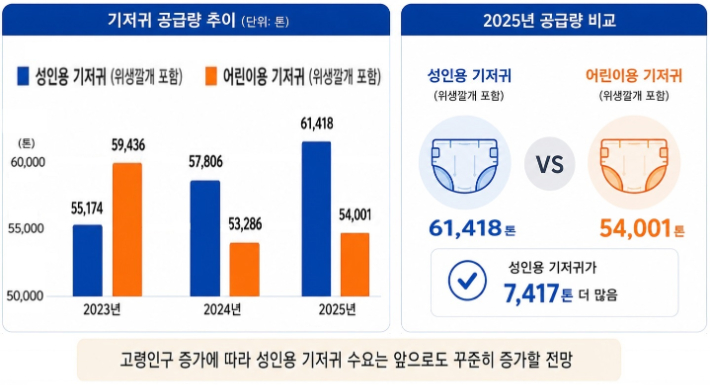
Adult diaper supply increased 6% to 61,418 tonnes, reflecting the effects of South Korea’s entry into a super-aged society. Supply of children’s diapers rose only 1% to 54,001 tonnes. Adult products consequently exceeded children’s products by 7,417 tonnes, extending a lead that has now persisted for two consecutive years.
The divergence is significant for manufacturers and retailers because it points to a lasting change in the composition of diaper demand rather than uniform growth across the category. Producers serving older consumers face an expanding volume market, while suppliers focused on infants are operating in a segment with much slower supply growth. Disposable diapers also remained the largest imported hygiene category: imports were valued at 325.7 billion won, equal to 52.8% of all hygiene product imports.
Toilet paper leads concentrated domestic production
Toilet paper was the largest domestically produced category by value, with output of 1.0111 trillion won, or 39.9% of total production. Disposable cups ranked second at 333.8 billion won, followed by disposable diapers at 310.1 billion won, disposable towels at 291.3 billion won and cleaning agents at 240.7 billion won. Together, these five categories generated 86% of domestic production value, showing that the market remains highly concentrated in high-volume household and food-service consumables.
Imports were similarly concentrated. After disposable diapers, oral-care products accounted for 68.0 billion won, cleaning agents for 46.8 billion won, disposable chopsticks for 43.2 billion won and disposable cups for 28.9 billion won. The data indicate that imported diapers have a particularly large role compared with other product groups, creating a material market for overseas manufacturers and Korean distributors.
New categories and disposable use support growth
The expansion of regulatory coverage also lifted the headline market figure. Oral-care products and tattoo inks, included in hygiene product supervision from 2024, recorded domestic production of 80.0 billion won and 900 million won, respectively. Together, the newly added categories represented 3.2% of total hygiene product production. However, the increase was not solely statistical: excluding the new categories, production of existing hygiene products still rose by 147.6 billion won.
Consumption patterns in food service also shifted toward disposable products. Production of wet wipes and dry tissues intended for use as wet wipes at food-service establishments rose 19% to 67.5 billion won. By contrast, production of reusable sanitary towels that undergo washing and sterilisation fell 12% to 7.5 billion won, while the number of processing businesses also declined. The Ministry of Food and Drug Safety said it would strengthen safety management in response to changes in the market and consumer environment.