South Korea shifts hydrogen policy from supply targets to bankable industrial demand
South Korea is considering a demand-led hydrogen strategy built around power generation, heavy industry, AI data centres and commercial transport. The proposed approach would link buyers with domestic production, imports and shared infrastructure while making policy signals more predictable for investors.
Policy focus moves from targets to buyers
South Korea’s hydrogen policy is shifting from production and deployment targets toward identifying who will buy hydrogen, where it will be used and in what volumes. Energy Daily reported that technologies including hydrogen production, fuel cells and hydrogen vehicles have advanced since the country’s 2019 hydrogen economy roadmap, but large-scale demand and storage and transport infrastructure have not developed at the same pace.
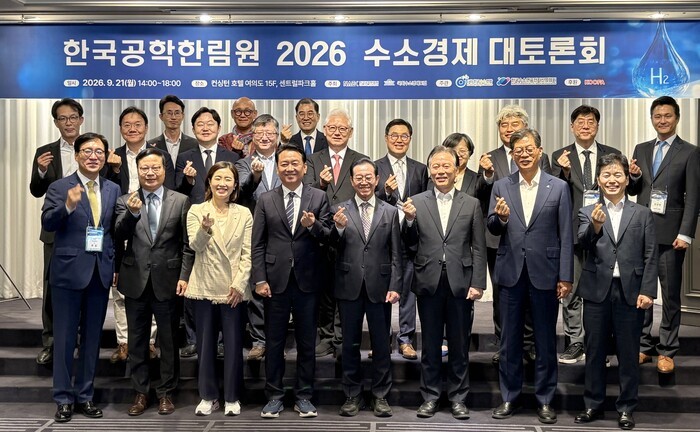
The Korea National Academy of Engineering and the National Assembly Hydrogen Economy Forum discussed the market-led approach at the 2026 hydrogen economy debate in Seoul on the 21st. About 150 lawmakers and representatives from industry, academia and research organisations attended. The central proposal was to connect production, infrastructure and demand within projects from the outset, rather than expecting each part of the value chain to emerge in sequence.
Participants said technology support alone does not give materials, components and equipment suppliers enough confidence to expand factories or enter new businesses. Demonstration opportunities, initial buyers and visible long-term demand are also required. Hydrogen production plants, pipelines, storage terminals, filling stations and generating facilities need substantial upfront capital and have long payback periods, making abrupt changes in support or projected market size a major investment risk.
AI power demand could provide an anchor market
Rapidly expanding electricity requirements from AI data centres and semiconductor plants have created a potential source of large-scale demand. Hydrogen generation could serve these projects and help address the hydrogen sector’s shortage of early buyers. However, participants cautioned that its system role and cost must be defined against nuclear power, renewable energy, LNG and energy storage systems.
Hydrogen could also support long-duration storage as renewable generation expands. A hydrogen energy storage system would use surplus electricity to produce and store hydrogen for later power generation or industrial consumption. Commercialisation could therefore give hydrogen a role in grid flexibility as well as fuel supply.
The Clean Hydrogen Portfolio Standard market was discussed as a mechanism for creating initial demand, not merely procuring electricity. Producers and importers need visibility over tender volumes and operating rules before signing long-term supply contracts, while generators need the same certainty before investing in equipment. Greater predictability could unlock related spending on production, transport and storage.
Domestic output, imports and hubs would develop together
The debate did not treat domestic production and imported clean hydrogen as mutually exclusive. Imports could eventually provide large volumes at competitive prices, while retaining a domestic market would preserve demonstration and commercialisation opportunities for Korean makers of electrolysers, compressors, storage vessels and valves. Options discussed included production tax credits combined with support for demonstrations and initial purchases.
Support could also be based on measured emissions reductions rather than hydrogen output alone. That would allow several production methods during the market’s early stage while differentiating assistance according to greenhouse-gas performance and gradually advancing the transition to clean hydrogen.
Shared hydrogen hubs around power plants, industrial complexes, ports and logistics centres could reduce the infrastructure burden on individual companies. Regional specialisation was also proposed: renewable-rich areas could focus on green hydrogen and storage; steel and petrochemical regions on industrial hydrogen and pipelines; ports on imported clean hydrogen and distribution; and logistics centres on commercial vehicles, forklifts and other high-utilisation transport.
Commercial mobility would be prioritised over simultaneous expansion across all vehicle types. Concentrating demand among long-distance, high-utilisation fleets could raise filling-station use, improve operating economics and lower supply costs. The organisers plan to turn the debate’s proposals into detailed policy tasks, followed by a policy paper and discussions in the National Assembly.