South Korea backs green pear varieties to broaden everyday consumption
South Korea’s Rural Development Administration is expanding production and distribution of three domestically bred green pear varieties. The program aims to diversify a market where Shingo accounted for 85.4% of pear acreage in 2025 and shift demand beyond holiday gifts.
A market dominated by one variety
South Korea’s Rural Development Administration plans to expand production areas and distribution capacity for three domestically bred green pear varieties as it seeks to develop a market for everyday consumption. NewsPim identified the varieties as Seolwon, Supergold and Greensis, which differ from the large brown pears traditionally sold as gifts during the Chuseok and Lunar New Year holidays.
The initiative addresses the domestic industry’s heavy dependence on Shingo, a variety bred in Japan. According to NewsPim and Food News, Shingo represented 85.4% of South Korea’s pear-growing area in 2025. Its share rose from about 35% in the 1980s to 70% by the late 1990s, supported by production, storage and distribution systems built around the variety.
NewsPim reported that gibberellin treatment introduced in the 1990s allowed growers to bring the Shingo harvest forward by about one week while increasing fruit size and yield. That helped establish the large, uniform fruit required by the holiday gift market. However, when Chuseok falls early, growers may ship pears before they are fully ripe, while pricing based mainly on size and appearance can weaken consumer satisfaction.
Different harvest windows, flavors and uses
Seolwon is an early variety harvested in early September. It weighs 600 grams on average and records at least 14 Brix, about 2 Brix above Shingo. The fruit is sweet and crisp, browns relatively slowly after cutting and can therefore be marketed as ready-to-eat sliced fruit. It can be stored for about 30 days at room temperature and flowers about one week later than Shingo, reducing exposure to spring cold damage.
Supergold is another early variety, averaging 570 grams and 13.6 Brix. It combines sweetness with mild acidity. In an assessment involving wholesale intermediaries, it recorded overall satisfaction of 4.25 out of 5 and ranked first for preference, with its juiciness receiving particularly strong scores. Its abundant pollen and flowering period, similar to Shingo’s, also allow it to serve as a pollinizer.
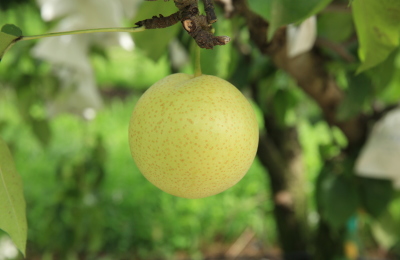
Greensis, South Korea’s first hybrid between Asian and European pears, is harvested in mid-September. It averages 460 grams and 12.3 Brix, with green skin, crisp flesh and abundant juice. Its resistance to pear scab can reduce crop-protection work. NewsPim also cited a case in which fruit held in cold storage remained available for distribution until June of the following year.
Production remains small and conversion is slow
The commercial base is still limited. Data compiled with municipal agricultural technology centers put 2025 acreage at 10 hectares for Seolwon, 27 hectares for Supergold and 43 hectares for Greensis, or 80 hectares combined. The Rural Development Administration is working with local governments and specialist distributors to form production clusters capable of supplying larger, consistent volumes.
For Seolwon, Ulsan plans a 10-hectare production area by 2029, while Naju is targeting 30 hectares by 2030. Naju, South Korea’s largest pear-producing area, is already moving faster than the national average: domestically bred new varieties occupied 425 hectares, or 25.8%, of its total 1,642 hectares of pear orchards in 2025. NewsPim said that proportion was about 1.8 times the national average.
Rapid conversion will nevertheless be difficult. Orchard renewal typically occurs every 20–30 years, and an established pear variety may remain in production for more than 50 years. Farmers changing varieties can also face more than three years without a harvest or income. The agency therefore plans to combine production clusters with distribution and consumer promotion while breeding later-flowering, self-fertile and disease-resistant pears suited to climate and pest risks.